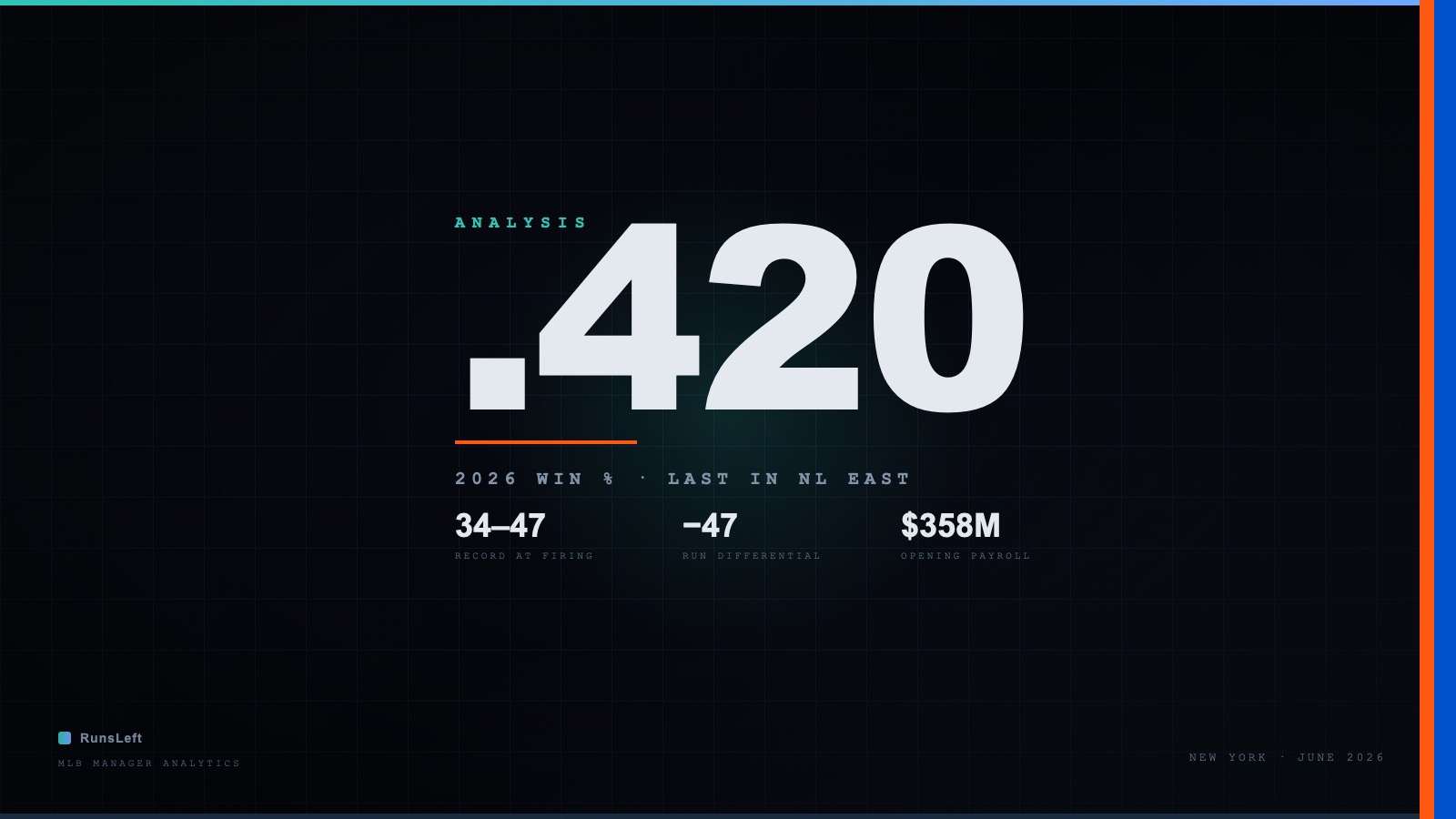
On June 26, 2026, the New York Mets dismissed manager Carlos Mendoza with the club mired at 34–47, last in the National League East and 15 games behind the division-leading Atlanta Braves. The move came in the wake of a four-game sweep at the hands of the Chicago Cubs — including a doubleheader in which the Mets committed six errors — and a six-game losing streak that left the team at 2–8 over its final ten games under Mendoza's watch. Andy Green, the club's senior vice president of baseball development and a former San Diego Padres manager, was named interim skipper.
This article updates our May 2026 analysis, Mendoza vs. Stearns — written when Stearns had publicly declined to scapegoat his manager.
I. Executive Summary
The decision carried the weight of a season that had spiraled beyond recovery and an organizational investment that demanded accountability. With an opening payroll of approximately $358 million — second in MLB behind the Dodgers — the Mets had produced the worst record in the National League East, a run differential of −47, and a Pythagorean expected record of just 36–45. The gap between financial commitment and on-field results was among the largest in the sport.
Yet the firing resists easy judgment. Mendoza's lineup was thinned by injuries to Francisco Lindor, Marcus Semien, Jorge Polanco, and Luis Robert Jr., while his rotation lost projected ace Kodai Senga and closer Clay Holmes for long stretches; high-profile offseason acquisitions Bo Bichette, Semien, and Freddy Peralta all underperformed. Notably, Juan Soto stayed largely healthy — playing the bulk of the season and hitting at an elite level — which complicates any "injuries alone doomed them" narrative: the Mets struggled even with their marquee bat producing. The Pythagorean analysis — projecting 36 wins against the Mets' actual 34 — suggests this was not a talented team victimized by managerial incompetence or bad luck; it was a genuinely sub-.500 roster performing near its true talent level. The failures of roster construction, the province of President of Baseball Operations David Stearns, were at least as consequential as anything that happened in the dugout.
This article examines the full arc of Mendoza's tenure, dissects the 2026 collapse in granular detail, and evaluates whether the firing was a justified accountability measure or the front office redirecting blame for its own missteps. The evidence supports an uncomfortable middle ground: the firing was defensible as organizational triage — something had to change with the franchise 13 games under .500 — but it was not a verdict that Mendoza was the root problem.
II. Career Overview: Promise to Collapse
Carlos Mendoza arrived in Queens in November 2023 as David Stearns' hand-picked hire — a first-time manager with no professional managerial experience at any level, chosen for his player-development pedigree and clubhouse rapport. His three-year contract would not survive to its expiration. What followed was one of the most dramatic arcs in modern Mets history: a pennant-series appearance in year one, regression in year two, and a freefall in year three that ended his tenure before the All-Star break.
| Season | Record | Win % | NL East | Postseason / Outcome |
|---|---|---|---|---|
| 2024 | 89–73 | .549 | 3rd | Reached NLCS — defeated Brewers (WC) and Phillies (NLDS), lost to Dodgers. 3rd in NL Manager of the Year. |
| 2025 | 83–79 | .512 | 2nd | Missed playoffs. Second-half collapse after strong start. |
| 2026 | 34–47 | .420 | 5th (last) | Fired June 26. 15.0 GB, 6-game losing streak. |
| Career | 206–199 | .509 | — | 7–6 postseason record. |
2024: The Miracle Season
Mendoza's debut season was nothing short of remarkable. The Mets were 11 games under .500 at one point before mounting a historic second-half rally, becoming just the eighth team in MLB history to reach a League Championship Series after falling that far below the waterline. Mendoza's ability to keep the clubhouse cohesive through adversity — his calling card throughout his coaching career — was credited as the decisive factor. He finished third in NL Manager of the Year voting, and the Mets' NLCS appearance validated Stearns' unconventional hiring decision.
2025: The Warning Signs
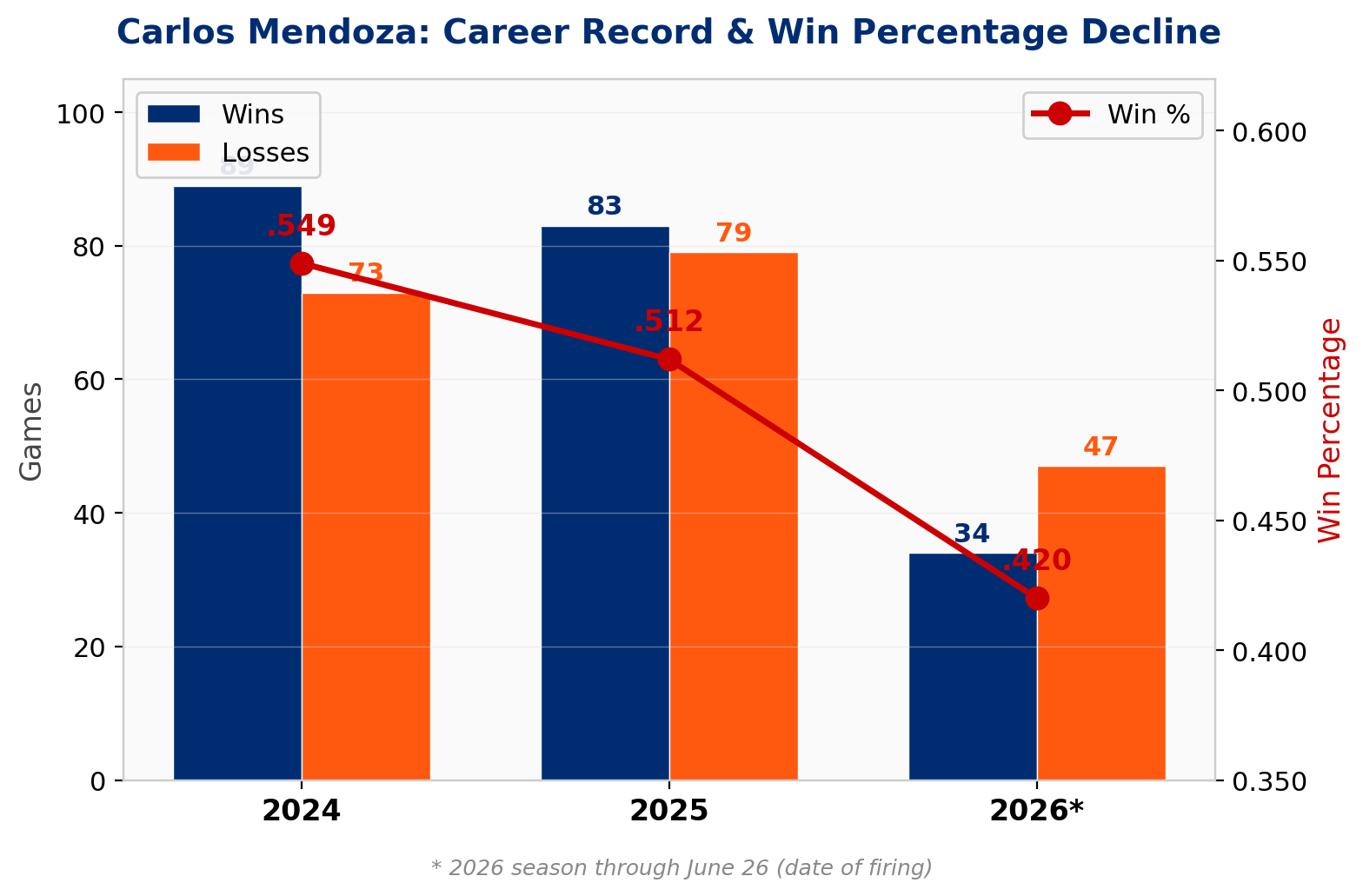
The 2025 season offered a more complicated picture. The Mets finished 83–79, nominally above .500 but well short of October. A strong first half gave way to a second-half collapse that foreshadowed the broader decline to come. Reports surfaced of communication friction between Mendoza and the front office, and the team's inability to close out winnable games became a recurring theme. The 37-point drop in winning percentage from 2024 (.549) to 2025 (.512) was modest in isolation but, in hindsight, marked the beginning of a downward trajectory that would accelerate sharply.
The Downward Arc
Mendoza's career arc — .549 to .512 to .420 — describes an accelerating decline. The year-over-year drop widened from −.037 (2024 to 2025) to −.092 (2025 to 2026), and the team's position relative to .500 swung from +16 games to +4 to −13. Crucially, Mendoza leaves with a winning career record (.509) and a pennant-series appearance, credentials that complicate any reductive "he failed" narrative. But the trajectory was unmistakable, and the organization concluded it could not wait for the arc to bend back.
III. The 2026 Season: Anatomy of a Collapse
April: The 12-Game Abyss
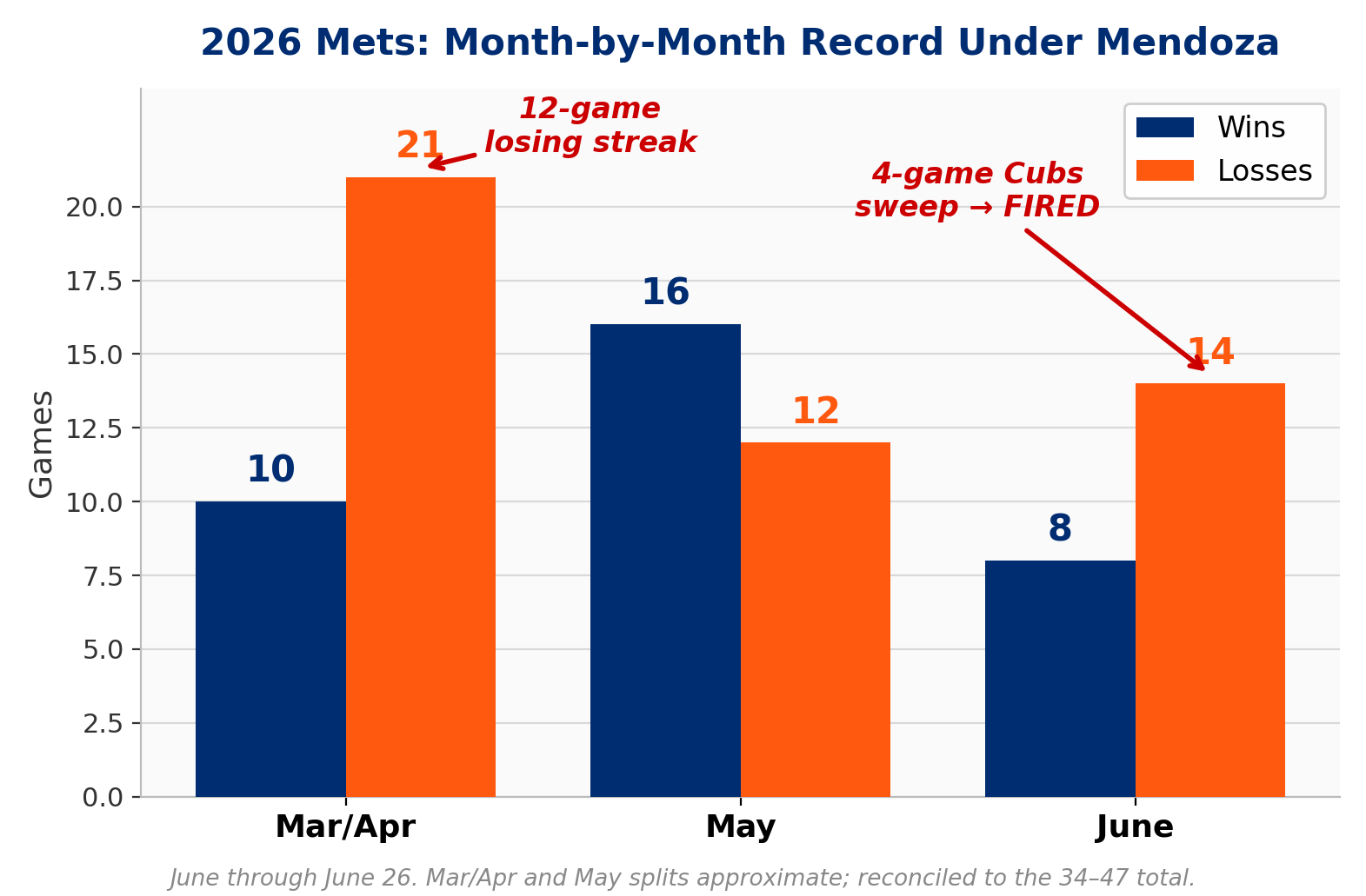
The 2026 season was effectively doomed before May. The Mets opened a promising 7–4, then dropped 12 straight — the franchise's worst skid since 2002 — burying the team in last place and creating a deficit from which they would never recover. The streak exposed every vulnerability simultaneously: the rotation lacked a dependable ace with Kodai Senga sidelined by back and ulnar nerve issues; the lineup, missing Lindor for stretches, produced anemic offense; and the bullpen, without Clay Holmes (fractured fibula), hemorrhaged late leads. The Mets finished the opening stretch roughly 10–21, a hole so deep that even a return to competence would leave them chasing a playoff spot from behind.
May: The Bounce-Back That Wasn't Enough
May offered genuine reason for hope. The team went 16–12 — a clear winning month and its best stretch of the season — generating cautious optimism that the April disaster had been an aberration rather than a harbinger. But a winning May for a team already deep in the red narrowed the gap without closing it: the Mets entered June at roughly 26–33, still seven games under .500 and firmly in last place. The underlying problems — roster attrition, offensive inconsistency, a pitching staff held together with organizational depth arms — had not been solved. The recovery proved to be a plateau, not a launch point.
June: The Breaking Point
June shattered any remaining illusions. After opening the month 8–8, the Mets lost their final six games — two to the division-rival Phillies, then all four to the Chicago Cubs — to fall to 8–14 in June and 2–8 over their last ten. The losing streak arrived at precisely the moment the season demanded a surge, and it removed any lingering benefit of the doubt the front office had extended after May.
The four-game Cubs sweep from June 23–25 was the final straw. The doubleheader included a game in which the Mets committed six errors — a fundamentals breakdown that came to symbolize the season. Mendoza did not defend the performance in his postgame comments. The sweep extended the losing streak to six games, dropped the team to 2–8 over its last ten, and provided the front office the political cover to act. The firing came the following morning, June 26, just hours before a series opener against the Philadelphia Phillies.
"The timing — just before a Phillies series and immediately after the Cubs sweep — signals a reactive decision driven by a specific breaking point rather than a long-planned transition." — Editorial analysis based on reporting from The Athletic, USA Today, and CBS Sports
The Injury Crisis: Context That Cannot Be Ignored
No honest assessment of the 2026 Mets can proceed without reckoning with the injury toll. The roster was devastated across every position group, losing players whose combined salary and projected production represented the core of the team's competitive thesis.
| Position Group | Injured Players | Injury |
|---|---|---|
| Outfield | Luis Robert Jr. | Lumbar disc herniation |
| Tyrone Taylor | Hip flexor | |
| Infield | Francisco Lindor | Calf strain |
| Marcus Semien | Hip flexor (played through before IL) | |
| Jorge Polanco | Achilles / wrist | |
| Pitching | Kodai Senga | Back / ulnar nerve |
| Clay Holmes | Fractured fibula | |
| Tylor Megill | Tommy John surgery | |
| Reed Garrett | Tommy John surgery | |
| Christian Scott | Hip impingement | |
| Justin Hagenman | Fractured rib |
This was not a garden-variety injury season. The Mets lost their starting shortstop (Lindor) for long stretches, their marquee free-agent infielder (Semien), their projected ace (Senga), their closer (Holmes), and two rotation candidates (Megill, Garrett) to season-ending Tommy John surgery. Marcus Semien notably played through a hip flexor strain for weeks before finally landing on the injured list in late June — a decision that itself raised questions about the organization's medical and roster management protocols. Their best healthy hitter, Juan Soto, raked all season; the offense cratered around him anyway.
No manager stabilizes a contender while absorbing this volume of losses to the pitching staff and infield. This is the strongest factual basis for arguing the firing punished the wrong person — but it is a roster-depth argument, not a "the stars were all hurt" argument, since the team's best healthy player was hitting like an MVP and it lost anyway.
IV. Statistical Analysis
The Career Decline: Visualized
Mendoza's three-season arc describes one of the sharpest managerial declines in recent Mets history. The chart below tracks wins and losses by season alongside the declining win-percentage trendline, illustrating the accelerating nature of the collapse from the 2024 NLCS run through the 2026 nadir.
The 2026 Monthly Trajectory
The month-by-month breakdown reveals a season defined by its catastrophic bookends: the April implosion and the June collapse, separated by an interlude of empty mediocrity in May. The chart below captures the monthly win-loss split, with annotations marking the critical inflection points.
Run Differential and the Pythagorean Reality
The most analytically significant finding in the 2026 data is the Pythagorean analysis. The Pythagorean Theorem of Baseball, which estimates expected wins based on runs scored and runs allowed, projected a 36–45 record for the 2026 Mets — just two wins better than their actual 34–47 mark. This narrow gap (approximately −1.4% "luck factor") carries profound implications for evaluating the firing.
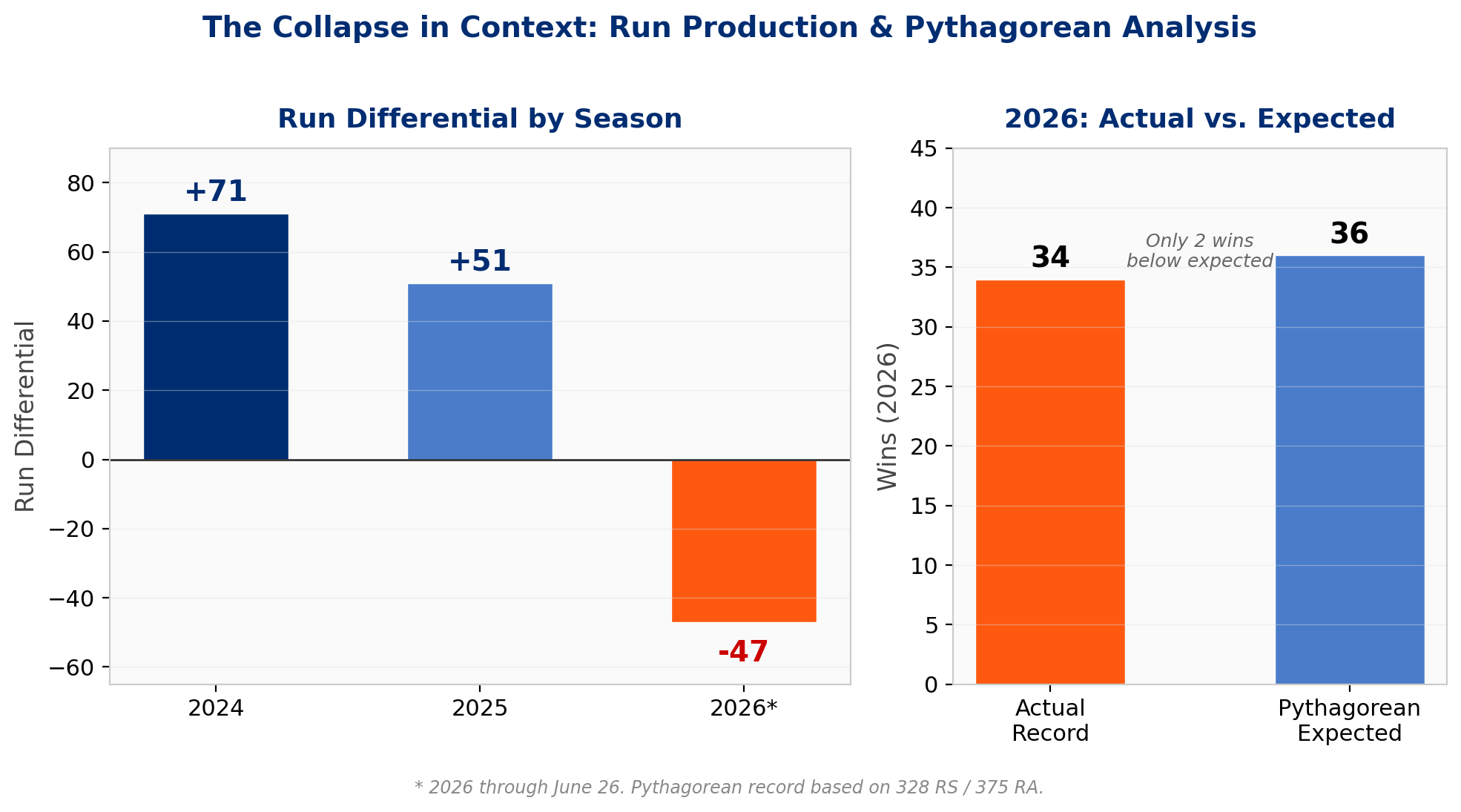
The Pythagorean Verdict: With 328 runs scored against 375 allowed, the Mets' run environment projected a .433–.439 winning percentage. The actual .420 represents marginal underperformance — roughly two games' worth — not the dramatic underachievement that would implicate managerial failure. This was a bad team playing near its level, not a good team being mismanaged.
The run-differential trend across Mendoza's tenure is equally telling. The Mets ran a +71 differential in 2024, +51 in 2025, and −47 in 2026 — a swing of 118 runs from peak to trough. This collapse in run production and prevention reflects the roster's deterioration through injuries and underperformance, not tactical regression. When the underlying talent produces 47 fewer runs than it allows, no amount of bullpen sequencing or lineup optimization closes the gap.
| Metric | 2024 | 2025 | 2026 (partial) |
|---|---|---|---|
| Runs Scored | 768 | 766 | 328 |
| Runs Allowed | 697 | 715 | 375 |
| Run Differential | +71 | +51 | −47 |
| Actual Win % | .549 | .512 | .420 |
| Pythagorean Win % | ~.542 | ~.530 | .433–.439 |
| Games Over/Under .500 | +16 | +4 | −13 |
V. The Justification Question
Any honest evaluation of the Mendoza firing must grapple with two competing narratives, each grounded in legitimate evidence. The decision sits at the intersection of organizational imperative and individual fairness — a tension inherent in every managerial dismissal, but amplified here by the scale of investment and the severity of mitigating circumstances.
The Justification Matrix
| Arguments For the Firing | Arguments Against the Firing |
|---|---|
| Payroll-to-Performance Gap: A ~$358M opening payroll — second only to the Dodgers — producing the worst record in the NL East creates an accountability imperative. Ownership and fans invested at championship levels; the returns were historically poor. | Roster Attrition: Losing Lindor (for long stretches), Semien, Polanco, Robert Jr., Senga, and Holmes constitutes a depth toll few managers overcome. The roster that took the field bore little resemblance to the one constructed. |
| Accelerating Decline: Three consecutive seasons of deterioration (.549 → .512 → .420) demonstrated a downward trajectory, not a single bad year. The pattern suggested systemic issues in the dugout. | Roster Construction Failures: Bichette, Semien, and Peralta — Stearns’ acquisitions — underperformed. Vientos posted negative fWAR. The failure to replace Alonso’s power was a front-office decision. These are construction flaws, not coaching failures. |
| Visible Collapse: The six-error doubleheader and six-game losing streak represented fundamental breakdowns in preparation and execution that fall within a manager’s domain. | Pythagorean Evidence: At 36–45 expected vs. 34–47 actual, the team played close to its true talent level. This undercuts the “underachieving but talented” narrative and redirects blame toward the roster itself. |
| Lost Season, Need for Evaluation: At 15.0 GB with 81 games remaining, the season was functionally over. A new voice was needed to evaluate younger players ahead of the trade deadline. | The Architect Survives: Cohen will reportedly retain Stearns while Mendoza loses his job. The man who built the team keeps his role — a contradiction that undermines the firing’s stated logic. |
The Central Irony
The most striking dimension of this firing is organizational: David Stearns, who assembled the roster, hand-picked Mendoza, and oversaw the offseason acquisitions that collectively underperformed, will reportedly remain in his position. Reports indicate Cohen may add a general manager to assist with pro scouting and roster construction — an implicit acknowledgment that the front office, not the dugout, bears significant responsibility for the 2026 debacle. The team had already begun retooling before the firing, trading pitcher David Peterson to the Cubs for prospect Cole Mathis (Chicago's No. 13 prospect) on June 25, just hours after the doubleheader sweep.
This dynamic — the architect survives while the builder is dismissed — is common in professional sports but rarely this transparent. Stearns' continued tenure, combined with the Pythagorean data showing the team performed near its (poor) talent level, creates a compelling circumstantial case that Mendoza was fired for problems that originated above him.
"The man who built the team keeps his job while the man who managed it loses his — the central irony that any honest assessment of this firing must confront."
Objective Verdict
The firing was defensible as an accountability measure but not a verdict that Mendoza was the primary problem. It was organizational triage — a symbolic reset triggered by a humiliating, public June collapse and an untenable payroll-to-results gap. In the narrow organizational sense, the decision was justified: something had to change with the franchise 13 games under .500 and hemorrhaging credibility with every series loss. But the deeper causes — roster attrition and flawed, injury-prone roster construction — sit largely outside the manager's control. The Pythagorean data confirms what the depth chart suggests: this roster, as built and as deployed, was a sub-.500 team. Mendoza managed a bad hand poorly, but the hand was dealt to him by others.
VI. Organizational Implications
The Stearns Question
Mendoza's dismissal sharpens the scrutiny on David Stearns' stewardship of the Mets' baseball operations. The 2025–2026 slide has unfolded entirely under Stearns' roster construction, from the decision to let Pete Alonso walk to the acquisitions of Bichette, Semien, and Peralta that have collectively failed to deliver. Cohen's reported decision to retain Stearns — while potentially adding a general manager — reads as a concession that the front office's talent evaluation and depth planning have been insufficient, even as Stearns himself is judged to have earned more time based on the 2024 NLCS run and his broader organizational restructuring.
The tension is inherent: Stearns' analytical approach and long-term vision attracted Cohen's investment, but the 2026 results suggest that analytical sophistication does not immunize against fundamental roster-building errors — particularly the over-reliance on injury-prone players and the failure to construct adequate depth. Whether Stearns adapts or repeats these patterns will determine whether the Mendoza firing was a course correction or merely a scapegoating that delayed a deeper reckoning.
The Short Leash in Big Markets
Mendoza's firing reinforces a well-documented pattern in major-market baseball: managers serve at the pleasure of ownership expectations, not just results. In smaller markets, a 34–47 start amid devastating injuries might buy a manager a full season to regroup. In New York, with Cohen's billions on the line and a fanbase conditioned to expect immediate returns on investment, patience is a luxury the organization cannot politically afford. The managerial position in Queens has always been a seat in which you are hired to be fired; Mendoza's 2.5-year tenure, while short, is not historically anomalous for the franchise.
Andy Green: The Interim Signal
The choice of Andy Green as interim manager is itself instructive. Green carries a 274–366 career record from his tenure managing the Padres (2016–2019) — a losing record that would typically disqualify a candidate for even an interim role. But Green's value lies not in his managerial résumé but in his organizational alignment: as SVP of Baseball Development, he is a Stearns lieutenant positioned to evaluate the roster through the front office's lens. His mandate is transparent: guide the remainder of 2026, assess the younger players, and prepare the organization for what comes next — likely significant roster turnover around the August 3 trade deadline.
This appointment signals retooling, not a win-now pivot. The Mets are acknowledging that 2026 is a lost season and positioning themselves to extract developmental and evaluative value from the remaining 81 games. A marquee managerial hire, if one comes, will wait for the offseason.
Looking Ahead
| Date | What to watch |
|---|---|
| June 26, 2026 | Mendoza fired. Andy Green named interim manager. Organization signals evaluation mode. |
| August 3, 2026 | Trade deadline. Mets expected to be sellers — trading rental players for prospects and future assets. |
| Offseason 2026–27 | Managerial search & roster overhaul. Cohen/Stearns will conduct a full search for a permanent manager; possible addition of a general manager to bolster roster construction. |
VII. Conclusion
Carlos Mendoza's dismissal is neither a clear-cut case of justified accountability nor an obvious injustice — it is both, simultaneously. The organizational imperative was real: a franchise spending at championship levels cannot absorb 13 games under .500, a six-error doubleheader, and a six-game losing streak without consequence. In the ruthless calculus of big-market baseball, someone must answer for a season this far below expectations, and the manager is the most visible — and most expendable — figure in the hierarchy.
But the evidence assembled in this analysis points to a conclusion that should trouble the Mets' front office: Mendoza was fired for managing a roster that was, by Pythagorean analysis and depth-chart reality alike, a sub-.500 team. The depth he lost to injury, the acquisitions that underperformed, and the bench that proved inadequate were decisions made above him. The −47 run differential was not a product of poor bullpen management or lineup construction; it was the predictable output of a roster that was shallow, injury-prone, and poorly assembled for the rigors of a 162-game season — one that lost even with Juan Soto healthy and raking.
Mendoza leaves Queens with a .509 career record, an NLCS appearance, and the distinction of having been fired for failing to overcome circumstances largely beyond his control. He will manage again. Whether the Mets learn the right lessons from his tenure — about roster depth, health infrastructure, and the limits of payroll as a substitute for sound construction — will determine whether his firing was a genuine turning point or simply another chapter in the franchise's long history of expensive disappointments.
"The firing was organizational triage — a defensible decision in the moment, but one that addressed the symptom rather than the disease. The deeper reckoning, if it comes, belongs to the architects, not the builder they dismissed."
Update. This article updates Mendoza vs. Stearns: Who Bears Responsibility for the Mets' Historic Swings?, published in May 2026.
Sources: USA Today, The Athletic (NYT), CBS Sports, Sports Illustrated, Yahoo Sports, MLB.com, Baseball-Reference, Fangraphs, NY Daily News, amNY, Sporting News, Fox News Sports, Rising Apple, and additional reporting.
Data notes: Opening payroll is reported at approximately $358M (second in MLB behind the Dodgers); some sources cite a $330M–$380M range depending on luxury-tax treatment. Mendoza's career record is reported as 206–199. Pythagorean winning percentage is reported between .433 and .439; both figures indicate performance near the team's true talent level. Monthly breakdowns are approximate where granular records were not comprehensively reported; this version corrects May to 16–12 (a winning month) and Mar/Apr to ~10–21, consistent with the 34–47 total and contemporaneous reporting. The earlier draft's per-series June table was removed pending line-by-line verification.