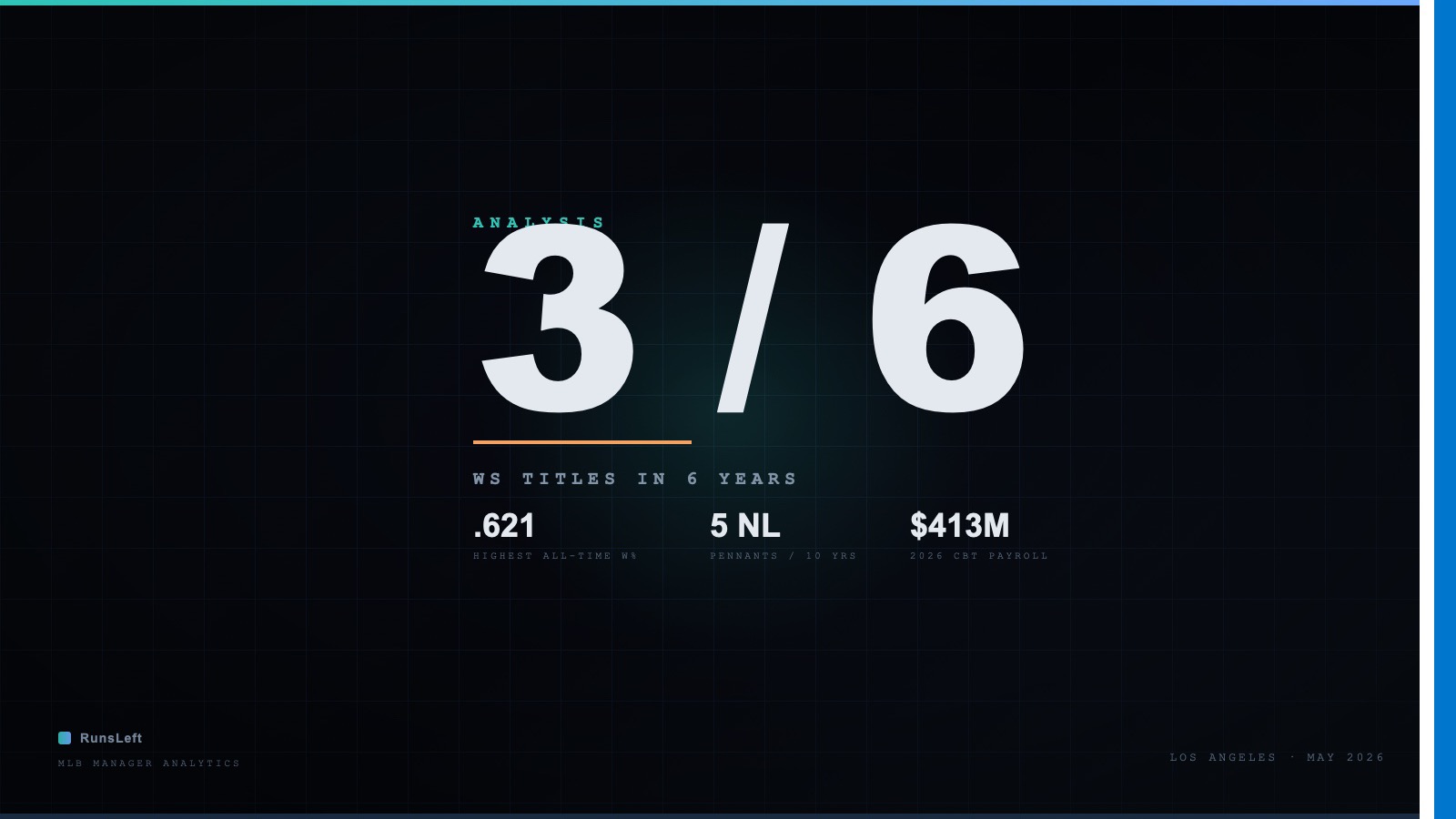
The Los Angeles Dodgers are back-to-back World Series champions for 2024 and 2025 — the first franchise to repeat since the 1998–2000 Yankees, the only one to do so under MLB's current revenue-sharing and luxury-tax structure. Dave Roberts has compiled a 965–589 regular-season record (.621) over ten seasons — the highest winning percentage in AL/NL history — alongside three championships, five pennants, and three uncomfortable first-round exits in 2019, 2022, and 2023. Andrew Friedman has built the dynasty on $1.55B in commitments to Betts, Freeman, Ohtani, and Yamamoto, with a 2026 CBT payroll near $413M and a $169M luxury-tax bill in 2025 alone. The question is whether the spending model is validated.
This is our analytical verdict.
Roberts holds the highest regular-season winning percentage in AL/NL history (.621), has delivered three World Series championships and five pennants in ten years, and has successfully managed some of the most complex and ego-laden rosters in modern baseball. The back-to-back titles of 2024 and 2025 were achieved through demonstrated in-series management skill: the 2024 NLDS comeback from a 2-1 deficit against San Diego, the 2024 World Series Game 5 comeback from 5-0, and the 2025 World Series in which the Dodgers won the final two games on the road, including an extra-innings Game 7. For comparison: Rob Thomson, holding the highest winning percentage in Phillies franchise history but with no title, was graded A− in this series. Roberts' record exceeds that benchmark. The three first-round exits in 2019, 2022, and 2023 — against teams the Dodgers finished 13, 22, and 16 games ahead of in the standings — are real failures engaged with rather than dismissed. They prevent a flawless grade, and they should.
Friedman has constructed the pre-eminent franchise of twenty-first century baseball. His record across this series' evaluation axes is unmatched: three championships in six years, five pennants in ten, the highest regular-season winning percentage in AL/NL history under his employ, and a farm system ranked No. 1 by a peer survey of MLB executives entering 2026. Within this series' calibration — where executives like Stearns, Breslow, and Preller, who have built competitive but not championship-winning rosters, have been graded in the B−/B range — Friedman's record places him above the scale we have applied to other franchises. The Ohtani-Yamamoto offseason alone, executed in the same winter, would qualify as the most consequential roster move of the decade. Both have already returned championships within the contracts' first two years. One acknowledged deduction: the 2026 CBT payroll approaching $413M and luxury tax bill exceeding $169M raise legitimate questions about whether the full ten-year Ohtani contract arc, with its back-loaded deferrals, will represent responsible long-term stewardship of organizational capital.
The Bottom Line
The Dodgers' spending model is validated by results within its first contract cycles. Three World Series titles in six years, five pennants in ten, the highest regular-season winning percentage in AL/NL history, and a #1-ranked farm system per a peer survey of MLB executives — that is the pre-eminent franchise of twenty-first century baseball. The qualifications are real: three first-round exits in 2019, 2022, and 2023 are genuine failures the championships do not erase, and a $413M CBT payroll with $169M+ in annual tax obligations demands continued scrutiny as the long-term contracts mature. But within this series' calibration, the Friedman-Roberts record stands above the scale.
The full case follows.
Part I: Andrew Friedman's Vision — Building a Modern Dynasty (2014–2026)
The Architect's Philosophy and the "Process Over Results" Doctrine
Andrew Friedman arrived in Los Angeles after the 2014 season carrying credentials that were unconventional for a baseball executive: a background in finance at Bear Stearns and private equity at MidMark Capital. That background would prove transformative. Friedman did not simply run a front office; he redesigned the Dodgers as a system — one optimized for sustained excellence rather than episodic brilliance. From his first days in the organization he articulated a philosophy that would define the next decade: process over results.
The doctrine holds that sound, repeatable decision-making based on deep analytical rigor will outperform reactive management over a sufficiently long time horizon. It demands that the organization accept the "variance" inherent in baseball — the randomness of a short postseason series, the unpredictability of injuries, the inevitable bad luck — without allowing those short-term fluctuations to corrupt the strategic framework. In practical terms, this meant refusing to make panic trades after devastating October losses, declining to overpay in desperation, and resisting the kind of impulsive roster overhauls that historically unsettle winning organizations.
Core tenet. "Everything that we can do right now to not buy in July" — Friedman's explicit preference for proactive offseason construction over reactive trade-deadline bidding, which he views as "a terrible time to acquire talent."
This doctrine was tested repeatedly and severely during the stretch from 2017 to 2023, when the Dodgers suffered three stunning Division Series eliminations despite entering each as overwhelming favorites. Friedman did not blink. He maintained the core of homegrown talent — refusing to break up Corey Seager, Cody Bellinger, and Walker Buehler for short-term patches — and acted decisively when the right opportunity emerged. The Mookie Betts trade before the 2020 season is the canonical example. The Ohtani-Yamamoto offseason is the more dramatic one. It is important to be precise about what the back-to-back championships actually demonstrate: the doctrine itself, by construction, cannot be vindicated or refuted by a small sample of October outcomes — that is the entire point of process-based reasoning. What the championships do show is that the system Friedman built generated enough consistently elite team-quality at-bats over a decade-long sample that, given enough postseason trials, championships became likely. That is the strongest defensible claim, and it is sufficient.
Franchise-Altering Acquisitions: The Four Pillars
The empirical record of Andrew Friedman's major roster moves is extraordinary in both volume and quality. Since 2015, the Dodgers have executed a series of acquisitions that, collectively, represent one of the most aggressive and successful transformations of a roster in the free-agent era. Four moves stand above all others as franchise-defining transactions.
Mookie Betts (Trade & Extension, 2020 offseason — $365M)
After failing to sign Gerrit Cole or Anthony Rendon in the preceding winter, Friedman pivoted dramatically, acquiring Betts from Boston in a blockbuster trade and immediately extending him to a record-setting contract. The move proved transformative across multiple dimensions. Betts became a perennial All-Star and Silver Slugger, a Gold Glove-caliber right fielder who later seamlessly transitioned to second base and then shortstop as the team's needs evolved. His leadership in the clubhouse, his on-field versatility, and his consistent elite production made him the organizational connective tissue linking the front office's vision to the dugout's execution.
Freddie Freeman (Free Agency, 2022 — $162M)
Signed to anchor first base heading into the 2022 season, Freeman provided immediate middle-of-the-order production and veteran leadership. His regular-season contributions were steady and significant, but his defining moment arrived in the 2024 World Series, where he was named Series MVP after delivering a walk-off grand slam in Game 1 and homering in an unprecedented four consecutive World Series games. He is now widely considered one of the most impactful position-player acquisitions in Dodgers history.
Shohei Ohtani (Free Agency, 2024 offseason — $700M, 10 years)
The signing of Shohei Ohtani was not merely a blockbuster acquisition; it was a cultural and competitive event unlike anything the sport had seen. On a contract worth a record $700 million over ten years — structured with unprecedented deferrals that reduced his annual competitive balance tax hit to approximately $46.1 million — Ohtani delivered two of the most remarkable individual seasons in baseball history as a Dodger. In 2024, he became the first player ever to hit 50 home runs and steal 50 bases in the same season, finishing with a then-franchise-record 54 home runs, winning a unanimous NL MVP award, and leading Los Angeles to its eighth World Series title. In 2025, he extended the achievement: 55 home runs, a new franchise record; a third consecutive unanimous MVP and his fourth in five years (joining Barry Bonds as the only four-time MVPs in MLB history); a return to two-way work with a 2.87 ERA in 14 starts; and an NLCS in which he homered three times and struck out ten over six shutout innings in the same game — arguably the single most extraordinary individual postseason performance in modern baseball. He was named NLCS MVP for that effort. His dual-threat ability, elite name recognition, and on-field production make this acquisition the defining move of the Friedman era.
Yoshinobu Yamamoto (Free Agency, 2024 offseason — $325M, 12 years)
In the same winter that delivered Ohtani, Friedman secured Yamamoto — a decorated ace from Nippon Professional Baseball on a record-setting twelve-year, $325 million contract that remains the largest pitching contract in MLB history. His debut 2024 season was uneven: a triceps injury limited him to 18 starts, but he posted a 3.00 ERA and contributed a strong Game 2 performance against the Yankees in that fall's World Series. The full vindication arrived in 2025. He threw a complete-game three-hitter against Milwaukee in NLCS Game 2 — the first complete-game postseason start in MLB in eight years — then a four-hit complete game in World Series Game 2 against Toronto. After a Game 6 win on six innings of one-run ball, he returned the following day on no rest to throw 2 2/3 scoreless relief innings and close out Game 7 in the eleventh. He finished the World Series 3-0 with a 1.02 ERA and was named Series MVP. Yamamoto is the fourth pitcher ever to win Games 6 and 7 of a single World Series. The contract has been validated more decisively than perhaps any pitching investment in baseball history.
Financial Strategy and the Luxury Tax Frontier
Andrew Friedman's financial background is most visibly evident in how the Dodgers have navigated MLB's economic framework. The organization has operated as a consistent luxury tax payer throughout his tenure, but the scale of that spending has accelerated dramatically in the Ohtani-Yamamoto era. Opening Day payrolls progressed from approximately $177 million in 2015 to $277.5 million in 2024 and $354.8 million in 2025. By 2026, the Dodgers' competitive balance tax payroll is projected between $410.8 million and $413.4 million — figures that shatter the previous franchise and MLB records.
The corresponding luxury tax bill for 2025 reached a record $169 million, a penalty that, by itself, exceeds the total payroll of at least twelve other MLB franchises. The 2026 bill is estimated to surpass that figure further, driven by CBT charges from Tucker ($57.2M), Ohtani ($46.1M), Glasnow ($27.3M), Yamamoto ($27.1M), and Snell ($31.4M).
What distinguishes the Dodgers' financial strategy from simple checkbook spending is the sophistication with which these obligations are structured. Ohtani's contract is the prime example: the $700 million deal is back-loaded with unprecedented deferrals, compressing the annual CBT impact and preserving short-term roster flexibility. Friedman has explicitly linked payroll decisions to revenue projections, treating the luxury tax not as a ceiling but as a predictable cost of doing business in a high-revenue market. Whether this model is financially sustainable for ownership over the full ten-year arc of the Ohtani contract is a legitimate question, but the baseball output to date has been unambiguous: two consecutive championships.
One structural caveat is worth flagging: high-payroll teams are designed to buy above-average wins, and each incremental win above league average is more expensive than the last by definition. So a $400M+ CBT payroll producing wins at higher cost per win than league average is partly the structural premium of operating at the top of the payroll distribution, not pure inefficiency. The more telling within-tier comparison is against fellow $300M+ payrolls (Mets, Yankees, Phillies) — and on that scale, the Dodgers' three rings in six years places them well clear of the peer group.
The Farm System as Competitive Lifeblood
One of the most analytically impressive aspects of the Friedman era is the coexistence of historically high payrolls with a consistently elite farm system. Since 2014, the Dodgers' developmental pipeline has produced a continuous stream of cost-controlled talent that has both supplemented the major league roster and provided trade currency. The system was ranked No. 1 by MLB Pipeline before the 2016 season and has remained in the top tier for most of the decade since.
A rare divergence of opinion emerged entering 2026: Baseball America dropped the system to No. 13, citing the graduation of Roki Sasaki, trades involving Ryan Pepiot, and injuries to other prospects. However, this pessimistic view was not shared by the broader industry. ESPN ranked the system No. 4, The Athletic's Keith Law placed it No. 2, and, most meaningfully, a survey of MLB executives ranked the Dodgers' farm system as No. 1 in all of baseball — a peer-driven endorsement that reflects genuine industry respect for the organization's developmental capabilities. The system boasts seven players on Top 100 lists entering 2026, including top outfield prospects Josue De Paula and Eduardo Quintero.
This paradox — elite payroll and elite development operating simultaneously — is the signature achievement of the Friedman model. Most high-payroll franchises sacrifice prospect depth in pursuit of immediate contention. The Dodgers have consistently refused that tradeoff, generating a self-reinforcing cycle where farm talent reduces payroll pressure at the margins, enabling even more aggressive investment at the top of the roster.
Part II: Dave Roberts' Complete Record — Dominance, Disappointment, and Dynasty (2016–2026)
Season-by-Season Analysis
Dave Roberts was named the 11th manager in Dodgers history on December 1, 2015, inheriting a talented roster with high expectations and a history of recent postseason failures under prior management. What followed is one of the most productive managerial tenures in the history of Major League Baseball — measured by wins, division titles, postseason appearances, pennants, and championships. The table below documents each full season under Roberts through 2025.
| Year | Record | Win% | Division | Postseason Result | Notes |
|---|---|---|---|---|---|
| 2016 | 91–71 | .562 | 1st (NL West) | NLDS Loss (Nationals) | Roberts' inaugural season |
| 2017 | 104–58 | .642 | 1st (NL West) | WS Loss (Astros) | NL Pennant; tainted by Houston scandal |
| 2018 | 92–71 | .564 | 1st (NL West) | WS Loss (Red Sox) | NL Pennant; Game 3 marathon controversy |
| 2019 | 106–56 | .654 | 1st (NL West) | NLDS Loss (Nationals) | Lost to eventual WS champ as heavy fav. |
| 2020 | 43–17 | .716 | 1st (NL West) | WS Champion | 60-game season; franchise's 7th title |
| 2021 | 106–56 | .654 | 2nd (NL West) | NLCS Loss (Braves) | Lost on Kiké Hernández game-7 error |
| 2022 | 111–51 | .685 | 1st (NL West) | NLDS Loss (Padres) | Franchise-record wins; shocking exit |
| 2023 | 100–62 | .617 | 1st (NL West) | NLDS Loss (D-Backs) | Third early exit in five years |
| 2024 | 98–64 | .605 | 1st (NL West) | WS Champion | Beat Yankees; Freeman WS MVP |
| 2025 | 93–69 | .574 | 1st (NL West) | WS Champion | Beat Blue Jays G7 in extras; Yamamoto MVP |
Table 1 — Dave Roberts season-by-season record, 2016–2025.
Across these ten seasons, Roberts compiled a regular-season record of 965 wins and 589 losses, a .621 winning percentage that is documented as the highest ever recorded by any manager in either the American or National League. He led the Dodgers to nine NL West division titles in ten seasons, missing only in 2021 (when the Braves edged the club by a game). His 69 postseason wins rank third all-time among MLB managers, and he is one of only six managers since 1969 to lead a single franchise to four pennants.
Historical footnote. Roberts' .621 winning percentage surpasses the career marks of Joe Torre (.605), Bobby Cox (.556), and Tony La Russa (.535) — managers widely regarded as all-time greats. The sample size of ten full seasons renders this comparison statistically meaningful rather than a small-sample anomaly.
The Championship Seasons: 2024 and 2025 in Detail
2024: Eight Is Enough — The Ohtani-Freeman Triumph
The 2024 season opened under the weight of extraordinary expectations. With Shohei Ohtani's arrival, the Dodgers were not merely favored to win the World Series; they were widely viewed as the most talented team assembled in the modern era. Roberts' primary challenge was managing an ego-laden, star-studded roster through the grind of 162 games while preserving collective purpose and cohesion. He succeeded brilliantly. The Dodgers finished 98–64, best in MLB, claiming home-field advantage throughout the playoffs.
Ohtani's historic 50-50 season — he became the first player ever to hit 50 home runs and steal 50 bases in the same year, ultimately finishing with 54 home runs and 59 stolen bases — was the individual centerpiece, but Roberts managed the lineup to distribute the offensive burden across a deep order. The postseason run required navigating a five-game NLDS against the San Diego Padres — during which the Dodgers came back from a 2-1 series deficit by winning consecutive elimination games — and a six-game NLCS against the New York Mets before reaching the World Series against the Yankees. Game 1 of the Fall Classic delivered one of the most dramatic moments in World Series history: Freddie Freeman's walk-off grand slam in the tenth inning, the first walk-off grand slam in World Series history. Freeman went on to homer in Games 1 through 4 — an unprecedented streak that earned him Series MVP honors — and the Dodgers closed it out in Game 5 with a stunning comeback from a 5-0 deficit, winning 7-6. The franchise's eighth championship validated the offseason investment and, after years of postseason frustration, supplied the data point that critics of both Friedman's spending and Roberts' October management had been waiting for.
2025: Dynasty Confirmed — The Yamamoto-Ohtani Encore
Successfully defending a World Series title is among the most difficult achievements in professional sport. The 2025 Dodgers became the first team to win consecutive World Series titles since the 1998-2000 New York Yankees, ending a 25-year span in which no franchise had managed back-to-back championships under MLB's revenue-sharing and luxury-tax era. The season featured a sweep of the Cincinnati Reds in the Wild Card Series and a sweep of the Milwaukee Brewers in the NLCS, capped by Ohtani's historic Game 4 performance: three home runs at the plate and ten strikeouts over six shutout innings on the mound — the first three-home-run, ten-strikeout performance in postseason history.
Ohtani was again extraordinary across the regular season, finishing with 55 home runs (a new franchise record), 146 runs scored (most in MLB and a modern Dodgers record), a 1.014 OPS, and 47 innings of 2.87 ERA pitching in his return to two-way play. He was unanimously named NL MVP for the third consecutive year, joining only Barry Bonds as a four-time MVP. Yamamoto's World Series performance, detailed above, was historic by any standard and earned Series MVP honors. The Series itself, against the Toronto Blue Jays, went seven games and ended in extra innings: the Blue Jays held a 4-3 lead with one out in the ninth of Game 7 in Toronto when Miguel Rojas hit a game-tying home run; Will Smith homered in the eleventh; and Yamamoto, on no rest, finished the game by inducing a double-play grounder with the tying run on third. The Dodgers' ninth championship — sealed in one of the most dramatic Game 7s in World Series history — cemented the dynasty designation. Clayton Kershaw's retirement following the title added an emotional capstone.
"What he's done over a decade, the consistency of winning, the ability to manage egos and stars and expectations, and now back-to-back — it's historic." — Anonymous NL executive, March 2026
The Postseason Paradox: Three Anomalies in a Dynasty
Any honest accounting of the Roberts era must engage squarely with its three most confounding results: the 2019 NLDS loss to Washington (whom the Dodgers finished 13 games ahead of in the standings), the 2022 NLDS loss to San Diego (22 games), and the 2023 NLDS loss to Arizona (16 games). In each instance, the Dodgers held the season-series advantage and superior rosters by virtually every measure. In each instance, they lost in the first round.
The pattern's significance is debated, and reasonable analysts disagree. Three observations are worth stating directly. First, in each of the three series, Roberts' bullpen deployment was specifically criticized: the Game 5 Kershaw appearance and Joe Kelly usage in 2019; the deployment of relievers in 2022 against a lineup the Padres had carefully constructed for short-series leverage; and the rotation order against Arizona in 2023. Second, the underlying expected-runs gap between the Dodgers and these specific opponents was much smaller than the standings gap suggested in each case — the 2022 Padres in particular had reconstructed themselves at the trade deadline and entered October as a different team from the one they were in July. Third, and most importantly, postseason performance is genuinely high-variance: the same five-game format that produced these three losses also produced the 2024 NLDS comeback over San Diego from a 2-1 deficit, and the same in-series management that drew criticism in 2022 produced championship runs in 2024 and 2025.
The honest reading is that the three exits represent a real failure mode that should not be erased by subsequent championships, but also that they do not invalidate a body of work containing three titles, five pennants, 69 postseason wins, and the highest regular-season winning percentage in AL/NL history. The 2017 and 2018 World Series losses are a separate matter: the 2017 series was played against a Houston team subsequently found to have systematically stolen signs at home, and the 2018 series included the famous Game 3 marathon in Boston. Neither is a credit to Roberts' record, but neither is a clean indictment either. The 2021 NLCS loss came one game short of a fourth pennant in five years and turned on a single defensive error.
Within this series' calibration, three NLDS upsets in a decade-long run that produced three championships and the highest winning percentage in league history is not a B-grade record. It is the cost component of an A-grade record, and it is recorded as such.
Part III: The 2026 Season — The Three-Peat Pursuit and Early Adversity
As of May 4, 2026, the Los Angeles Dodgers sit at 21–13, holding first place in the National League West and tracking as one of the better records in all of baseball. The three-peat pursuit — a feat not accomplished since the 1998–2000 New York Yankees — is the stated and widely understood organizational objective. The roster assembled for this quest is, by financial measures, the most expensive in MLB history, with a CBT payroll approaching $413 million and an anticipated luxury tax bill that will once again shatter records.
The offseason brought significant turnover at the margins while preserving the championship core. Clayton Kershaw's retirement ended an 18-year connection to the franchise and removed a critical veteran voice from the clubhouse. The front office responded by re-signing key utility contributors and adding outfielder Kyle Tucker (CBT hit: $57.2M) and closer Edwin Díaz, reinforcing the bullpen and the outfield depth that was tested during the 2025 run. Yoshinobu Yamamoto, fresh off World Series MVP honors, assumes the clear mantle of ace, a role he appeared ready to fully inhabit entering the season.
Injury update (as of May 4, 2026). Mookie Betts sustained an oblique strain in early April 2026, with a projected recovery timeline of four to six weeks. His absence removes one of the team's most versatile and catalytic contributors from the lineup during the season's first quarter, representing, in the words of one analyst, "the first real speedbump for the defending champions." See how Roberts is filling that lineup hole on tonight's Dodgers edges →
Roberts' early-season management of the Betts injury has drawn praise for roster creativity: the team has shifted its positional alignment, given regular at-bats to depth pieces, and maintained its elite run differential without one of its three most important players. The 21–13 start is broadly consistent with the team's historical pace under Roberts — the franchise has exceeded 90 wins in nine of his ten full seasons — and provides early evidence that the dynastic infrastructure Friedman has built is deep enough to absorb significant injury without a dramatic performance drop.
The 2026 season will ultimately be judged by October results. The team enters with both the talent and the organizational infrastructure to accomplish what only three franchises have ever done in the modern era. Whether Roberts can deliver that third consecutive title, and whether Friedman's unprecedented financial model continues to produce championships at an ROI that satisfies ownership, are the defining questions of the season ahead.
Part IV: Statistical Audit — Eight Charts Examined
The following eight visualizations collectively constitute a data-driven portrait of the Roberts-Friedman era. Each chart is presented with analytical commentary contextualizing the data within the broader narrative of the franchise's competitive trajectory.
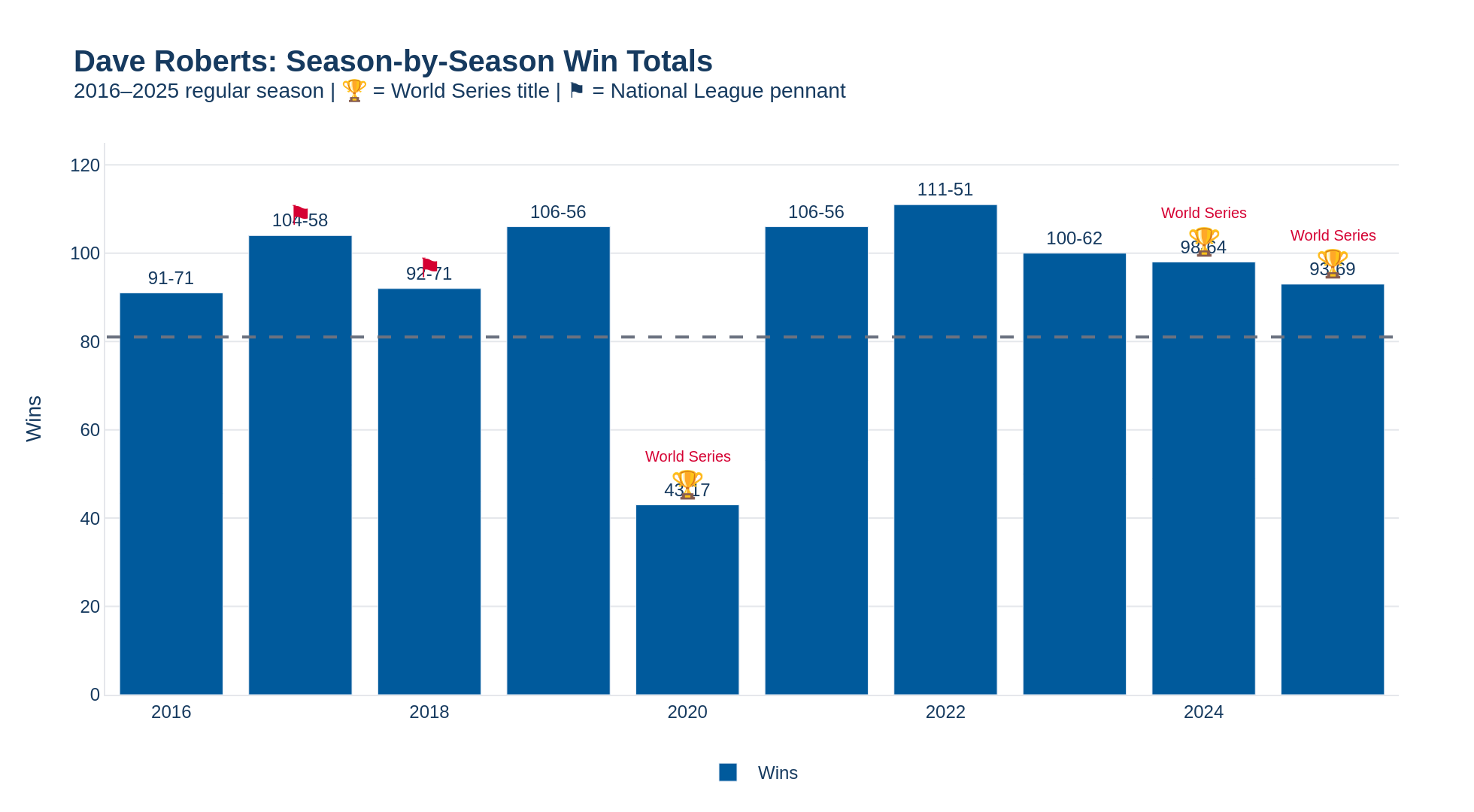
Chart 1 establishes the bedrock of the statistical case for Roberts' tenure: uninterrupted regular-season excellence. Every full 162-game season under Roberts produced at least 91 wins, with the franchise reaching three separate 100-win thresholds in 2019, 2021, and 2023. The 2022 season stands as the architectural apex, with 111 wins representing the most dominant single-season record in Dodgers history. The 2025 championship's 93-win total looks modest by comparison, but reflects the broader phenomenon of winning teams managing late-season rest and health management in preparation for postseason play. The dashed .500 line at 81 wins frames how dramatically above the competitive baseline the Dodgers have operated throughout this decade-long run.
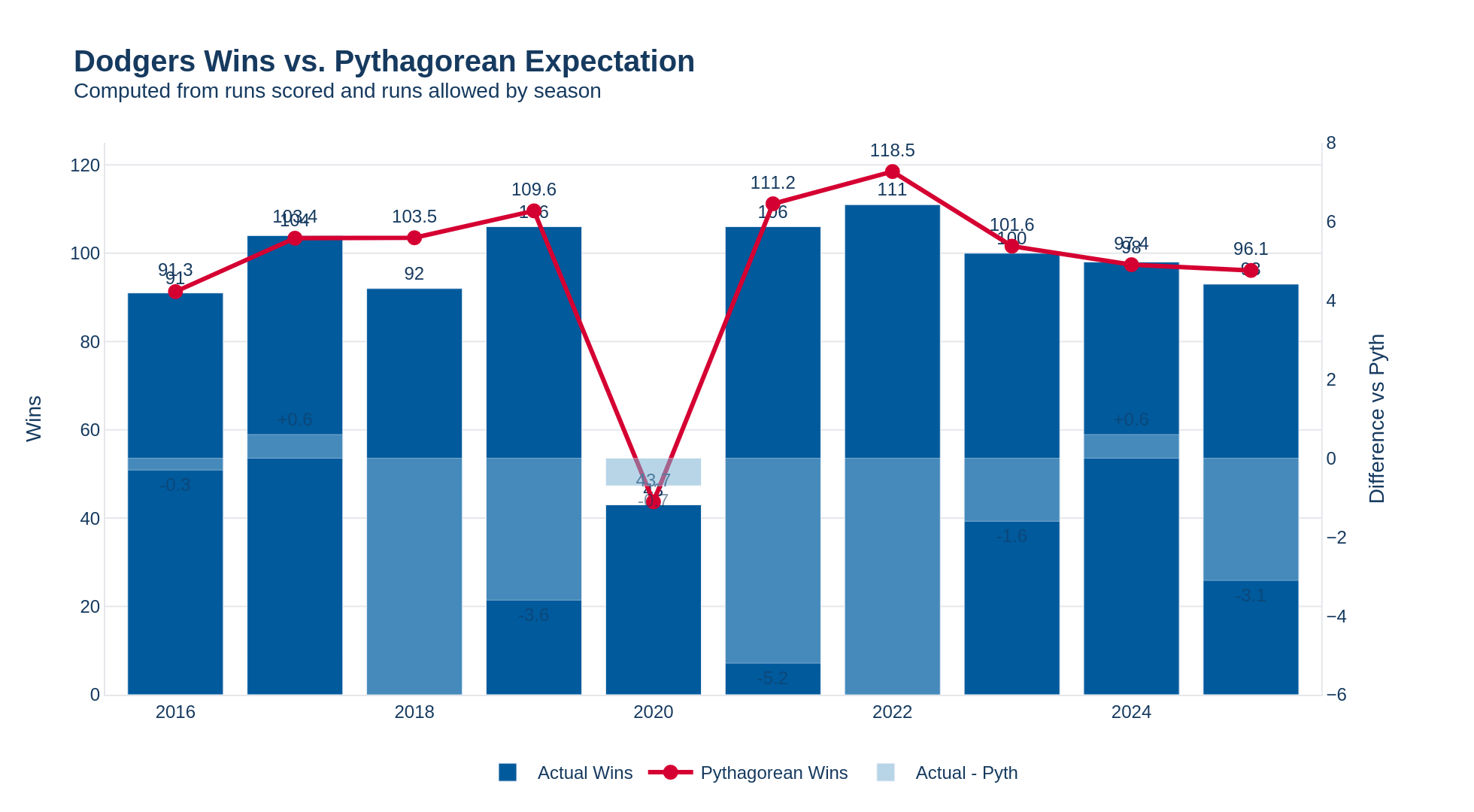
The Pythagorean expectation comparison in Chart 2 addresses a sophisticated analytical question: has the Dodgers' win total reflected genuine team quality, or has it benefited from luck in close games? The data delivers a nuanced answer. In several seasons — notably 2019 and 2022 — the Dodgers actually underperformed their Pythagorean expectation, meaning their underlying run metrics suggested they were even better than their elite win totals indicated. The 2020 championship season showed modest outperformance in a small 60-game sample. Critically, there is no sustained pattern of winning-record luck; the franchise's dominance is rooted in genuine run differential superiority, not clutch-hit good fortune. This finding strengthens the analytical case for both the front office's roster construction and Roberts' in-game management.
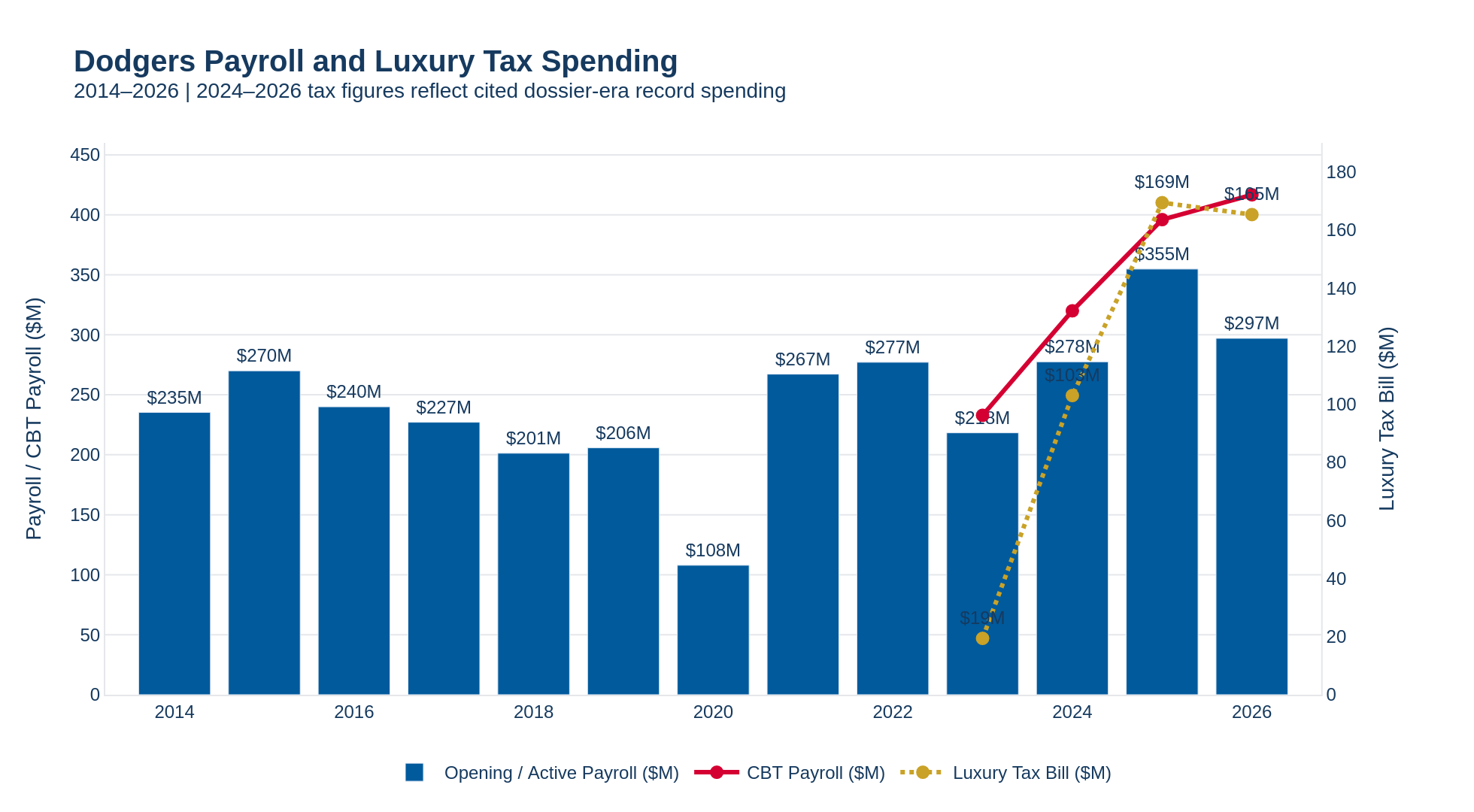
Chart 3 provides the financial architecture underlying the dynasty. The most striking visual feature is the inflection point at 2024: both the active payroll and CBT payroll undergo a step-change of historic magnitude with the Ohtani-Yamamoto signings, pushing CBT payroll from the $270–$290 million range into territory that no MLB franchise had previously occupied. The yellow luxury tax line tells a parallel story of compounding financial commitment: from modest tax payments in the mid-2010s to a $169M bill in 2025 and a record-projected obligation in 2026. Friedman's financial sophistication is visible in the gap between active payroll and CBT payroll in the Ohtani years, reflecting the contract deferrals that artificially compress the CBT impact relative to true economic value delivered. The team is paying to win, and so far, it is winning.
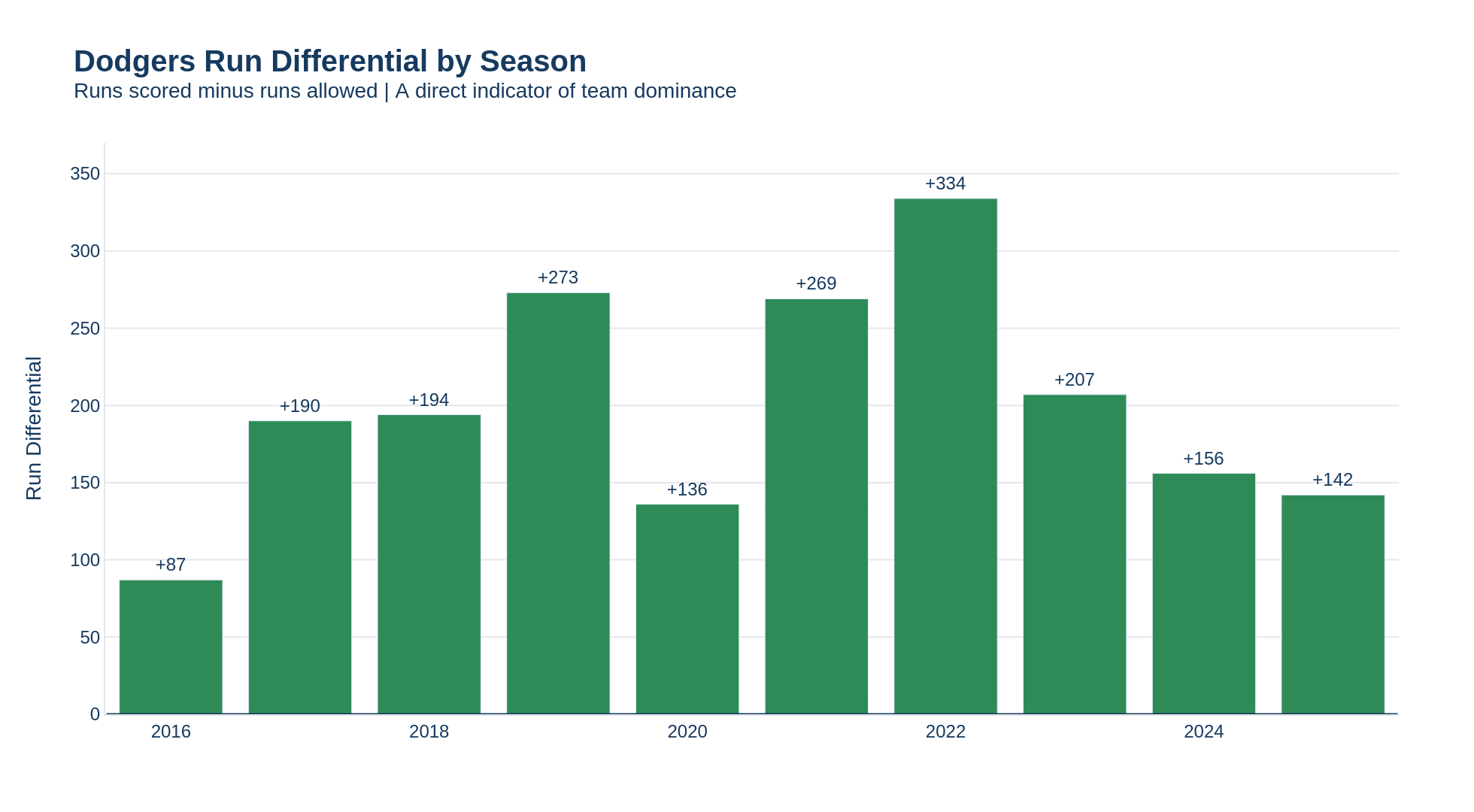
Run differential is among the most reliable indicators of genuine team quality, stripping away the noise of close-game outcomes to measure the sustained gap between a team's offensive production and its run prevention. Chart 4 shows the Dodgers operating at elite levels across the entire Roberts era, with positive run differentials in every season. The 2022 peak of +334 is extraordinary by any standard — a figure comparable to the best single-season run differential marks in modern baseball history. The championship seasons of 2024 and 2025 show slightly lower but still substantial positive differentials, consistent with the broader finding that dominant teams sometimes manage energy levels late in regular seasons as postseason preparation takes priority. This data is the clearest statistical refutation of any narrative that the Dodgers' win totals have been inflated by scheduling, opponent quality, or lucky outcomes in close games.
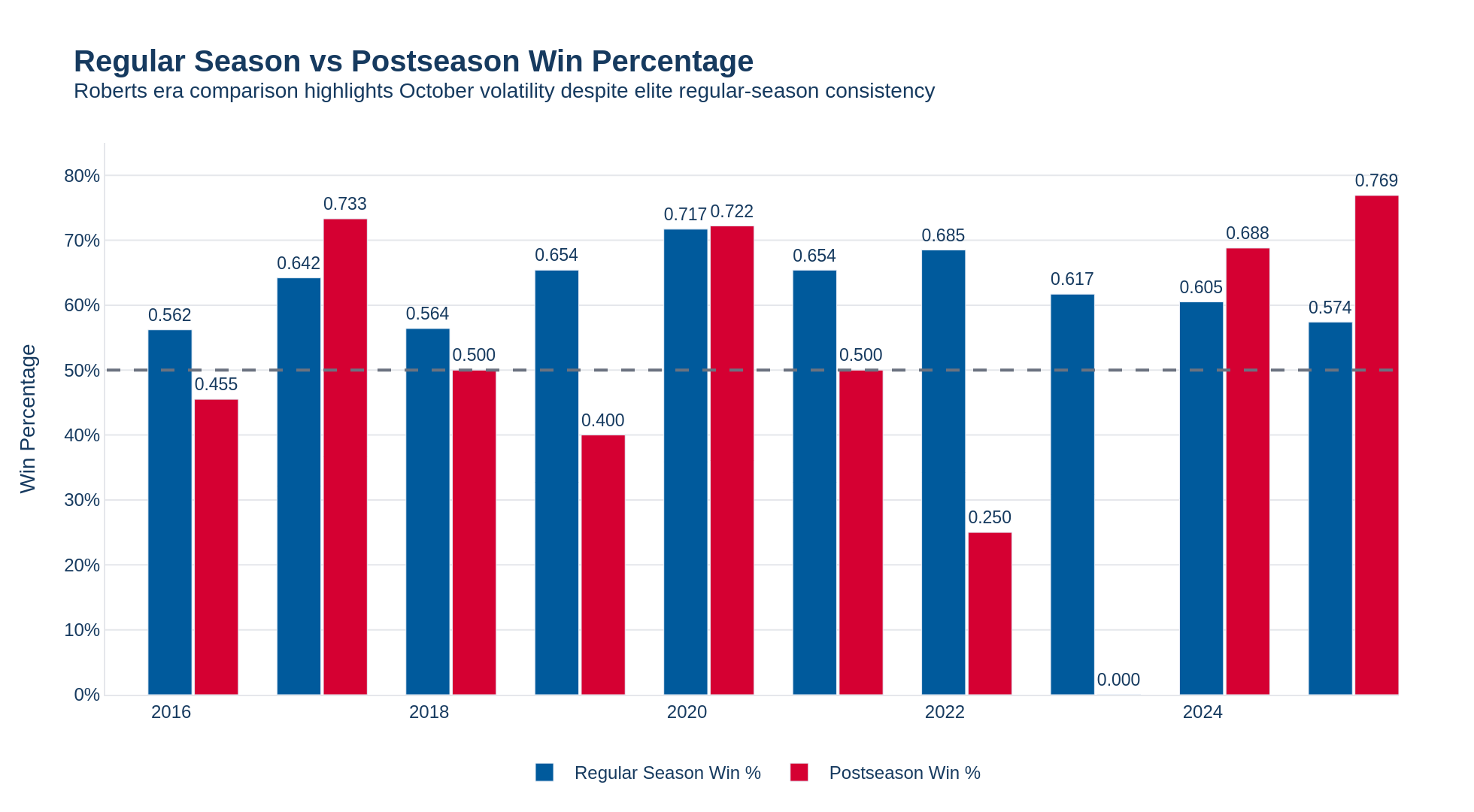
Chart 5 is the most analytically provocative visualization in this audit, directly confronting the postseason paradox documented in Part II. The clustering of regular-season win percentages in the .600–.685 range is consistent across all seasons shown, demonstrating the remarkable stability of Roberts' regular-season performance. The postseason win percentages, however, are dramatically volatile — ranging from below .400 in the anomalous exit years to above .700 in championship runs. This extreme variance is partially structural: the postseason is a fundamentally different statistical environment, where small samples and opponent-specific pitcher matchups distort the signal. But the magnitude of the 2022 collapse — the team with the best record in baseball losing in four games — cannot be entirely attributed to sampling variance. The chart honestly presents both the dynasty's heights and its valleys without papering over either.
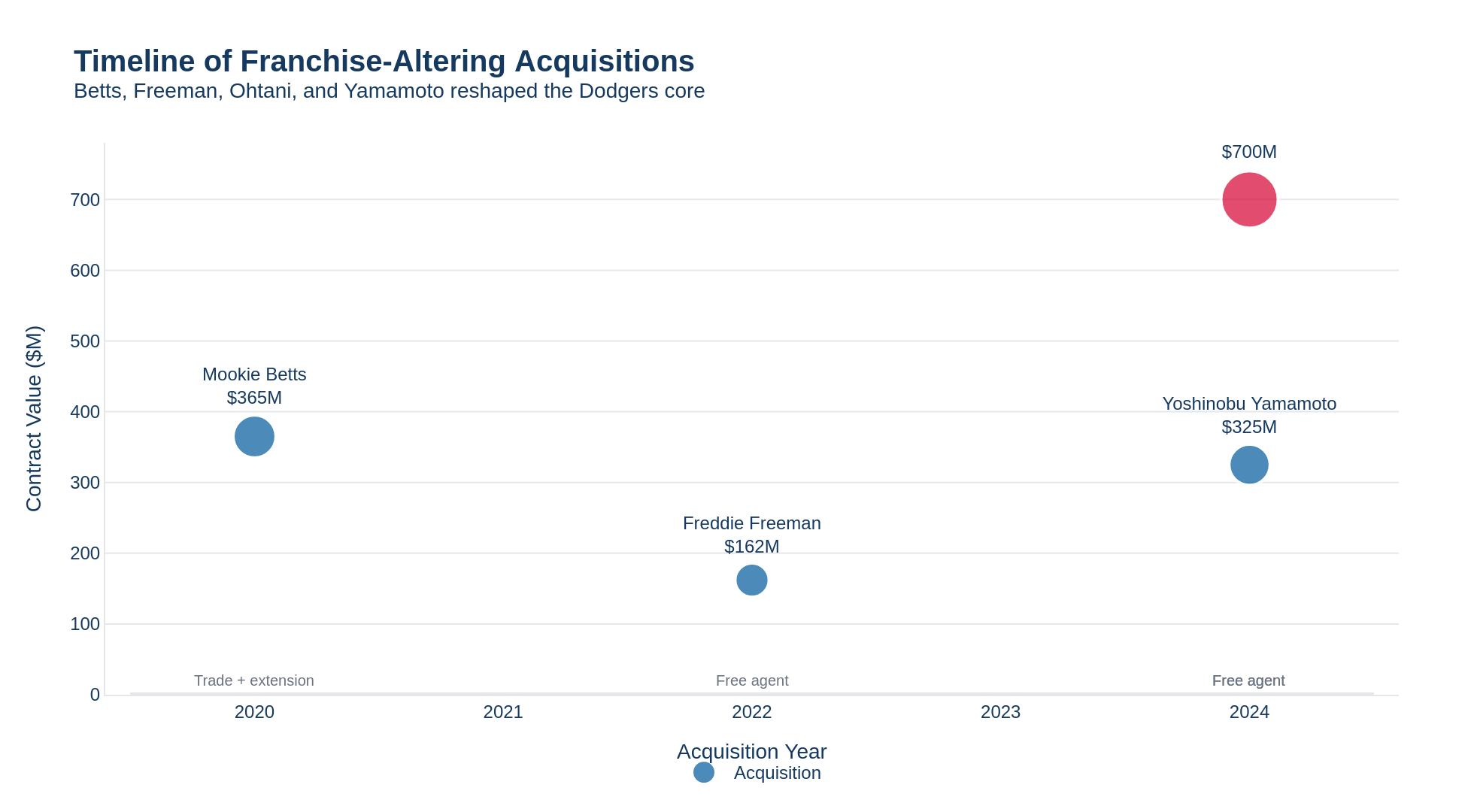
Chart 6 contextualizes the four cornerstone acquisitions of the Friedman era by total contract value and timing. The visual impact is deliberate: the 2024 winter appears as a financial discontinuity, with Ohtani ($700M) and Yamamoto ($325M) together representing a $1.025 billion commitment in a single offseason. Placed alongside the Freeman ($162M) and Betts ($365M) deals from prior winters, the total investment in these four players alone exceeds $1.55 billion. What the chart cannot fully capture is the return on that investment: two World Series championships from the 2024 signing class within a two-year window, two Freeman walk-off World Series moments, and Mookie Betts' decade of organizational leadership. By any standard of competitive return, the investment has been justified.
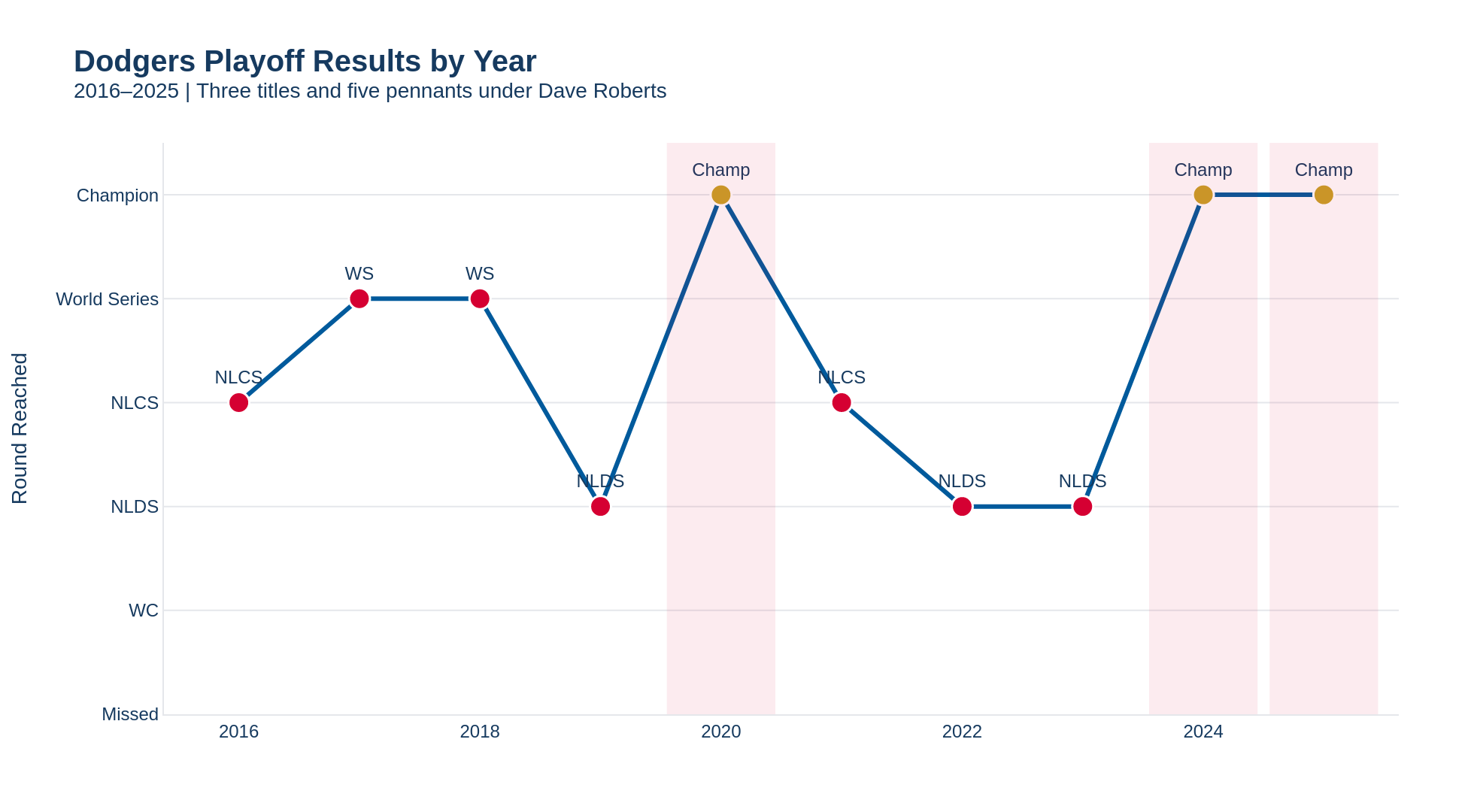
The playoff results line chart in Chart 7 provides perhaps the most intuitive visual summary of the Roberts era's complexity. The trajectory is not a smooth ascent; it is a jagged but ultimately upward-trending line punctuated by three sharp drops to first-round exits in 2019, 2022, and 2023. These valleys are flanked by peaks: the 2020 championship, the 2024 championship, and the 2025 championship. Reading the chart from left to right, a clear organizational arc emerges — early pennants, then a championship, then frustrating regression, then back-to-back championships that definitively resolve the question of whether the Friedman-Roberts partnership could deliver sustained October excellence. The back-to-back peaks at the chart's right end are the most important data points on the entire visualization.
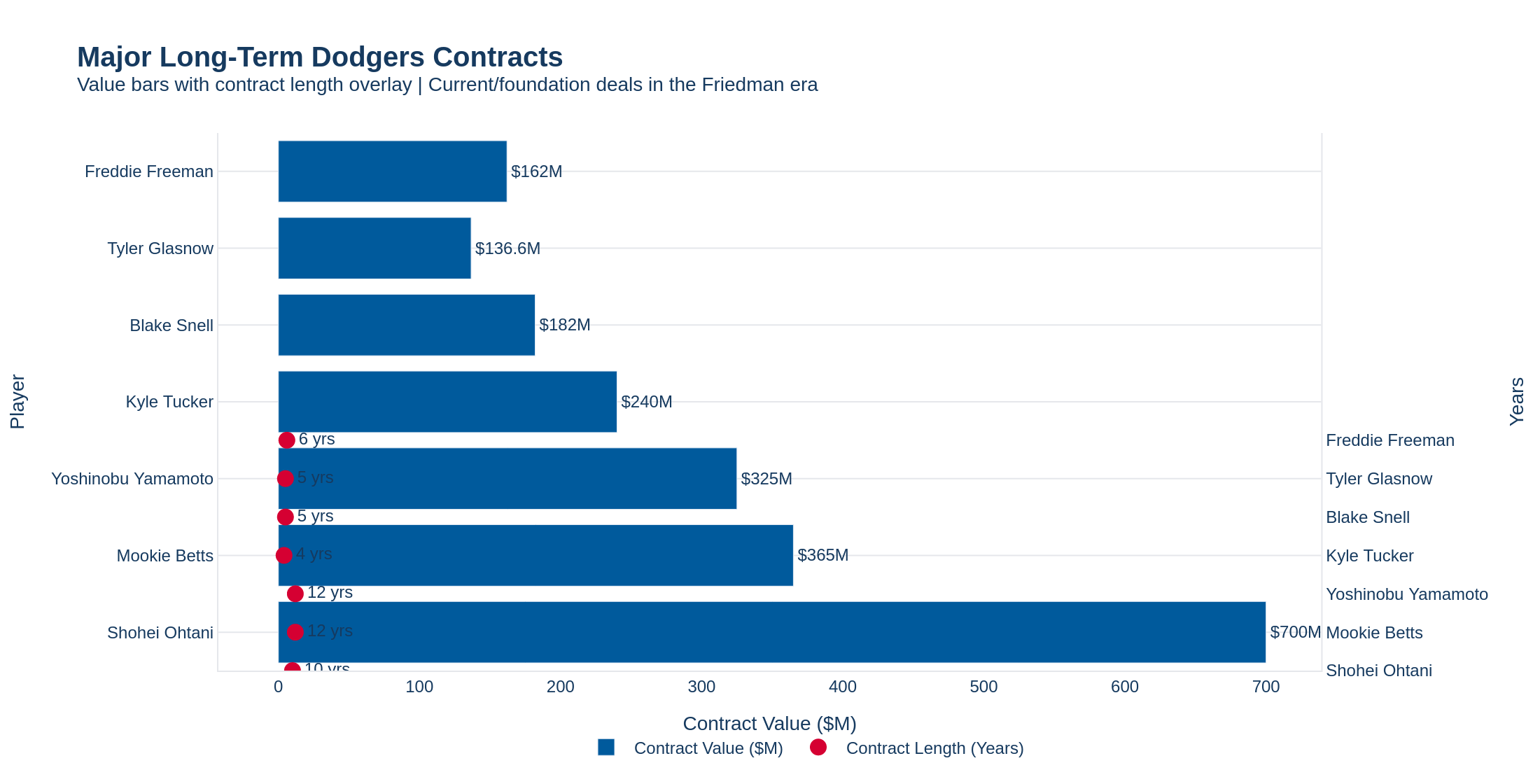
Chart 8 frames the sustainability question at the heart of the Friedman model's long-term assessment. The horizontal bar chart reveals the extraordinary concentration of long-duration, high-value commitments: Ohtani's $700M over ten years anchors the left end, followed by Yamamoto's twelve-year, $325M commitment — the longest-term contract in the history. Both commitments extend well into the 2030s, meaning the Dodgers are locked into record payrolls for most of the coming decade. Betts' $365M and Tucker's deal add further long-term obligations. The chart does not adjudicate whether this model is ultimately wise; it simply illustrates the financial ambition, and arguably the financial courage, required to construct a modern baseball dynasty. Whether the model proves prescient or profligate will ultimately be determined by how many additional championships it delivers.
Part V: The Verdict — Objective Letter Grades
The grades on the front-loaded verdict box are assigned based on the complete evidentiary record documented in this article, with reference to three evaluation axes: (1) vision and strategy — the quality of the decisions made; (2) execution — the degree to which stated objectives were achieved; and (3) accountability — honest assessment of failures alongside successes. The back-to-back World Series championships of 2024 and 2025 are treated as the primary validation metric, but the three anomalous first-round exits are included without mitigation as evidence of genuine failure that must be incorporated into a complete accounting.
Category-Level Breakdown
| Category | Friedman Grade | Roberts Grade | Key Evidence |
|---|---|---|---|
| Vision & Philosophy | A+ | A | Process doctrine; team culture; winning system |
| Championship Delivery | A+ | A+ | 3 WS titles, 5 pennants in 10 seasons |
| Regular-Season Management | A+ | A+ | .621 W%, 9 division titles, 111-win season |
| Postseason Performance | A− | B+ | 3 early exits as heavy favorites undercut otherwise elite record |
| Financial Management | A− | N/A | Historic investment, deferred structures, record tax bills |
| Player Development | A+ | N/A | #1 farm by executives' poll; sustained pipeline depth |
| Roster Construction | A+ | N/A | Betts, Freeman, Ohtani, Yamamoto, Tucker acquisitions |
| Clubhouse & Culture | A | A | Premier player destination; consistent morale and leadership |
| 2026 Positioning | A | A | 21–13 start, managed Betts injury effectively |
Table 2 — Friedman and Roberts: category-level evaluation matrix.
Conclusion: Is the Spending Model Validated?
The central question this article posed is direct: does an accumulated investment of more than $1.5 billion in four cornerstone players, combined with record-shattering luxury tax obligations projected to exceed $169 million in a single season, represent sound organizational stewardship? The answer, as of May 2026, is yes — but with important qualifications that distinguish the current assessment from a permanent verdict.
The affirmative case rests on the most fundamental currency in professional sports: championships. The Dodgers have won back-to-back World Series titles in 2024 and 2025, the first franchise to do so since the 1998–2000 New York Yankees and the only one to manage it under MLB's current revenue-sharing and luxury-tax structure — a structure specifically designed to prevent the kind of sustained dominance the Dodgers have produced. They have done so with players whose individual performances have validated their contract values: Ohtani's back-to-back 50-plus home run seasons (54 in 2024, 55 in 2025) and three consecutive unanimous MVP awards directly justify the largest contract ever signed; Yamamoto's 2025 World Series MVP performance — 3-0 with a 1.02 ERA and the historic Game 6 / Game 7 double — validates a twelve-year commitment in only its second season; Freeman's four consecutive World Series home runs in 2024 and walk-off heroics across two consecutive Fall Classics stand among the most celebrated individual performances in postseason history. The spending model has produced not merely wins but iconic, culturally resonant championship moments.
The qualifications are real. Three franchise-tier contracts with overlapping windows — Betts, Yamamoto, and the back-loaded Ohtani deal — create structural inflexibility that will test Friedman's ability to reload. The farm system's ability to replenish around an aging core will be the defining challenge of the 2028-2033 window. And the three first-round exits in 2019, 2022, and 2023 remain genuinely unresolved questions that a credible accountability framework cannot erase because championships followed. They happened. They cost real October baseball at the highest level. They revealed something about preparation or in-series deployment that the organization has worked to address but that any honest accounting must continue to mark.
But dynasties are ultimately judged by their championships, and the Dodgers have three in the past six years, five pennants in ten, and the highest regular-season winning percentage in AL/NL history. Set against the rest of this series — in which Stearns, Breslow, and Preller earned grades in the B−/B range for building competitive non-championship rosters, and Rob Thomson earned an A− for the highest Phillies winning percentage in franchise history — the Friedman-Roberts record stands above the scale this series has applied to other organizations. That is the most important single fact about the Los Angeles Dodgers of this era.
As the team pursues an unprecedented third consecutive championship in 2026, they do so from a position of organizational strength, financial commitment, and historical momentum that few franchises in any sport have ever occupied. Whether the three-peat arrives or not, the verdict on the first twelve years of the Friedman-Roberts partnership is already written: it is, by any rigorous measure, one of the most successful sustained runs of organizational performance in modern professional baseball.
Bottom Line: The Dodgers' spending model is validated by results within its first contract cycles, but demands continued scrutiny as long-term obligations mature. Friedman earns A+. Roberts earns A. The franchise earns its designation as the benchmark organization of its era — the standard against which the rest of this series' subjects must be measured.
All statistical data sourced from Baseball-Reference, FanGraphs, MLB.com, Cot's Baseball Contracts, Spotrac, and contemporaneous Los Angeles reporting through May 4, 2026. Pythagorean win projections calculated from RS/RA data using the formula RS²/(RS²+RA²) × 162. CBT payroll figures from Cot's Baseball Contracts and Spotrac. Farm system rankings from MLB Pipeline, Baseball America, ESPN, and The Athletic; the executive-poll #1 ranking from a March 2026 industry survey of MLB front-office executives. Contract figures from FanGraphs RosterResource and Spotrac. We invite informed disagreement: methodology, data, and editorial judgment can all be challenged via the contact form at /contact, and corrections are issued where warranted. This article is Article VII of the 2026 MLB front-office and managerial leadership accountability series.