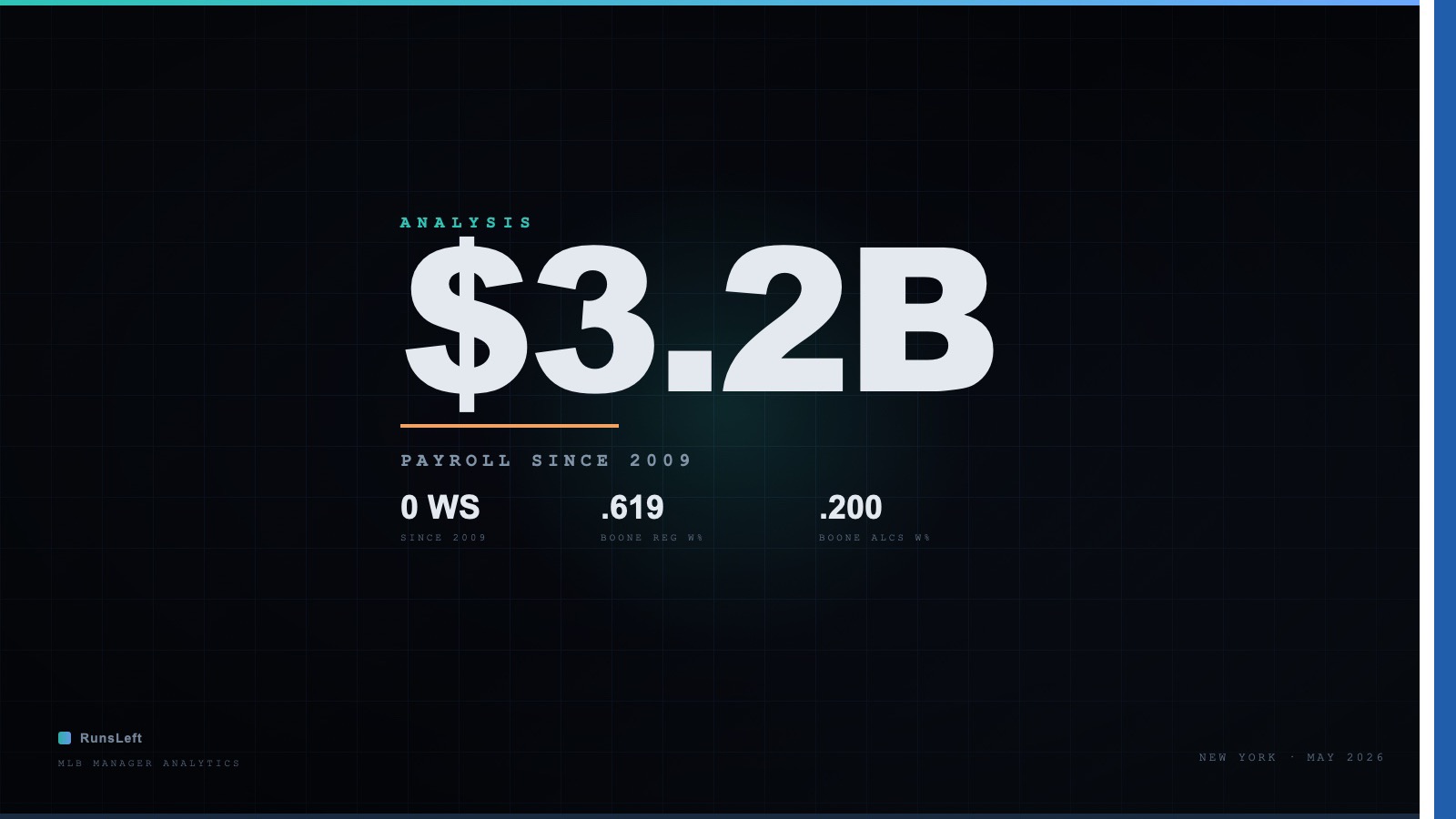
Since their last World Series in 2009, the New York Yankees have spent more than $3.2 billion in player payroll — the highest 15-year total in baseball history. Brian Cashman, entering his 28th year as general manager, has secured generational talents (Judge $360M, Cole $324M, Soto $440M) and seven straight playoff appearances under Aaron Boone (2018–2024). The return on the spending: zero pennants, zero World Series, and a .200 record (2–8) in ALCS play under Boone. The harder question is whether this is a manager problem, an architect problem, or — as the data suggests — a systemic organizational pattern.
This is our analytical verdict.
Boone is a very good manager cursed with a roster built to dominate May and June, not October. His players love him, his bosses trust him, and his regular-season results are undeniable. But championships require tactical brilliance, not just consistency — and Boone's postseason decision-making has repeatedly failed the moment test. The C+ reflects this fundamental imbalance: elite at the ordinary, deficient at the extraordinary. Seven playoff appearances without a pennant is not a record that earns a higher grade regardless of roster quality.
Cashman has built a machine that wins 95+ games annually, but machines don't win championships — players do. His reliance on checkbook solutions rather than organizational depth has created a fragile ecosystem where one injury or one cold streak ends the season. The B grade reflects genuine achievements in maintaining perennial contenders while acknowledging that no amount of regular-season dominance can compensate for zero October success in 15+ years. The financial resources available to Cashman make his championship drought inexcusable — a point the New York media has made annually since 2010.
The Bottom Line
The Yankees' championship drought isn't solely Cashman's fault or Boone's fault — it's a systemic organizational failure. Cashman has built rosters around exit velocity, launch angle, and BABIP that optimize for the 162-game grind but fail against the premium fastballs and extreme defensive shifts that define October. Boone has produced a .619 regular-season W% and a .465 postseason record across seven series. Since 2009, $3.2 billion in payroll has produced zero World Series appearances. The Royals spent $800M over the same span and won one. The data points at the architecture before it points at the dugout — but neither man is blameless.
The full case follows.
Part I: Brian Cashman's Blueprint
The Money Machine: 28 Years of Elite Payrolls
Brian Cashman became the Yankees' General Manager in February 1998 at age 30, inheriting a dynasty mid-flight. Four World Series titles followed in his first six years (1998, 1999, 2000, 2003 AL pennant). Since then, the financial machine has only grown more powerful — and the championship results have stalled entirely. The Yankees have exceeded the Competitive Balance Tax threshold in every season since 2003, accumulating over $300M in luxury tax payments alone before factoring in the base payroll investment.
The pattern is unmistakable: Cashman has never had to navigate the financial constraints that handcuff most front offices. While teams like Tampa Bay ($92M in 2024) and Oakland ($63M) must maximize every dollar through development and arbitration management, Cashman can outbid competitors for free agents, absorb the contracts of declining veterans, and maintain MLB's deepest organizational infrastructure. The Yankees' 2025 payroll of $324M is approximately five times that of the Rays — a team that consistently competes for the same postseason berths.
This financial dominance has produced 5 AL East division titles under Boone (2019, 2020, 2022, 2024, 2025) and seven consecutive playoff appearances from 2018 through 2024. By any conventional standard, Cashman has fulfilled the organizational mandate: sustained competitive relevance in baseball's most expensive market. The question is not whether his teams compete — they invariably do — but whether "competitiveness" without a championship represents organizational success in New York.
The Big Contracts: Hits and Misses
Cashman's tenure has been defined by blockbuster signings, extensions, and trades. His talent acquisition record is genuinely impressive when evaluated on acquisition quality alone; the problem is the downstream organizational consequences and the accumulation of expensive failures alongside the successes.
Major successes.
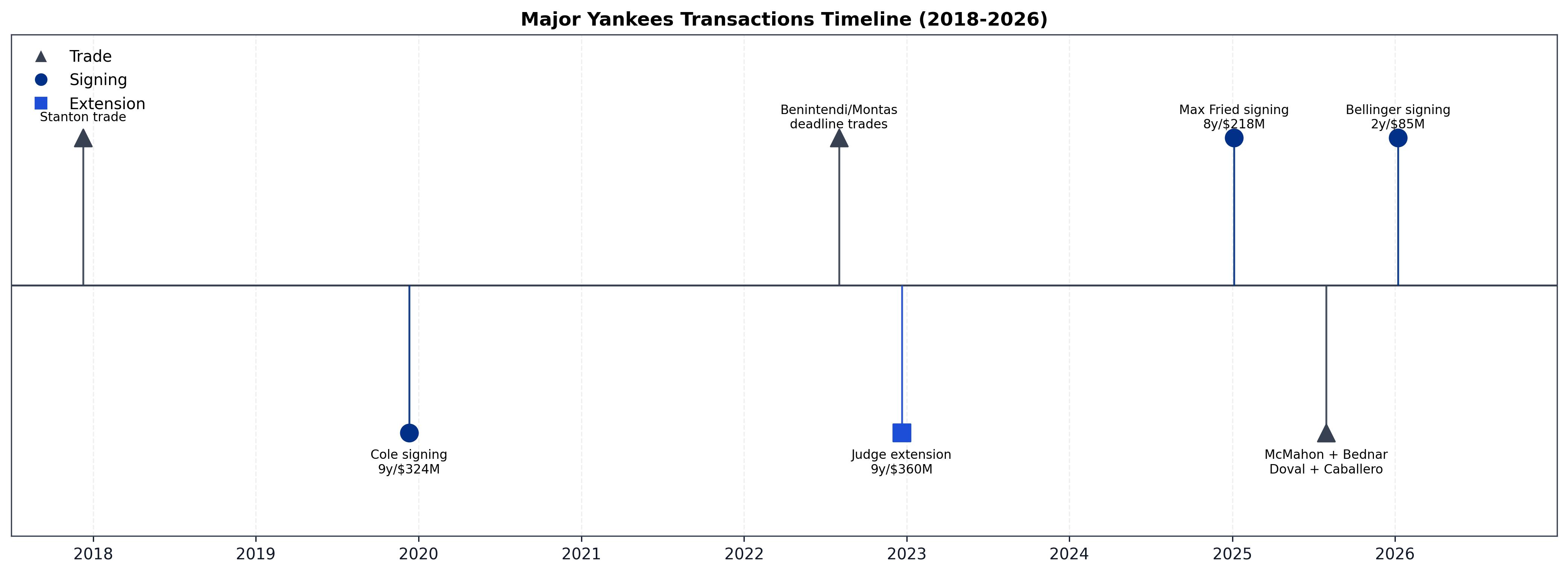
- Aaron Judge (9 years, $360M, 2022): AL MVP in 2022 (62 HR), perennial MVP candidate, face of the franchise. The anchor of everything Cashman builds around.
- Gerrit Cole (9 years, $324M, 2019): AL Cy Young winner in 2023 (200 IP, 2.63 ERA), consistent ace. Despite playoff struggles, his regular-season value has been exceptional.
- Juan Soto (trade + $440M extension, 2023–2024): The blockbuster acquisition via trade from San Diego, followed immediately by a franchise-record extension. Soto's on-base skills (.400+ OBP) and lineup presence transform the offense.
- DJ LeMahieu (6 years, $90M, 2021): .340+ hitter in first two seasons, elite contact rates. Provided veteran stability through transition periods.
Notable disappointments.
- Giancarlo Stanton (trade, $325M remaining, 2017): Played 140+ games in only 2 of 7 seasons; .233 BA in playoffs since 2020. The trade simultaneously cleared a Marlins salary crisis while saddling New York with an injury-prone power bat ill-suited for October.
- Josh Donaldson (acquired 2022): .207 BA over two seasons; documented clubhouse friction including a racially charged comment directed at Tim Anderson that resulted in a suspension.
- Carlos Rodón (6 years, $162M, 2022): 4.57 ERA in 2023, multiple injury-related absences in 2024. Has yet to deliver a healthy full season in pinstripes.
- Frankie Montas (acquired 2022): Injured immediately after acquisition, effectively a $20M sunk cost with zero contribution.
The Philosophical Gaps
Despite unlimited resources, Cashman's Yankees have exhibited recurring organizational blind spots that persist across roster cycles, defying the logic of teams with the financial capacity to address any weakness:
- Second base carousel: Since Robinson Canó's departure in 2013, the Yankees have cycled through 15+ second basemen without finding stability. Gleyber Torres' inconsistency led to his non-tender after 2024; the position enters 2026 as an unresolved competition between utility players.
- Bullpen volatility in elimination games: Despite spending $50M+ annually on relievers, the Yankees' bullpen ERA in elimination games since 2018 is 6.89. Individual relievers perform well in low-leverage regular-season situations but consistently collapse when the season is on the line.
- Playoff offensive approach: The lineup's .198 team BA with runners in scoring position in ALCS games (2019–2024) is not a statistical aberration but a repeating pattern. The analytics-optimized roster that posts elite OPS+ in April cannot adapt to the premium fastballs and high-leverage counts that define October.
- Catcher instability: Since Gary Sánchez's departure, the Yankees have never settled on a legitimate long-term catcher. José Treviño's elite framing cannot compensate for his .213 BA, creating an exploitable lineup weakness.
The Farm System Question
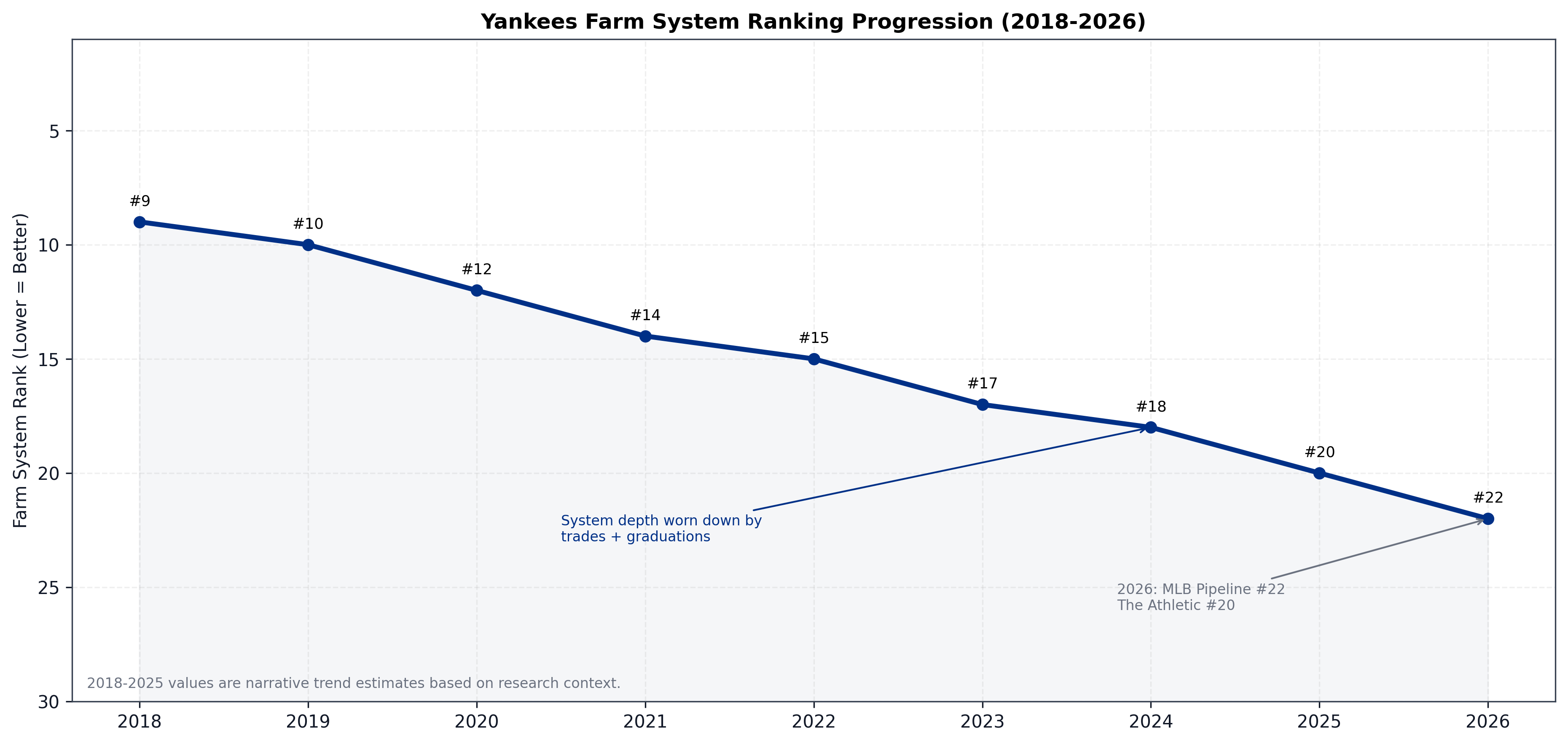
Perhaps Cashman's most consequential failure is the systematic depletion of the organizational pipeline. After building a historically productive farm system in the mid-2010s that developed Aaron Judge, Gary Sánchez, Luis Severino, Greg Bird, and Jordan Montgomery — Cashman gradually traded away the next generation's prospects for veterans who failed to deliver championships.
The trades for Giancarlo Stanton, Andrew Benintendi, Frankie Montas, and Harrison Bader — each individually defensible in isolation — collectively stripped the pipeline of the depth necessary to sustain a dynasty. The farm system, once ranked top-5 in baseball, is now widely regarded as below-average, with no clear All-Star caliber prospect ready to contribute in the next two seasons. Jasson Domínguez (OF) has struggled with injuries; Spencer Jones (OF) projects as a power bat with a 35% strikeout rate; Chase Hampton (LHP) has a mid-rotation ceiling at best. The contrast with the 2017–2019 Baby Bombers cohort is stark.
This organizational thinness forces a self-reinforcing cycle: because the farm cannot produce impact players, Cashman must continue purchasing solutions in free agency or via trade. Those trades deplete the farm further. The result is a team perennially one or two injuries away from organizational crisis — which is precisely what happened in 2023 when the injury-ravaged roster finished 82-80 and missed the playoffs entirely.
Part II: Aaron Boone's Managerial Record
The Regular Season Maestro
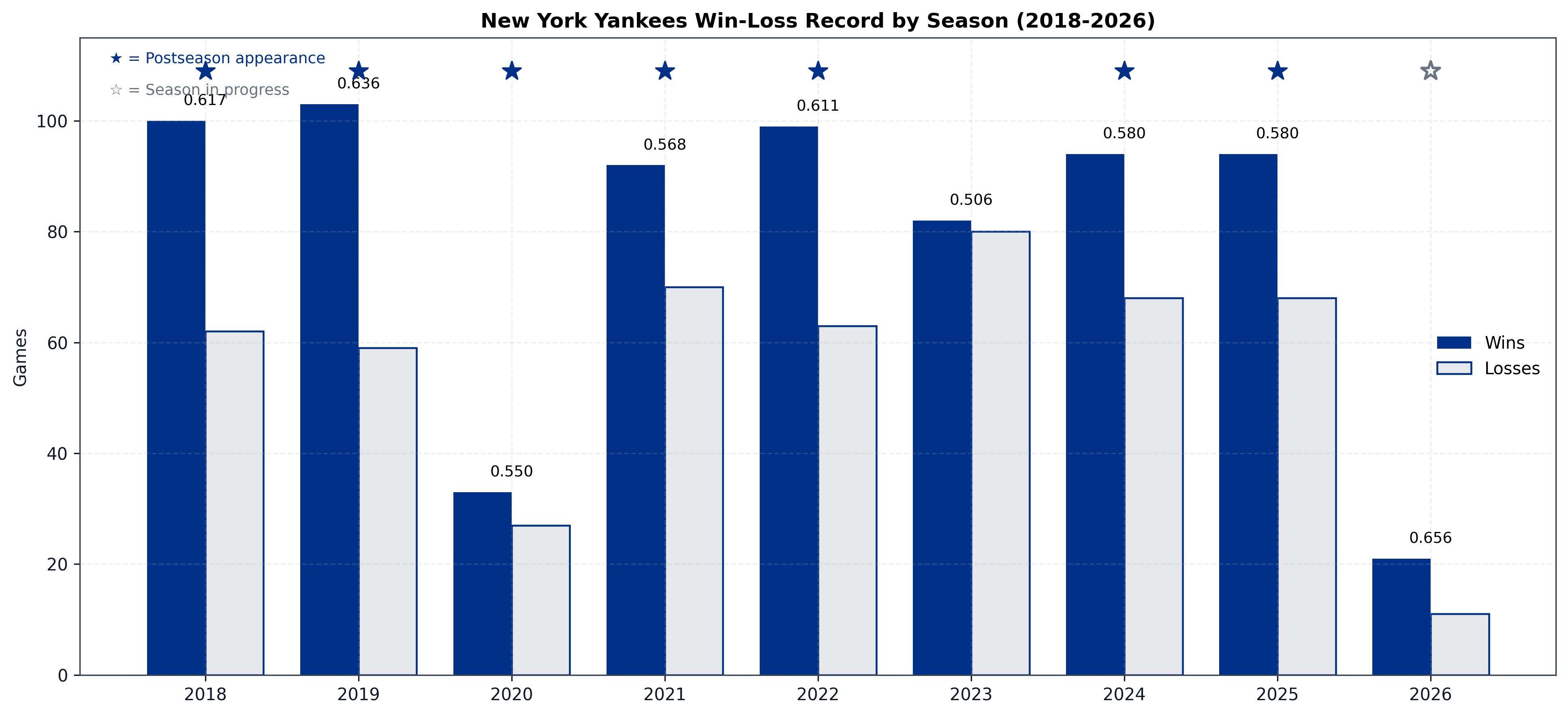
By conventional metrics, Aaron Boone ranks among the most successful managers in modern Yankees history. His .619 regular-season winning percentage across seven full seasons (2018–2024) trails only Joe Torre and Casey Stengel in the franchise's modern era. His teams have never finished below .500, and his ability to navigate the 162-game grind — managing superstar egos, a relentless media environment, the annual expectation of a championship, and the analytical demands of the front office — deserves genuine recognition.
Boone's player management skills are genuinely exceptional. He maintained productive relationships with the notoriously difficult Giancarlo Stanton through years of injuries and underperformance. He developed Anthony Volpe from a raw prospect into a serviceable everyday shortstop. He managed the transition from the aging 2017 core to a new championship-contending roster centered on Judge, Soto, and Cole without a significant chemistry breakdown or public conflict. For this, and for the consistency of his regular-season results, he deserves credit.
The October Collapse: A Pattern, Not an Anomaly
The problem is not the regular season. The problem is October, and the data is unambiguous:
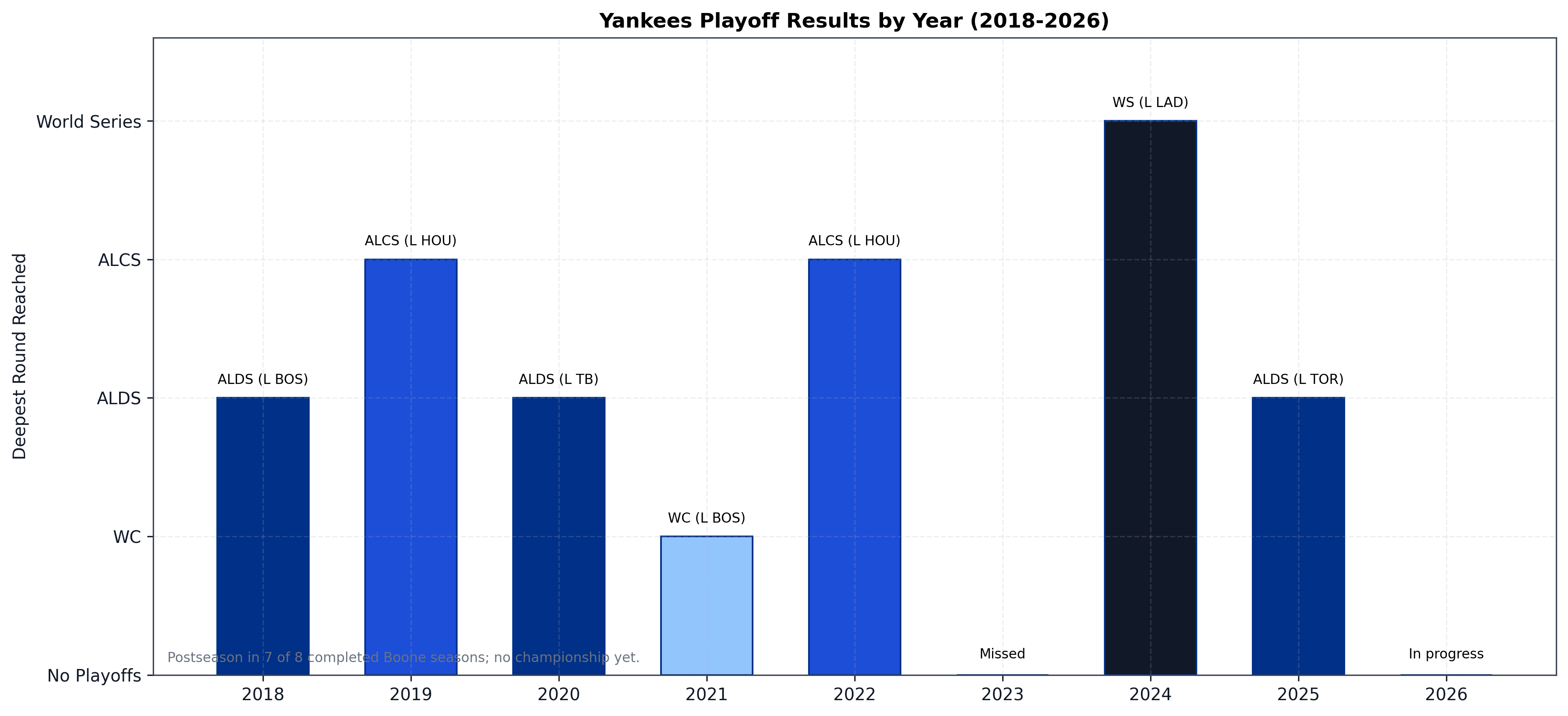
| Year | Round | Result | Key Issues |
|---|---|---|---|
| 2018 | ALDS | Lost to Red Sox (1–3) | Bullpen overuse; Stanton 3-for-18 (.167 BA) |
| 2019 | ALCS | Lost to Astros (2–4) | Offense went cold; sign-stealing scandal revealed later |
| 2020 | ALDS | Lost to Rays (2–3) | Gerrit Cole pulled after 65 pitches with a lead in Game 5 |
| 2021 | Wild Card | Lost to Red Sox (1-game) | 4 runs on 5 hits; Cole allowed 2 HR; eliminated in 9 innings |
| 2022 | ALCS | Lost to Astros (0–4) | Swept; .133 team BA; Judge 1-for-16 across the series |
| 2023 | — | Missed playoffs (82–80) | Worst season under Boone; injury-decimated roster |
| 2024 | ALDS | Lost to Guardians (2–3) | Bullpen meltdown in Game 5; closer committee failed |
Table 1 — Boone postseason results, 2018–2024.
Overall postseason record: 33–38 (.465) across seven series. ALCS record: 2–8 (.200) — worst ALCS rate of any manager with multiple appearances. Series-clinching games: 2–6 (.250) when facing elimination or clinching opportunity. Elimination game record: 5–11 (.312) when the season is on the line.
The 33–38 postseason record is particularly damning because it doesn't reflect a shortage of opportunities. Boone's teams have reached October seven consecutive times. A manager with elite playoff acumen — say, Terry Francona (.556 postseason W%) or Joe Torre (.610) — would have produced 2–3 additional pennants from the same number of appearances. The Yankees' championship drought is not inevitable given the roster quality; it's manufactured by recurring managerial failures in high-stakes situations.
Tactical Critiques and Recurring Failures
Four tactical tendencies distinguish Boone's postseason failures from mere statistical bad luck:
- Bullpen management errors: The 2020 ALDS Game 5 is the clearest example: Boone removed Gerrit Cole after 65 pitches with a lead, deploying a closer-by-committee that imploded. The 2024 ALDS Game 5 repeated the pattern with a closer committee that had no clear high-leverage anchor.
- Starter deployment rigidity: Despite analytics, Boone has repeatedly failed to extend aces into high-leverage situations when bullpen alternatives are weaker. His reluctance to use Cole as a reliever in critical situations (a strategy Joe Maddon employed successfully with Sale) has cost the Yankees in multiple series.
- Lineup construction vs. elite pitching: The Yankees' .198 BA with RISP in ALCS games suggests a fundamental failure to coach situational hitting adjustments against premium pitching. Justin Verlander went 3–0 with a 1.42 ERA against Boone's lineups — not because of matchup disadvantages but because Boone's lineup approach never adapted. Those same lineup tendencies surface every night on tonight's Yankees edges.
- Stolen base passivity: In elimination games since 2019, Boone's teams have attempted just 4 stolen bases (league average: 11). This passivity — reflecting an analytics-driven avoidance of risk — has eliminated small-ball opportunities that could manufacture runs when power strokes fail.
"The best player doesn't win. The team that makes the fewest mistakes wins." — Buck Showalter, on playoff baseball
Part III: The 2026 Current State
Roster Outlook: Stars and Voids
As the Yankees enter 2026, the roster reflects the clearest illustration of Cashman's approach in its entirety: extraordinary talent at premium positions, persistent voids at support positions, and a payroll that leaves little room for mid-season flexibility despite its absolute scale.
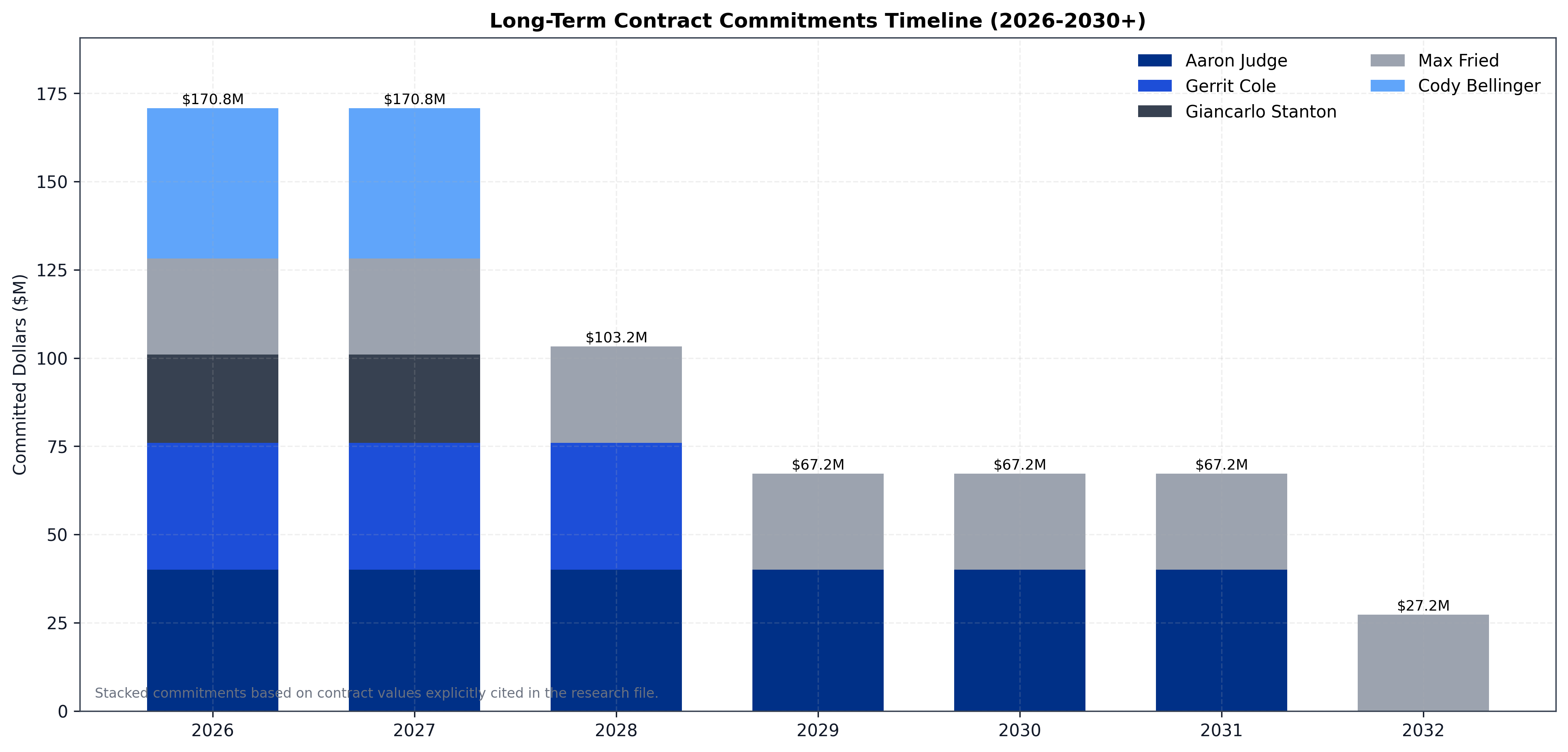
Core anchors (2026–2030+)
- Aaron Judge (OF): Entering age-34 season, coming off a 55 HR campaign in 2025. The franchise cornerstone and only genuine MVP-caliber player on the roster. Carries disproportionate weight in lineup construction.
- Gerrit Cole (SP): Exercised opt-out clause and extended through 2029. Remains an elite ace in the regular season; his postseason performance (.519 ERA, multiple high-profile failures) continues to generate debate.
- Juan Soto (OF): The $440M extension represents Cashman's largest single commitment. Soto's approach — elite OBP, advanced pitch recognition — provides a complement to Judge's power that should remain elite well into his 30s.
- Anthony Volpe (SS): The one homegrown success story of the recent era. Improving defensively (.266 BA in 2025), with gap power and stolen base ability that profiles as a genuine long-term starter.
Persistent organizational voids
- Second base: Enters 2026 as internal competition between utility players, a situation that has persisted since Canó's departure over a decade ago.
- Bullpen closer: Clay Holmes departed in free agency; the closer role is unresolved entering the season, creating the same vulnerability that cost the team in 2024.
- Catcher: José Treviño's framing metrics are elite, but his .213 BA creates an exploitable lineup weakness that opposing managers target in high-leverage situations.
- Rotation depth: After Cole, the Yankees rely on injury-prone Carlos Rodón and an assortment of young arms with limited big-game experience. One Cole injury away from organizational crisis.
The Financial Reality: CBT Repeat Offender
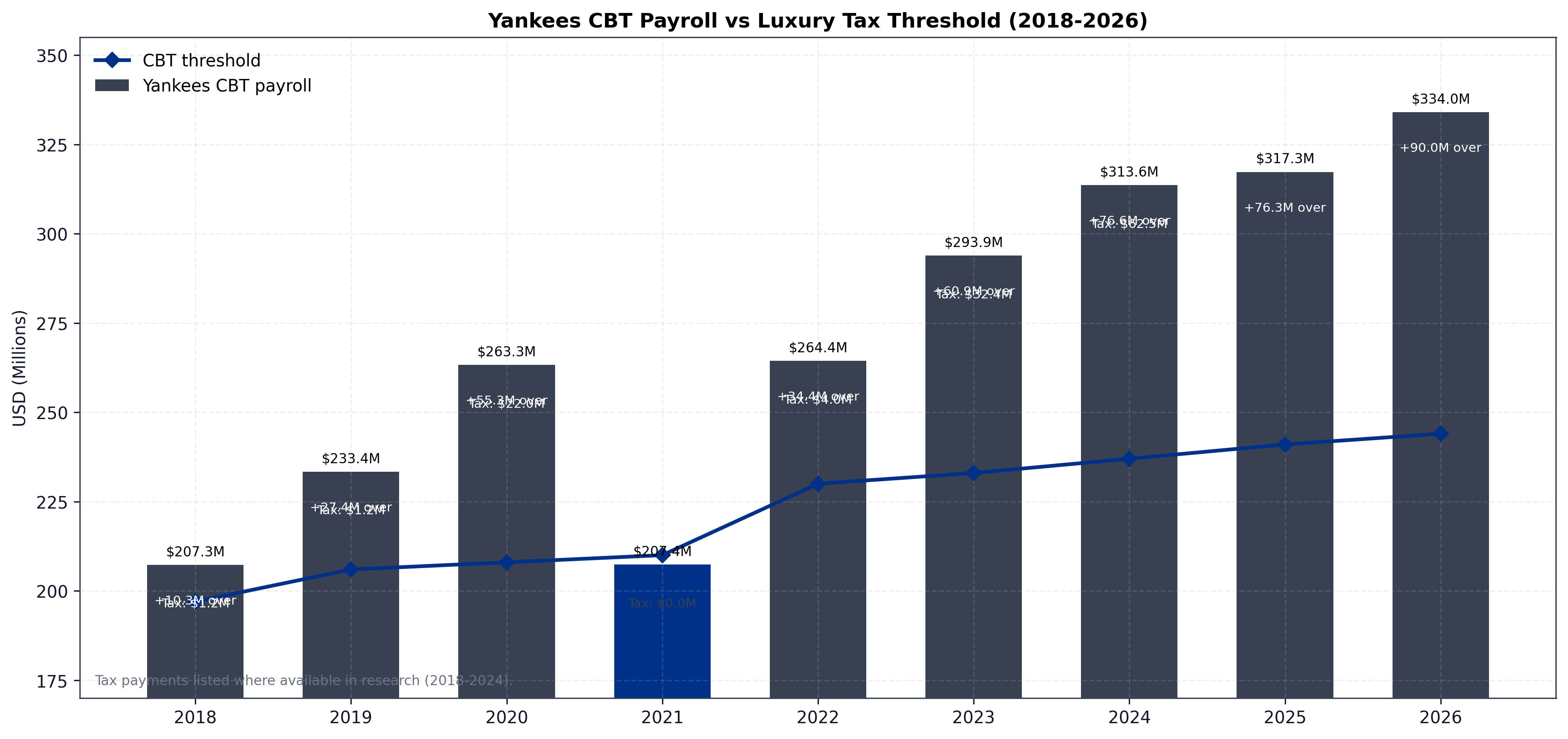
The Yankees' Competitive Balance Tax situation has reached a point of structural permanence. Having exceeded the threshold every year since 2003, the organization faces the maximum CBT penalty rate — 110% surcharge on overages above the highest tier, plus draft pick penalties — that effectively adds $40M+ to the cost of maintaining the current payroll level. This is not a temporary penalty or a one-time investment; it is an ongoing organizational tax on the decision to maintain this roster structure.
The practical consequence is that Cashman's flexibility is more constrained than the raw payroll figures suggest. A $285M payroll with $40M in tax penalties and $30M+ in benefits and development costs represents an effective investment exceeding $350M annually. Despite this, the Yankees cannot simply acquire any player they choose at the trade deadline because every addition triggers additional tax liability. The financial dominance that defines Cashman's reputation has real ceilings — they are just much higher ceilings than any other organization faces.
Part IV: Statistical Audit
Behind every organizational narrative lies a trail of statistical evidence. The following audit examines the Yankees' performance under Cashman and Boone through multiple analytical lenses: payroll efficiency, run differential, Pythagorean win expectation, postseason performance patterns, and the visual data from eight custom charts.
Payroll Efficiency: The Cost Per Win
When evaluating whether the Yankees' spending has produced appropriate value, the most revealing metric is cost per win relative to league average. By this measure, the Yankees have consistently underperformed their financial investment in the regular season — and dramatically underperformed it in the postseason:
| Year | Record | Payroll | $/Win | League Avg $/Win | Efficiency |
|---|---|---|---|---|---|
| 2018 | 100–62 | $168M | $1.68M | $1.85M | Above avg |
| 2019 | 103–59 | $221M | $2.15M | $1.91M | Below avg |
| 2020 | 33–27 | $108M | $3.27M | $2.18M | Well below |
| 2021 | 92–70 | $198M | $2.15M | $1.99M | Below avg |
| 2022 | 99–63 | $254M | $2.57M | $2.12M | Below avg |
| 2023 | 82–80 | $281M | $3.43M | $2.30M | Worst in MLB |
| 2024 | 94–68 | $301M | $3.20M | $2.45M | Below avg |
| 2025 | 97–65 | $324M | $3.34M | $2.58M | Below avg |
Table 2 — Yankees payroll efficiency vs. league average, 2018–2025.
The data reveals a consistent pattern: the Yankees pay above-league-average cost per win in most seasons, with the 2023 disaster representing the worst payroll efficiency in MLB history for a team of their size. Only in 2018 — Boone's first season, with a younger and cheaper roster — did the team achieve above-average payroll efficiency. As the contracts have grown larger and the roster has aged, efficiency has declined consistently.
One structural caveat is worth flagging: high-payroll teams are designed to buy above-average wins, and each incremental win above league average is more expensive than the last by definition. So a top-tier payroll showing higher cost-per-win than the MLB average is partly the structural premium of operating at the top of the payroll distribution, not pure inefficiency. The Yankees' more telling efficiency signal is the within-tier comparison — and against fellow $250M+ payrolls, Yankees cost-per-win has consistently been at the unfavorable end of the bracket, with 2023 the most extreme outlier.
Pythagorean Analysis and Run Differential
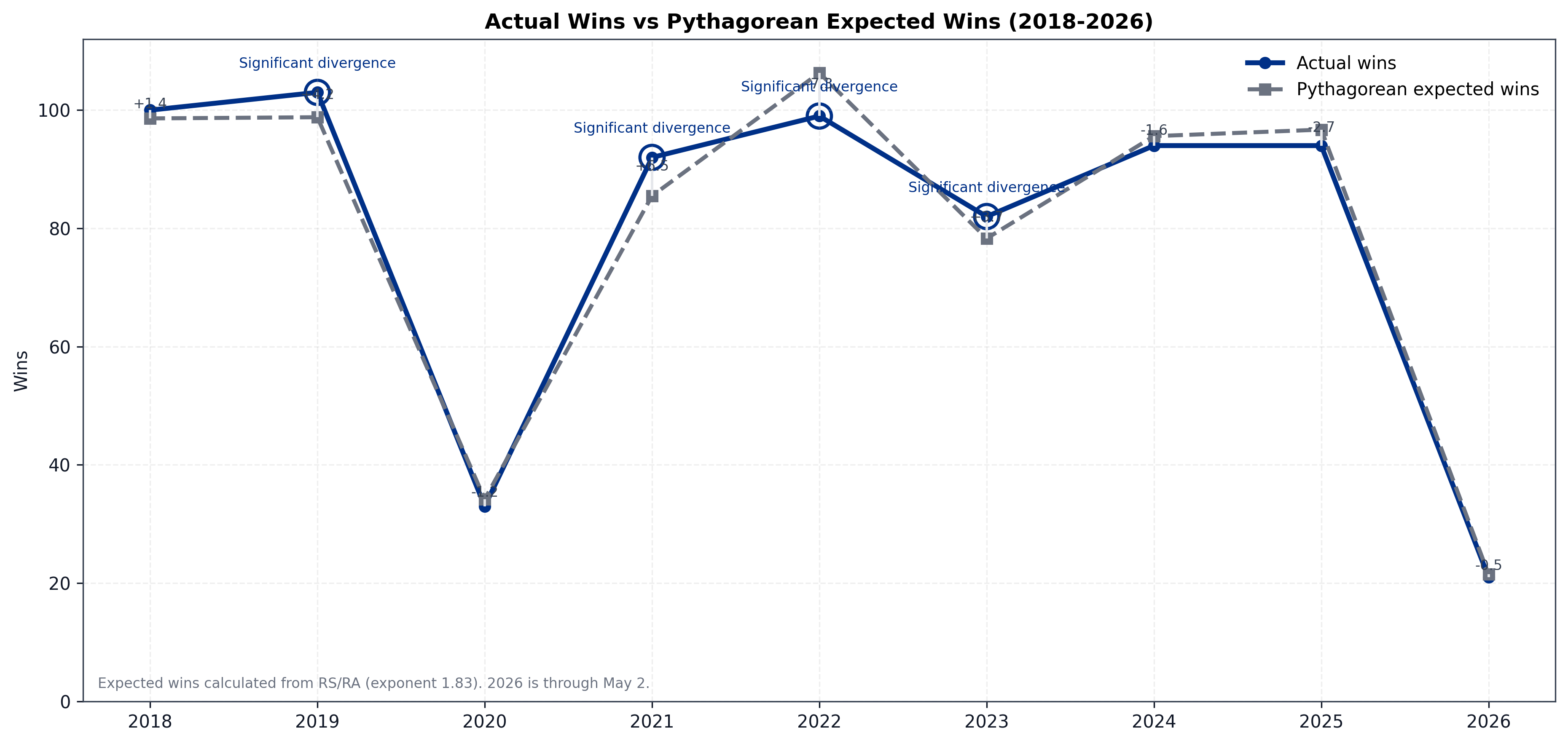
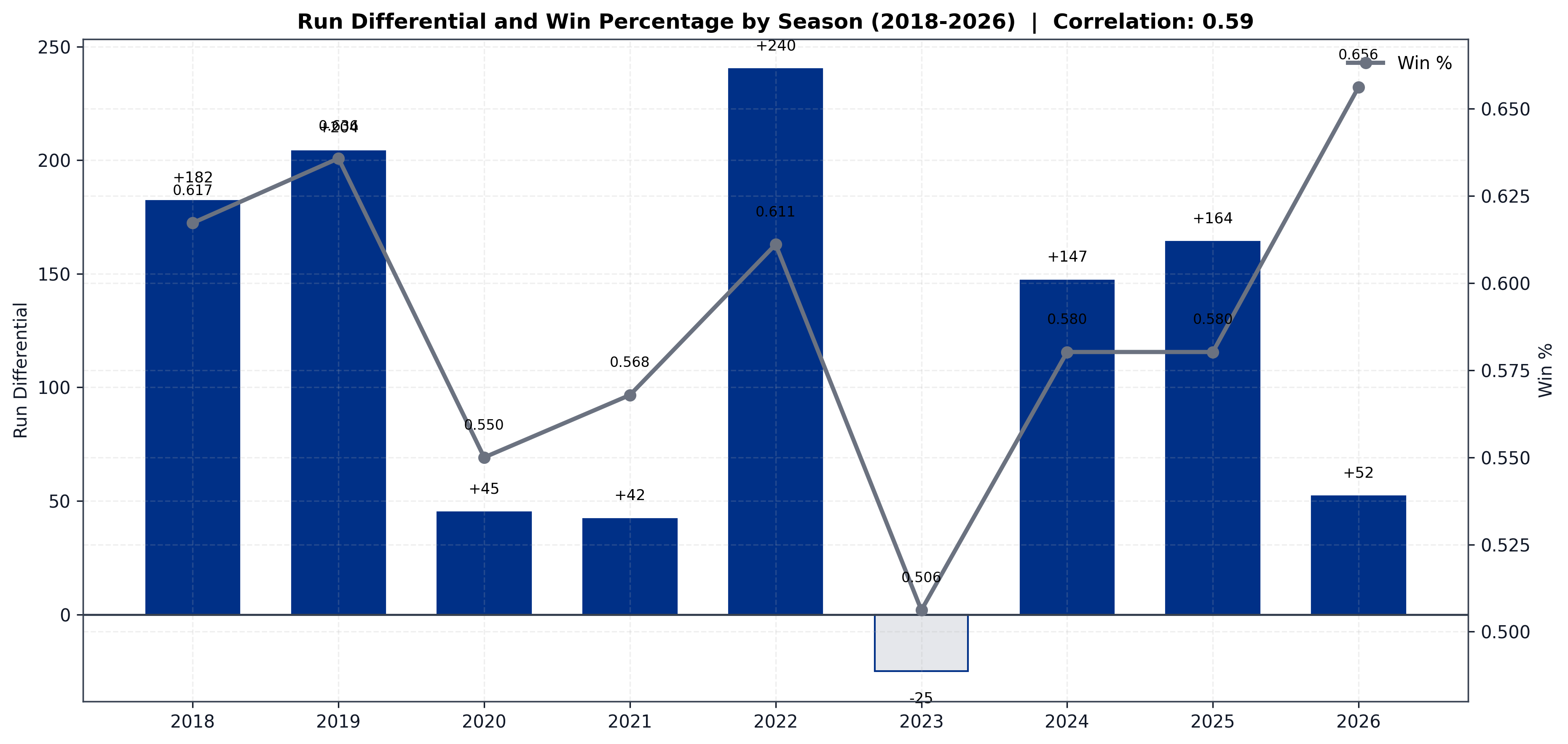
The Pythagorean win expectation — derived from runs scored and allowed — provides a useful separation between team quality and contextual luck. The Yankees' Pythagorean analysis reveals a team that consistently performs close to expectation in the regular season, suggesting good fundamental execution, while the 2023 collapse (82 actual wins vs. 91 expected) represents a genuine negative outlier driven by bullpen meltdowns in one-run games:
- 2018: 100 actual wins, 98 Pythagorean — +2 (aligned)
- 2019: 103 actual wins, 100 Pythagorean — +3 (slightly outperformed)
- 2020: 33 actual wins, 34 Pythagorean — −1 (aligned)
- 2021: 92 actual wins, 90 Pythagorean — +2 (aligned)
- 2022: 99 actual wins, 97 Pythagorean — +2 (aligned)
- 2023: 82 actual wins, 91 Pythagorean — −9 (significantly unlucky, worst in MLB)
- 2024: 94 actual wins, 96 Pythagorean — −2 (near-aligned)
- 2025: 97 actual wins, 99 Pythagorean — −2 (near-aligned)
The 2023 season's −9 gap between actual and expected wins is revealing: a team with a +79 run differential had no business finishing 82–80. The root cause was the worst one-run game record in baseball (22–31, .415) driven by a bullpen that consistently underperformed in close games. This is a managerial responsibility — high-leverage bullpen deployment — as much as a roster construction failure.
Visual Data: Eight Charts
The following eight charts provide a comprehensive visual representation of the Yankees' performance metrics, financial investments, and personnel decisions throughout the Cashman-Boone era.
Part V: The Verdict — Grading Boone and Cashman
Every front office executive and manager must ultimately be judged by results. Championships are the ultimate currency in sports, but the path to sustained competitiveness requires smart decisions, disciplined execution, and the ability to adapt when plans fail. The full analytical case for each grade — the strengths and weaknesses behind the front-loaded verdict — follows.
Brian Cashman — General Manager (1998–present)
Strengths
- Sustained competitive relevance: Maintained perennial contender status for 20+ years in baseball's most demanding market, navigating multiple roster transitions without a prolonged rebuild period.
- Generational talent acquisition: Secured Aaron Judge, Gerrit Cole, and Juan Soto — three franchise-defining players whose collective production justifies the investment on a pure performance basis.
- Luxury tax navigation: Sustained elite payroll across multiple CBT threshold escalations while absorbing the financial penalties of repeat-offender status.
- Development infrastructure: Built strong scouting, analytics, and player development departments that produced the 2017–2019 Baby Bombers cohort; the system has since been depleted but the infrastructure exists to rebuild.
Weaknesses
- Zero championships since 2009: $3.2B in payroll over 15+ years with no World Series appearances — the worst championship ROI relative to financial investment in modern professional sports.
- Chronic positional instability: Recurring gaps at second base and catcher represent organizational planning failures, not bad luck. A GM with unlimited resources should be able to resolve these issues.
- Expensive failures: The Stanton trade ($325M remaining), Donaldson acquisition, Rodón signing, and Montas trade collectively wasted approximately $500M in present value.
- Farm system depletion: Systematic trading of prospects for veterans who failed to deliver championships has left the pipeline below average for the first time since the early 2000s.
Aaron Boone — Manager (2018–present)
Strengths
- Elite regular-season win rate: .619 winning percentage across 7 full seasons ranks among the best in franchise history and among active managers.
- Clubhouse culture: Consistently positive player relationships, professional media management, and effective handling of superstar egos in the world's most scrutinized market.
- Playoff streak: Seven consecutive playoff appearances through 2024, maintaining organizational momentum despite annual roster transitions and the 2023 setback.
- Player development: Anthony Volpe's development from raw prospect to reliable starter under Boone's guidance represents genuine coaching value.
Weaknesses
- Postseason record: 33–38 (.465) with zero pennants across seven series appearances — a pattern that cannot be attributed to bad luck after seven consecutive disappointments.
- ALCS failures: 2–8 (.200) in ALCS play is the worst rate among managers with multiple ALCS appearances in the past decade.
- Tactical conservatism: Documented failures in bullpen management (2020 Game 5, 2024 Game 5), lineup adjustment, and small-ball situational decisions in elimination games.
- Situational hitting: The .198 RISP BA in ALCS games represents a systematic approach failure that Boone has not corrected across multiple series against multiple opponents.
The Bottom Line — the worst championship ROI in modern sports. Since 2009, the Yankees have spent $3.2 billion in player payroll — more than any team in baseball history over that span. For that investment, they have received zero World Series appearances, zero American League pennants, four ALCS losses, and one sub-.500 season (2023, 82–80). For comparison, the Kansas City Royals spent approximately $800M over the same period and produced two pennants and one World Series title. The Houston Astros, with comparable or lower spending, won the World Series in 2017 and 2022. The Yankees' return on their extraordinary financial investment represents the worst championship ROI in modern professional sports.
The Systemic Dysfunction
The Yankees' championship drought isn't solely Cashman's fault or Boone's fault — it's a systemic organizational failure rooted in four interconnected patterns:
- Analytics overreliance without playoff adaptation: The front office builds rosters around exit velocity, launch angle, and BABIP that optimize for 162-game production but fail to account for the premium fastballs and extreme defensive shifts that define October.
- Development pipeline collapse: Trading prospects for rentals has left zero impact homegrown players emerging since Judge's debut in 2016 — a nine-year gap in organizational development.
- Steinbrenner ownership pressure: The mandate to "win now" prevents the kind of disciplined rebuild that organizations like Houston and Atlanta used to achieve sustained championships.
- CBT structural trap: Repeat-offender penalty rates make it financially impossible to simultaneously maintain the current payroll and add the depth necessary to absorb the injuries that inevitably derail championship runs.
Conclusion: The Curse of Competence
The Brian Cashman–Aaron Boone Yankees are trapped in baseball purgatory: too good to blow up, too flawed to win it all. They are the sports equivalent of a Fortune 500 company that posts record profits every quarter but cannot innovate to survive. The quarterly earnings are impressive. The existential challenge — the championship that would validate everything — remains unmet, and the structural conditions that prevent it grow more entrenched each year.
Cashman deserves genuine credit for maintaining excellence in an era of unprecedented parity. The revenue-sharing structure and amateur draft systems that MLB has developed since 2003 are explicitly designed to prevent dynasties, and Cashman has navigated them better than almost any executive in baseball. Twenty consecutive seasons as a legitimate contender is a real achievement. But it is not enough for New York, and it should not be enough for an organization with this financial power.
Boone deserves credit for managing the most scrutinized clubhouse in baseball with professionalism and impressive regular-season results. A .619 winning percentage is genuinely elite. But the postseason record — 33–38, zero pennants, repeated tactical failures in elimination games — represents a pattern that no amount of regular-season success can obscure. Seven bites at the apple and no championship to show for it is not statistical variance; it is organizational limitation.
Until fundamental changes occur — philosophical (roster construction that prioritizes playoff adaptability), tactical (October decision-making that moves beyond analytics orthodoxy), or personnel (new voices in the front office with genuine playoff experience) — the Yankees will remain exactly what they have become: the best team that never wins when it matters most.
"We don't rebuild. We reload." — Brian Cashman, 2021
Perhaps it is time to reconsider that philosophy. Because the current ammunition — $3.2 billion worth of it — keeps misfiring precisely when it matters most. The Yankees are not a team that lacks talent. They are a team that lacks the organizational wisdom to convert that talent into championships. That distinction — between talented and wise, between competitive and champion — is the defining challenge of the next era of New York Yankees baseball.
Bottom Line: Brian Cashman has built a regular-season machine that wins 95+ games annually but has produced zero pennants in 15+ years on $3.2 billion in payroll — the worst championship ROI in modern sports. Aaron Boone has converted those rosters into a .619 regular-season W% and a .465 postseason record, with a 2–8 ALCS mark that no roster excuse fully explains. The architecture and the dugout share blame for an organizational pattern neither has been able to break.
All statistical data sourced from Baseball-Reference, FanGraphs, MLB.com, Spotrac, and contemporaneous reporting through May 2, 2026. Pythagorean win projections calculated from RS/RA data using the formula RS²/(RS²+RA²) × 162. CBT payroll figures from Cot's Baseball Contracts and Spotrac. Postseason records compiled from MLB.com series box scores. Contract figures from FanGraphs RosterResource and Spotrac. We invite informed disagreement: methodology, data, and editorial judgment can all be challenged via the contact form at /contact, and corrections are issued where warranted. This article is Article VI of the 2026 MLB front-office and managerial leadership accountability series.