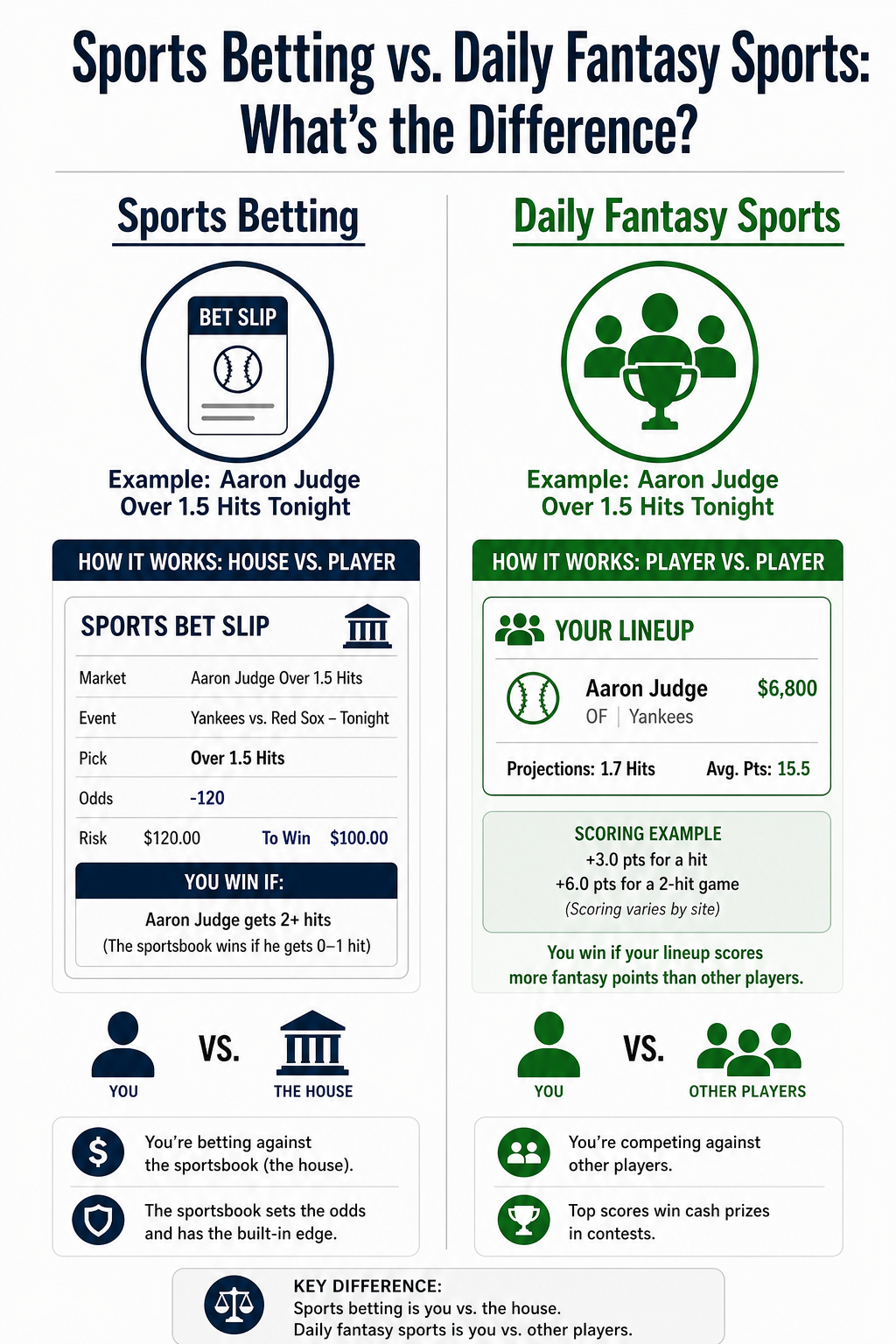
Walk into a baseball-fan Discord and ask whether sports betting and daily fantasy sports are the same thing, and you'll get answers in both directions. The ads run side by side. The apps look similar on a phone. A bet on Aaron Judge to go over 1.5 hits at FanDuel Sportsbook and an Aaron Judge over 1.5 hits pick on PrizePicks even read identically on the screen. So — same product, different brand?
Not quite. They're related, and they sit next to each other in most people's mental category of "things where you put money on baseball." But they work differently under the hood. The mechanics are different, the legal status is different, and the math you'd use to figure out whether you're actually winning over time is different too. By the end of this guide you'll know which is which, where each one fits, and which (if either) makes sense for how you want to engage with the game.
How they actually differ at the mechanics level
The cleanest way to see the difference is to put the same player in both products at the same time.
Tonight, Aaron Judge has an over/under on hits set at 1.5 across most platforms. On FanDuel Sportsbook, you can bet "Aaron Judge over 1.5 hits" at -120, meaning you risk $120 to win $100 (or any proportional amount). FanDuel sets that line and that price. If Judge gets two hits, FanDuel pays you. If he gets zero or one, FanDuel keeps your stake. You're betting against FanDuel.
On PrizePicks, you can take "Aaron Judge over 1.5 hits" as one leg of a 4-pick parlay. PrizePicks isn't going to win or lose money on Judge specifically — they're going to take a percentage of every entry fee as their service charge and pay the rest out to whichever contestants picked the most winners that night. You're not betting against PrizePicks. You're competing against thousands of other entries.
That's the structural difference. Sports betting is house-versus-player. DFS is player-versus-player, with the operator hosting the contest and taking a rake.
The skill that wins each game also differs. In sports betting, the central skill is beating the closing line — finding spots where the book's price is mispriced relative to the true probability, before the rest of the market corrects the line. In DFS, the central skill is picking players who outperform the field — predicting which props (or which full lineups) the rest of the contestants are getting wrong tonight. Related skills — both require accurate probability estimates — but they pay off differently. A sportsbook bettor needs to be right more often than the book's margin. A DFS player needs to be more right than the other players in the contest.
Why the legal status is different
The legal histories of sports betting and DFS run on different tracks, and that's why you'll see DFS apps available in states where you can't legally place a single-game bet.
DFS expanded under a different legal theory than sportsbook gambling. Because DFS contests are scored against other players and involve research and optimization skill, most state legislatures have classified DFS as a game of skill rather than a wager. That classification let it grow from 2009 onward without needing a federal court ruling to clear the way. Sports betting, by contrast, was blocked at the federal level by a 1992 law called PASPA. It took a Supreme Court decision (Murphy v. NCAA, May 2018) to strike that law down, and even then each state had to pass its own legislation before sportsbooks could open. Many still haven't. The practical result: today, the DFS map is larger than the sportsbook map.
That said, "DFS works everywhere" isn't accurate either. Five states sit outside the standard commercial DFS market: Hawaii, Idaho, Nevada, and Washington prohibit DFS operators outright. Montana allows fantasy sports only through the state lottery's own product, so commercial operators don't operate there. And even in states that allow DFS, the specific operators differ in availability — the pick'em apps (PrizePicks, Underdog) have faced restrictions and product-format changes in several states, including New York, Florida, Michigan, and Pennsylvania at various points. The salary-cap apps (DraftKings, FanDuel) have generally had broader access.
So is DFS gambling? Legally, in most U.S. states, no — DFS is classified as a skill-based contest. Economically and behaviorally, it shares enough with gambling that the responsible-play framing applies: most casual players lose money over time, the operators take a rake, and bankroll discipline matters.
The legal map shifts every legislative session. If you're signing up anywhere, check what's available in your state first.
The math is different too
Both products have a math problem you have to solve to know whether you're actually beating them. The two problems look different.
Sports betting math
Sportsbook prices are quoted in American odds — numbers like -110, +150, -250. The "-110" most American books use for standard sides means you risk $110 to win $100. That implies a probability of about 52.4% (110 divided by 210). To break even over time, you need to win at least 52.4% of your -110 bets — and to actually make money, you need to clear that line by enough to cover variance. The extra 2.4 percentage points above the coin-flip rate is the vig, the book's built-in margin. Different markets carry different vigs (player props often run hotter than sides and totals), but the structure is always the same: implied probability from the odds, with a margin baked in.
The straight-bet math above is the simplest case. Sportsbooks also offer parlays — multiple bets combined into one ticket, all of which must win — and same-game parlays, where all the legs come from a single game. Parlays pay larger multipliers (a 4-leg parlay might pay 12x your stake), but the math gets meaner: each leg's probability multiplies with the others to give the parlay's overall chance of cashing, and the book's margin compounds across legs. That makes parlays popular with casual bettors and lucrative for sportsbooks. A future article in this series will walk through parlay and same-game parlay math specifically.
DFS pick'em math
A PrizePicks 4-pick "power play" pays around 10x your entry if all four picks hit. That means you need a true probability of about 10% on your full slip to break even — 1 in 10 entries should win, paying 10x on the rare hit. If you treated your four picks as independent coin flips, you'd need about 56% on each one to compound to a 10% slip probability (because 0.56⁴ ≈ 0.10).
That 56% number is a useful mental floor, not a target. Real picks aren't independent — your four picks are usually correlated by game, team, and weather (start two Yankees in the same lineup and they share a wind direction and the same opposing pitcher), so the actual per-pick rate you need is messier than the clean compound math suggests.
Salary-cap DFS has its own math problem — lineup correlation, ownership rates, contest field size, and payout shape all matter — that's substantial enough to deserve its own article. We'll cover it in a future piece in this series.
The practical take: both products require you to find spots where your probability estimate beats the operator's price. Sportsbook math is more standardized — once you know what -110 means, you can apply the same framework to every -110 line on the board. DFS math varies more by contest format, but the underlying skill — accurate probability estimates — is the same.
Which one should you try?
This isn't a recommendation — both products can be played sensibly or recklessly, and the right answer depends on what you actually want out of the experience. A rough framework:
Sports betting might suit you if:
- You want simple, one-decision-at-a-time engagement with a game ("will the Yankees cover the run line?") rather than the multi-pick optimization DFS requires.
- You want a wider variety of markets — live betting, futures, alternate lines, and parlays that go several layers deep.
- It's legal in your state. (As of 2026, most states have legalized in some form, but not all.)
DFS might suit you if:
- You like research and optimization — picking the right player from a slate, balancing salary against projection, looking for mispriced lines.
- You want low entry costs. Most operators have $1–$5 contests; sportsbook minimums are nominally lower but in practice people bet bigger to make the math meaningful.
- You live in a state where DFS is available but full sportsbook gambling isn't.
Plenty of players do both. A DFS contest can give you sweat across half the league's games, while a sportsbook bet can lock in a specific outcome you have a strong read on. They're not in direct competition for your time, and most serious players treat the two as different tools for different jobs.
Where RunsLeft fits
RunsLeft is built primarily for DFS players. Our model identifies edge picks — spots where the market line on a player prop looks mispriced relative to the underlying performance signal — and surfaces them with the reasoning attached on our tonight's DFS edges page. The same edges work across PrizePicks, Underdog, DraftKings DFS, and FanDuel DFS, since the underlying prop projections (hits, total bases, strikeouts, and so on) are largely the same from contest to contest.
The same projections also show up as sportsbook props at DraftKings Sportsbook, FanDuel Sportsbook, BetMGM, and others. If you bet props at a sportsbook, the analysis still applies — but the math translates differently: you're converting our probability read into American odds (where the vig matters), not into a pick'em payout multiplier (where the operator's rake is wrapped into the payout structure). The signal is the same; what you do with it differs.
Where to go from here
If you're brand new to both worlds and want the cheapest possible way to get a feel for what putting money on baseball is like, a $1 pick'em slip on PrizePicks or Underdog is hard to beat. The minimum is smaller than most sportsbooks', and you'll learn faster from one entry with skin in the game than from a week of reading.
If you're new to DFS specifically and want a longer look at how it works before you put any money down, the earlier piece in this series — What is Daily Fantasy Sports? A Plain-English Guide — walks through the operators, contest types, and a step-by-step example. More guides on bankroll, prop selection, and operator-by-operator strategy are on the way in /learn.