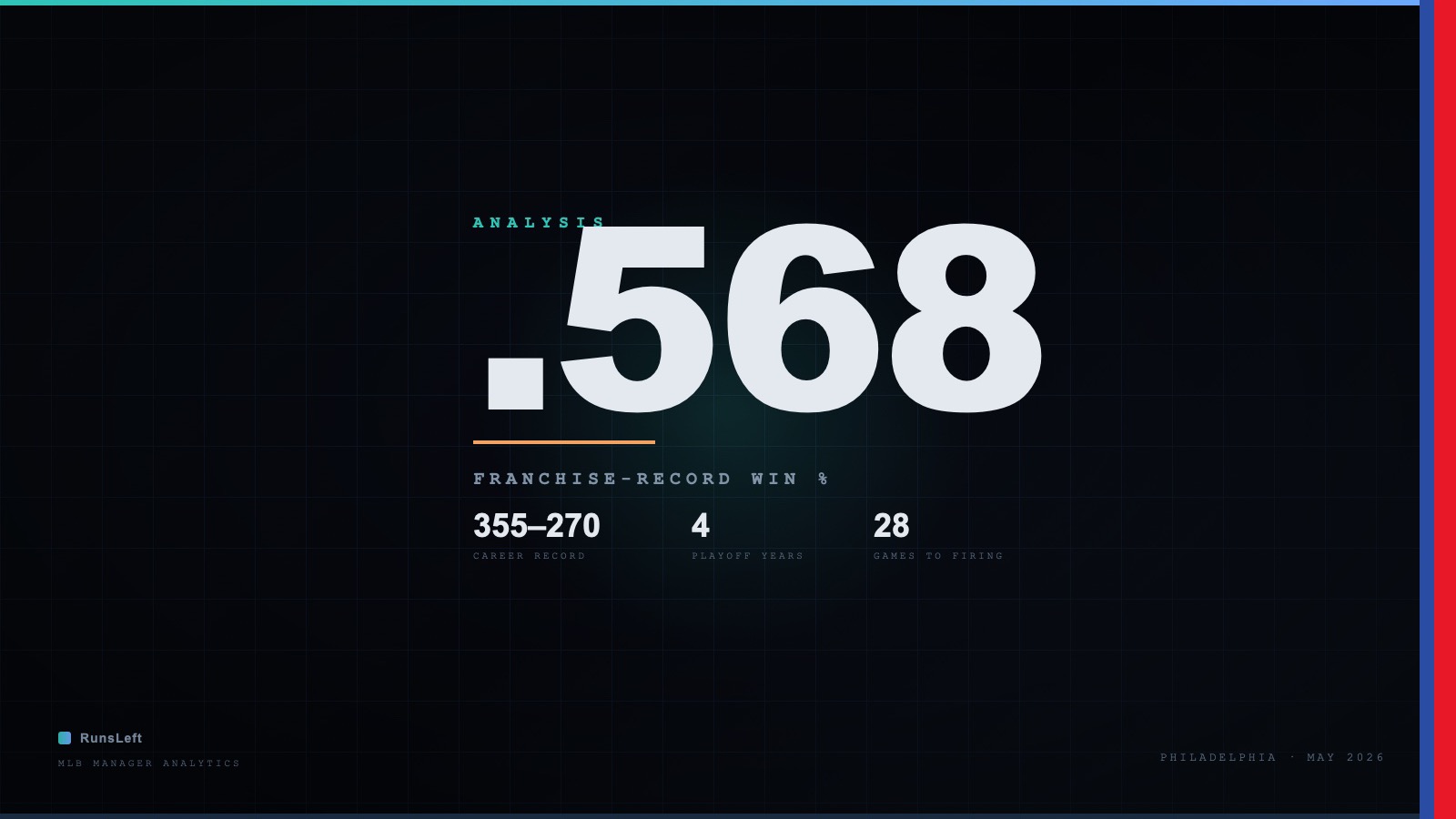
On April 28, 2026, the Philadelphia Phillies fired manager Rob Thomson after a 9–19 start — one of the worst openings in franchise history. The decision came from President of Baseball Operations Dave Dombrowski, who cited the need for a "new voice." But in a city where $284 million buys the third-largest payroll in baseball, the harder question is who actually built the roster that just collapsed.
This is our analytical verdict.
Compiled the highest winning percentage in Phillies franchise history (.568). Outperformed Pythagorean expectations every full season. Maintained an elite clubhouse culture that players publicly defended after his firing. Fired during a 28-game collapse driven by roster failures he could not control.
Delivered the primary mission: four playoff appearances, one pennant, consistent 90-win seasons. His best signings — Realmuto, Strahm — generated $93M in surplus value. His worst — Castellanos, Walker, Gregorius — destroyed roughly the same amount. Built a star-heavy, depth-poor roster that fractured when multiple veterans declined simultaneously.
The Bottom Line
Thomson did not cause the Phillies' 2026 collapse. He managed against it for 28 games before the front office made him the institutional answer to a problem the front office created. Dombrowski built the roster, signed the contracts, made the trades, and pulled the trigger on the firing — but the structural fragilities that defined the 2026 team are his to own. The organization demanded accountability of its manager; the data suggests that accountability should be more evenly shared.
The full case follows.
Part I: Rob Thomson — The Manager's Record
The Historical Achievement
Rob Thomson inherited a 22–29 wreck on June 3, 2022, and immediately won 14 of his next 16 games. By the time he was dismissed nearly four years later, he had compiled a 355–270 regular-season record — a .568 winning percentage that stands as the highest in the 140-plus-year history of the Philadelphia Phillies franchise. No manager in Phillies history has ever guided a team to sustained winning at this rate.
Win Percentage and Wins Above Expected
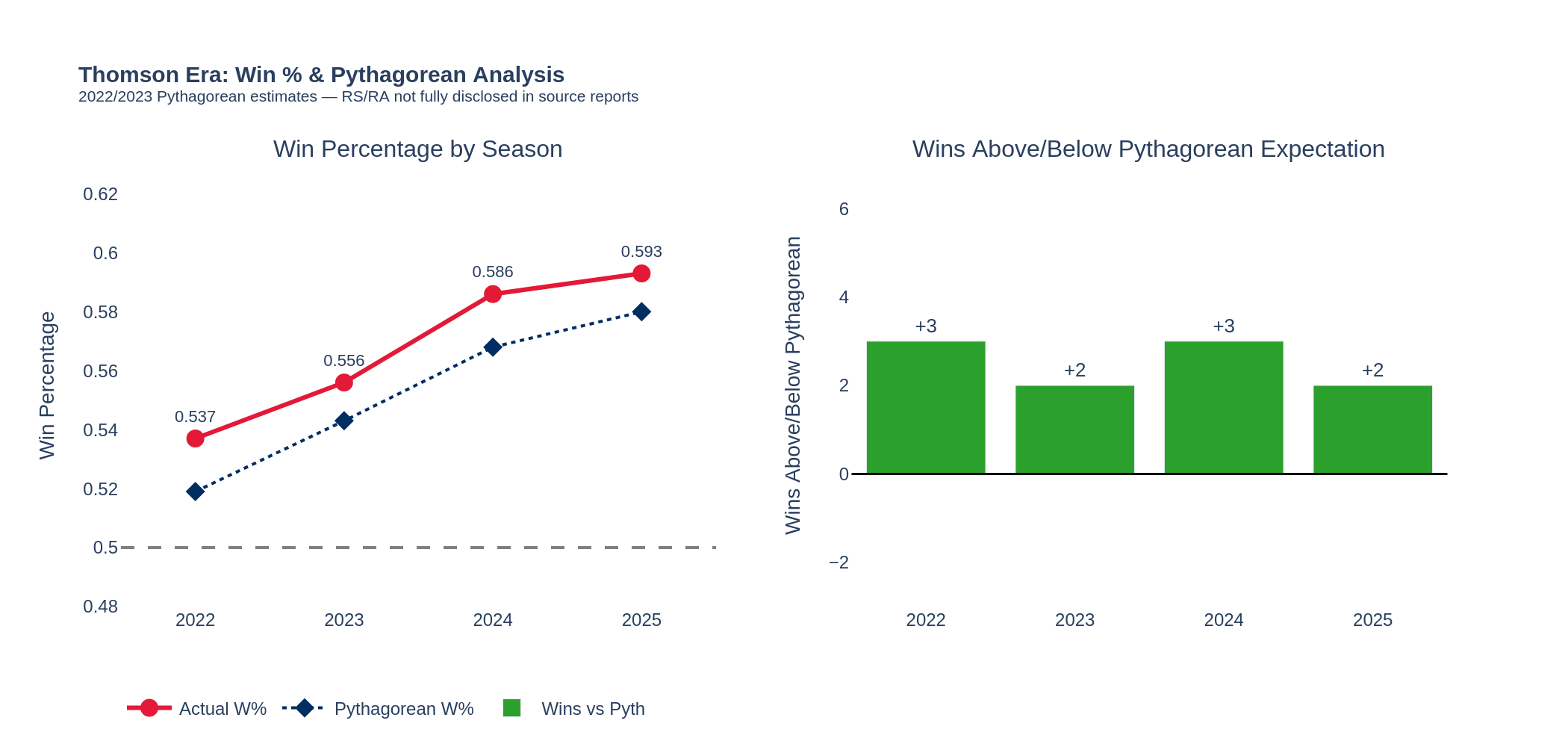
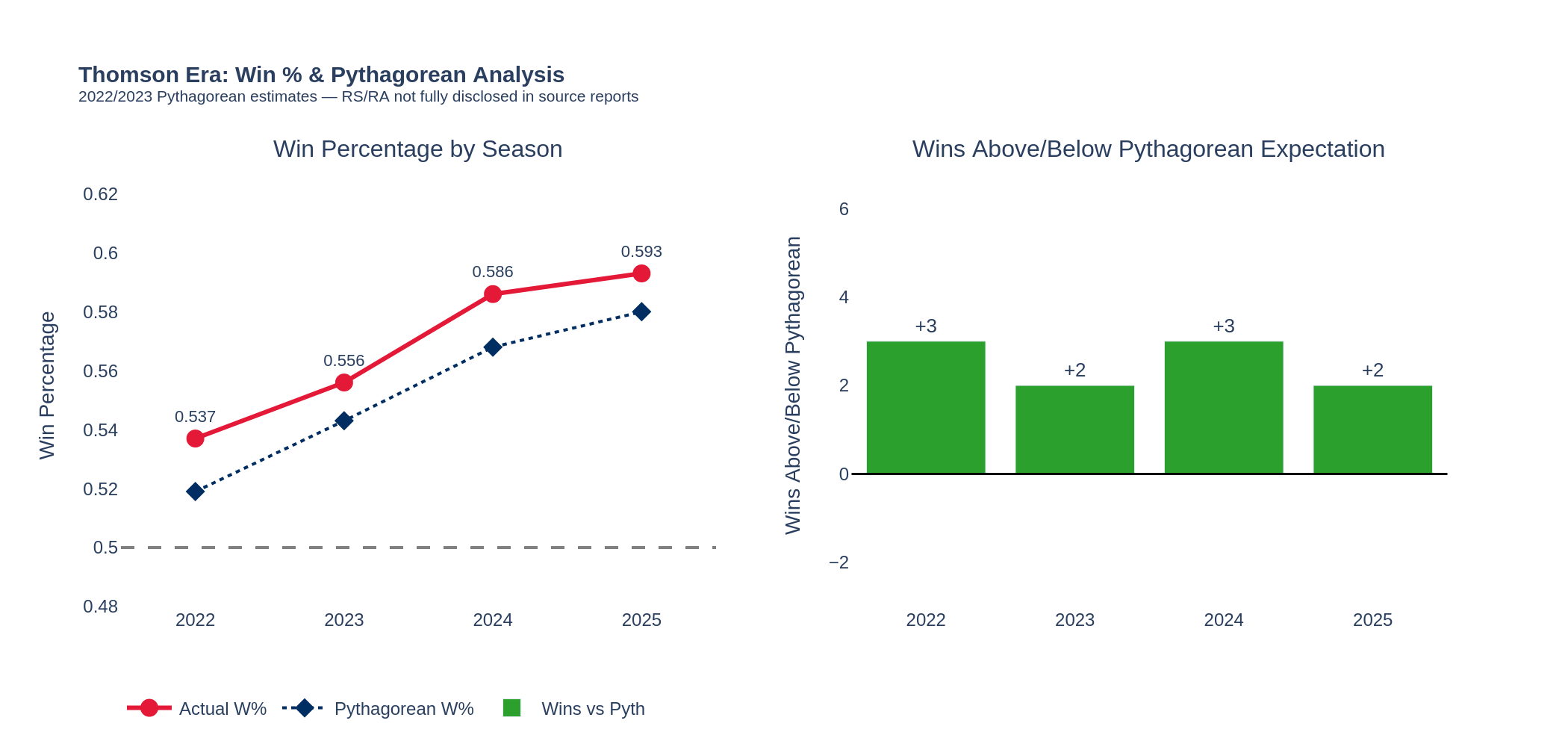
One of the most revealing metrics in evaluating a manager's in-game decision-making is the gap between a team's actual win total and its Pythagorean expectation — the number of wins a team's run differential mathematically predicts. A persistent positive gap suggests tactical competence: the manager consistently coaxes slightly better results than the underlying talent dictates.
| Season | W | L | W% | Pyth W | Pyth L | +/– Pyth | Division Finish |
|---|---|---|---|---|---|---|---|
| 2022* | 87 | 75 | .537 | ~84 | ~78 | +3 | Wild Card |
| 2023 | 90 | 72 | .556 | ~88 | ~74 | +2 | 2nd, NL East |
| 2024 | 95 | 67 | .586 | 92 | 70 | +3 | 1st, NL East |
| 2025 | 96 | 66 | .593 | 94 | 68 | +2 | 1st, NL East |
| 2026† | 9 | 19 | .321 | — | — | — | Last, NL East |
Table 1 — Thomson's season-by-season record with Pythagorean comparison. *2022 reflects full team record; Thomson managed 65–46 portion. †2026 through April 28 (date of firing).
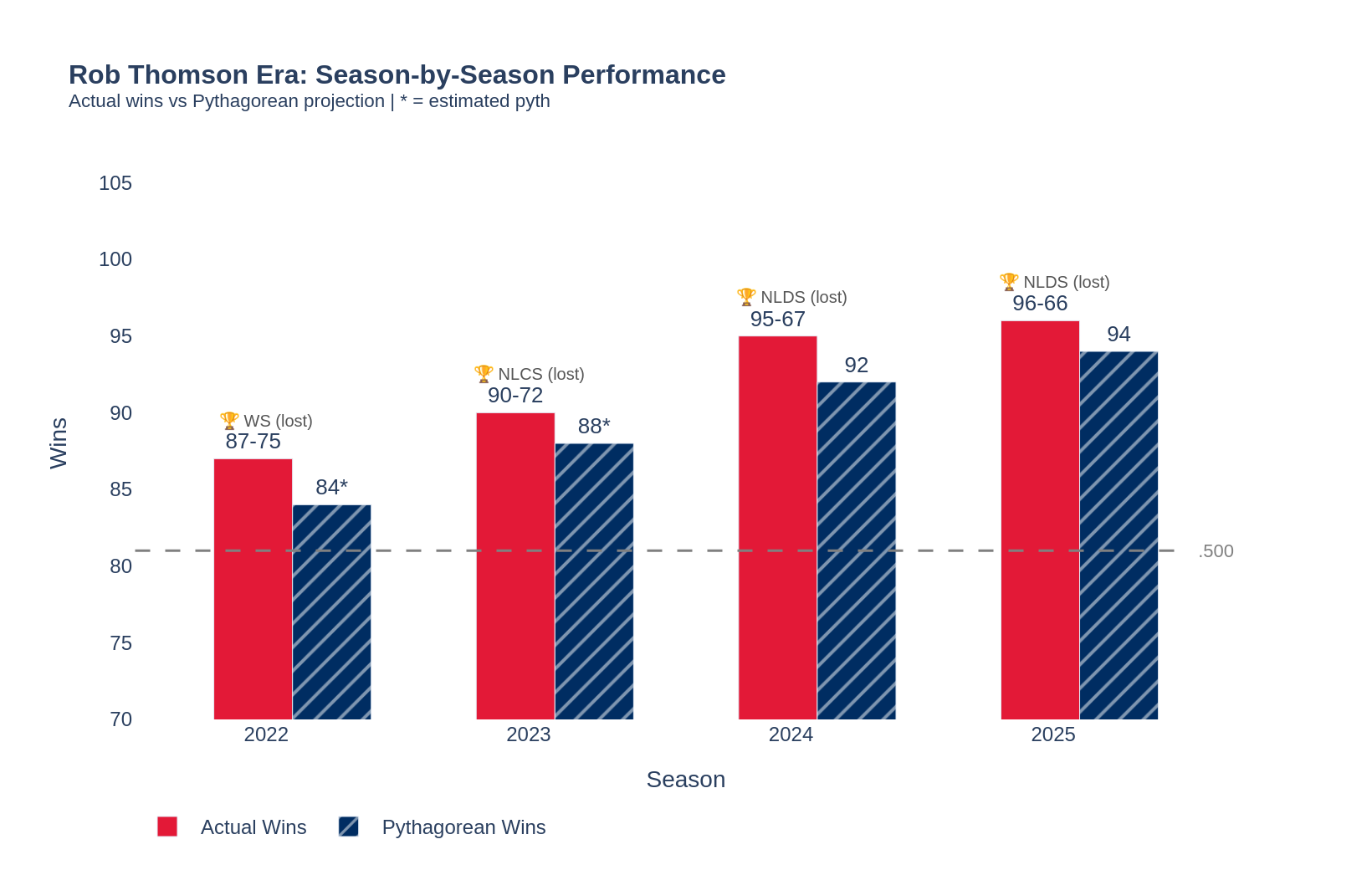
The data reveals a consistent pattern: Thomson outperformed Pythagorean expectations by +2 to +3 wins in every complete season. Across four full years, that represents roughly eight to twelve wins drawn from superior game management — bullpen timing, sacrifice opportunities, and lineup construction — beyond what the roster's raw talent would have predicted. The 2026 collapse, while stark, occurred over just 28 games with a demonstrably struggling roster.
Player Performance vs. Projections
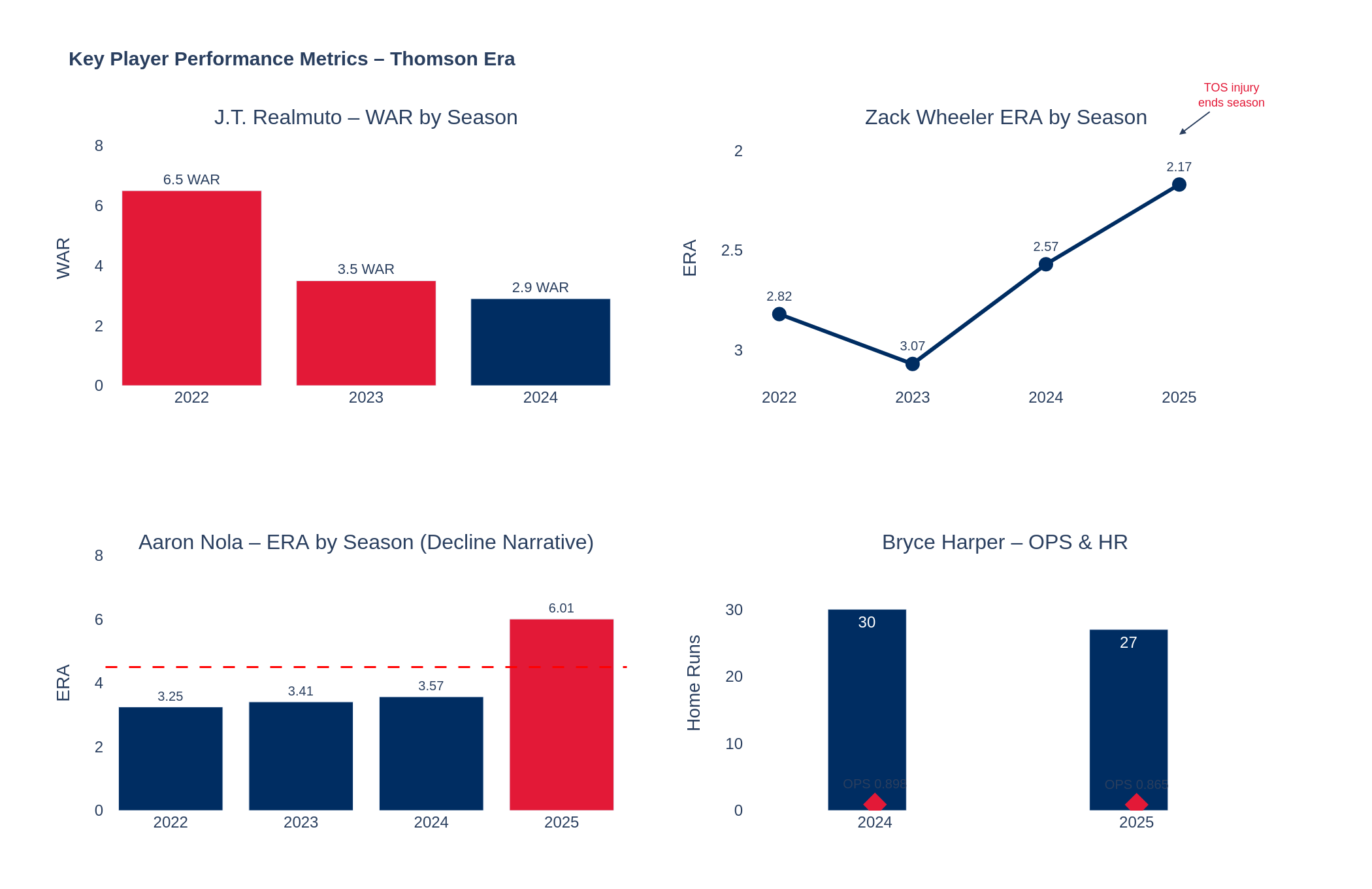
The most tangible evidence of a manager's impact is whether players exceed their projected performance. Under Thomson, several key contributors delivered results significantly above pre-season expectations.
Kyle Schwarber — The Leadoff Revolution
One of Thomson's most analytically-grounded lineup decisions was batting Kyle Schwarber — a player whose career batting average has rarely topped .215 — in the leadoff spot. Batting a high-walk, high-power hitter at the top of the order is a documented sabermetric play in the modern game; the typical National League manager still wouldn't have done it. Thomson did, and embraced Schwarber's true skill set: elite walk rates, elite power, and an ability to punish pitchers even before they can establish a rhythm. The results were historically significant: Schwarber led the National League in home runs in 2022 (46) and 2025 (56). His 2025 campaign — 56 HR, 132 RBI (MLB leader), NL MVP runner-up — was a career season achieved at age 32 in Thomson's lineup structure. The credit goes to a manager who made an analytically-supported decision the league was slow to adopt, and to a player who rewarded the call. The successor's lineup card is on tonight's Phillies edges — Schwarber's slot is the first thing to check.
Bryce Harper's First-Base Transition
When elbow surgery forced Harper out of the outfield, a lesser coaching staff might have deployed him as a designated hitter and limited his defensive value. Thomson's group undertook the full position transition to first base. By 2024, Harper was a Rawlings Gold Glove finalist at the position — remarkable for a player who had never played first base professionally before the Thomson era. Harper's offensive numbers under Thomson were equally impressive: a .898 OPS and Silver Slugger Award in 2024, followed by 27 home runs in 2025. The transition maintained Harper's elite bat in the lineup while solving a major defensive question, a dual achievement that reflects strong organizational competence.
| Player | Season | Key Metric | Achievement / Context |
|---|---|---|---|
| K. Schwarber | 2025 | 56 HR / 132 RBI | NL HR leader; MLB RBI leader; NL MVP runner-up |
| K. Schwarber | 2024 | ~40 HR / 3.3 WAR | Consistent power production from leadoff spot |
| J.T. Realmuto | 2022 | 6.5 WAR / 20 HR–20 SB | Only 2nd catcher in MLB history with 20/20; Gold Glove + Silver Slugger |
| Bryce Harper | 2024 | .898 OPS / 30 HR | Silver Slugger; Gold Glove finalist (1B); 6th NL MVP |
| Zack Wheeler | 2025 | 2.17 ERA (18 GS) | On pace for career year before TOS diagnosis ended season |
| Aaron Nola | 2025 | 6.01 ERA / 1.35 WHIP | Career-worst; 17 starts; velocity decline; xFIP 3.71 (some bad luck) |
| Aaron Nola | 2026† | 6.03 ERA | Struggles persisted at time of Thomson's firing |
Table 2 — Key player performance outcomes under Thomson. †Through April 28, 2026.
The Aaron Nola situation deserves honest assessment, and gets one in its own subsection at the end of Part I. The short version: a pitching coach intervention that could halt Nola's slide would have materially changed the team's trajectory entering 2026.
Bullpen Usage Efficiency
Bullpen management was Thomson's most complex and contested domain. The 2025 relief corps ranked 20th in MLB with a collective 4.27 ERA, hampered by José Alvarado's 80-game PED suspension and Jhoan Duran's late arrival (26 appearances after a July trade deadline deal). The unit's 1.30 HR/9 ranked fourth-worst in the league — a structural problem tied to roster composition rather than purely tactical deployment.
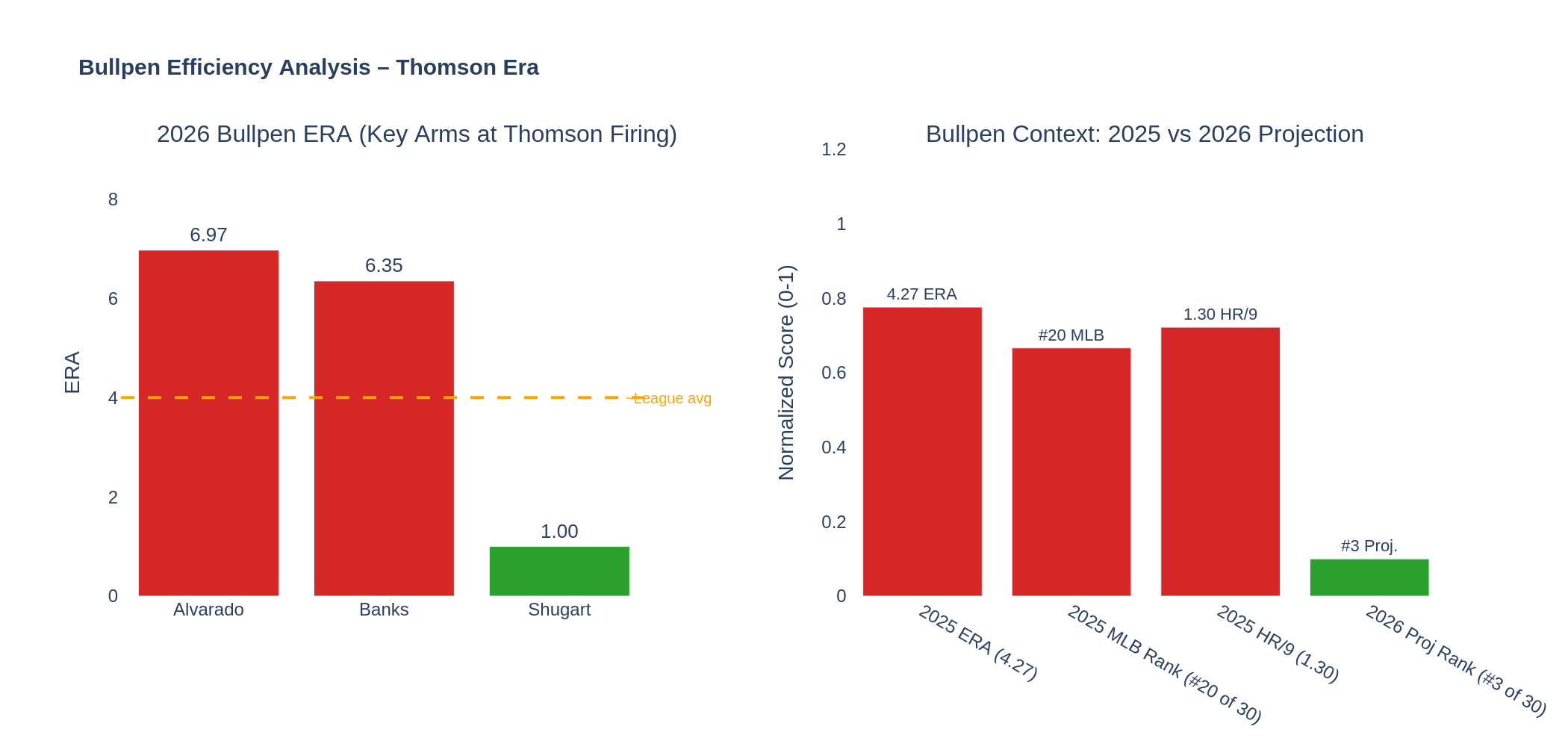
The 2026 picture was paradoxically worse despite superior personnel. FanGraphs projected the Phillies' 2026 bullpen as the third-best in MLB following offseason additions of Brad Keller and Jonathan Bowlan and the expected return of a healthy Alvarado and Duran. The actual results at the time of firing told a different story: Alvarado posted a 6.97 ERA, Tanner Banks a 6.35 ERA, while newcomer Chase Shugart excelled at 1.00. This volatility — a projected top-3 unit performing well below expectations — points as much to arm regression and health variance as to tactical error by the manager.
Player Development Outcomes
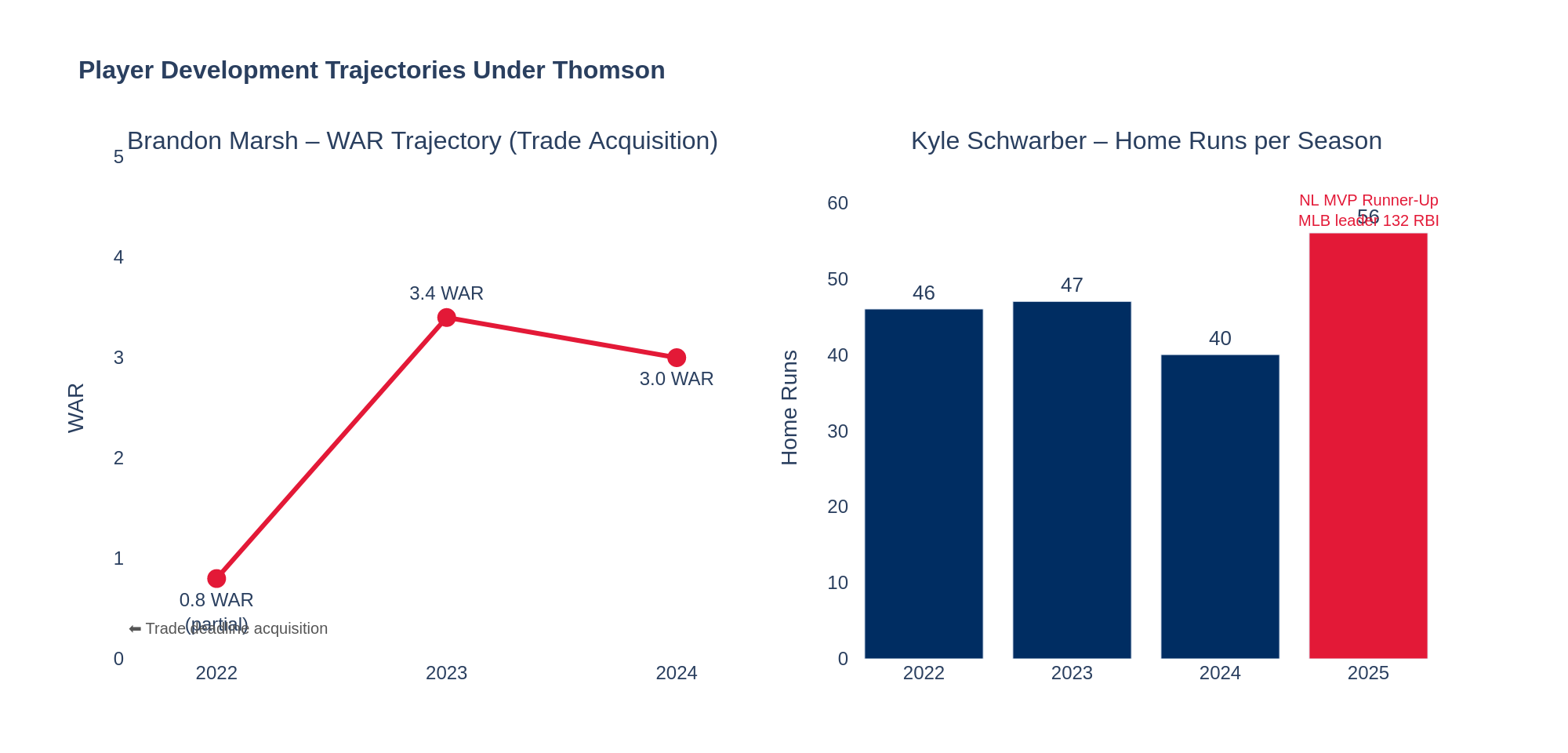
Thomson's developmental record among non-veterans is a point of genuine credit. Brandon Marsh, acquired mid-2022 from the Angels, produced 0.8 WAR in a partial season, then broke out to 3.4 WAR in 2023 and 3.0 WAR in 2024 — a development arc that reflects organizational quality. Shortstop Edmundo Sosa emerged as a 2.2-WAR defensive asset in 2024. Bryson Stott and Brandon Marsh became reliable everyday contributors under Thomson's management. These are players who exceeded their organizational projections — a positive reflection on the coaching environment Thomson fostered.
Clubhouse Culture: The Intangible Ledger
Data cannot fully capture what Thomson built in the Phillies clubhouse, but the reactions to his firing provide an unusually candid window. The sentiment was uniform and striking: sadness, not relief.
"We love Topper in here. He's a great manager for us over the years… Topper is definitely one of the guys at the top." — Bryce Harper, following Thomson's dismissal
"It sucks that the players are the ones not playing well, and somebody else has to lose their job for it. We all feel responsible for what happened to him." — J.T. Realmuto, catcher
"Personally, he's a person that always helped me when I needed it the most, that always supported me in tough times." — José Alvarado, reliever
Thomson himself reinforced this character in departure, holding an uncommon post-firing press conference: "I think if you're an accountable person and you're a leader, you're going to stand up in front of people and answer the questions when it's all over." In 25 years of covering professional sports, reporters in Philadelphia described his exit as one of the most graceful they had witnessed. This culture — accountable, unified, player-first — was Thomson's most enduring contribution and the starkest argument that the 2026 failure was a roster problem before it was a management problem.
Where Thomson's record is genuinely vulnerable
The most legitimate criticism of Thomson's tenure is the Aaron Nola decline. From 2024 forward, Nola lost velocity and effectiveness in a slow but unmistakable arc; the staff's inability to course-correct over multiple seasons is real. xFIP softens the picture (3.71 in 2025 suggests genuine bad luck on top of the trend), but xFIP doesn't excuse a two-year failure to halt a slide on a $172M arm. The postseason regression pattern — World Series, NLCS, NLDS, NLDS — is a related but lesser concern: short-series variance is real, but with the highest payroll in the National League, earlier exits represent some opportunity cost. This article isn't a defense brief for Thomson. The Nola situation is where his record is genuinely weakest.
Part II: Dave Dombrowski — The Architect's Record
The Strategic Mandate
Dave Dombrowski arrived in Philadelphia on December 11, 2020, with an explicit mandate from managing partner John Middleton: end a nine-year playoff drought and build a perennial contender. His tools were generous: a large-market willingness to exceed the Competitive Balance Tax threshold, an established (if aging) core of Bryce Harper, and the organizational credibility to attract elite free agents. His response was an aggressive, high-variance "win-now" philosophy that reshaped the Phillies' roster through four consecutive offseasons of consequential spending and trading.
Trade Ledger Analysis
Dombrowski's most unambiguous successes came via the trade market, particularly during the 2022 trade deadline push that ultimately fueled a World Series run. The Brandon Marsh acquisition from the Los Angeles Angels stands as the definitive transaction of his tenure: executed mid-season at modest prospect cost, Marsh delivered 7.2 cumulative WAR over 2022–2024 while remaining cost-controlled. Edmundo Sosa, a low-cost supplemental add from St. Louis, quietly became one of baseball's more efficient defensive infielders, peaking at 2.2 WAR in 2024.
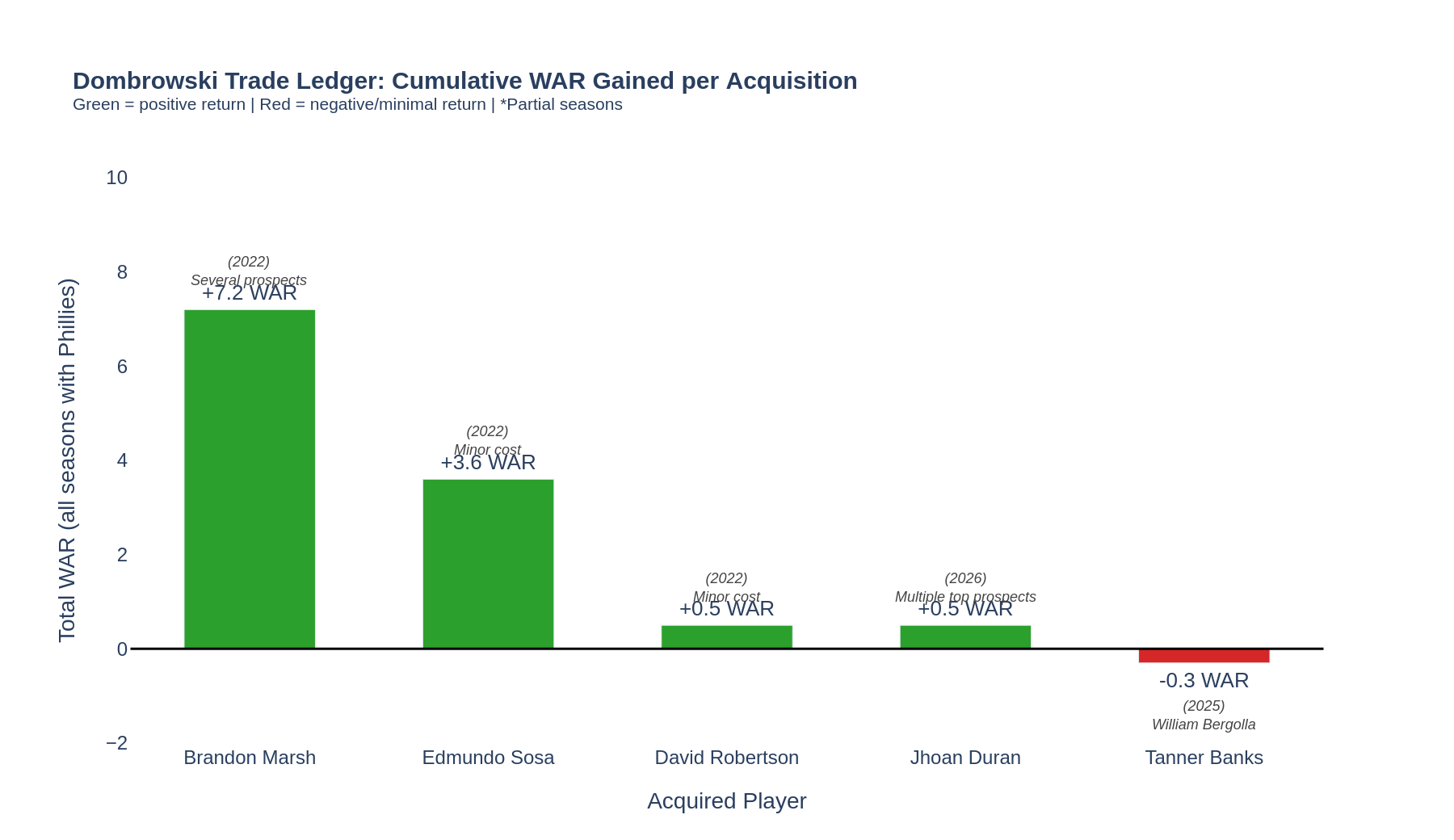
| Player | Year | From | WAR '22 | WAR '23 | WAR '24 | Total WAR | Assessment |
|---|---|---|---|---|---|---|---|
| Brandon Marsh | 2022 TDL | LAA Angels | 0.8 | 3.4 | 3.0 | 7.2 | Clear Win |
| Edmundo Sosa | 2022 | STL Cardinals | 0.8 | 0.6 | 2.2 | 3.6 | Win |
| David Robertson | 2022 TDL | CHC Cubs | 0.5 | — | — | 0.5 | Situational |
| Jhoan Duran | Off. 2025–26 | MIN Twins | — | — | ~0.5 | ~0.5 | Too Early |
| Tanner Banks | 2025 | CHW White Sox | — | — | ~–0.2 | ~–0.2 | Poor (6.35 ERA '26) |
Table 3 — Dombrowski trade ledger; WAR contributions and net assessments. 2025/2026 trades are early-stage evaluations.
The more recent, higher-cost trades raise legitimate concerns. The Jhoan Duran acquisition from Minnesota reportedly cost multiple top prospects. The Jesús Luzardo deal from Miami consumed Starlyn Caba — the organization's highest-rated 2023 international signee — and Paul McIntosh. William Bergolla, a 2022 international signee, was spent to acquire Tanner Banks, who posted a 6.35 ERA in the early 2026 season. Dombrowski has repeatedly used the international amateur pipeline as trade currency, a strategy that keeps the MLB team competitive but systematically depletes the organization's long-term development base.
Free Agent Signing ROI
Free agency is where Dombrowski's high-variance philosophy is most legible. His signing ledger contains some of the best value plays in recent Phillies history alongside some of the most expensive failures.
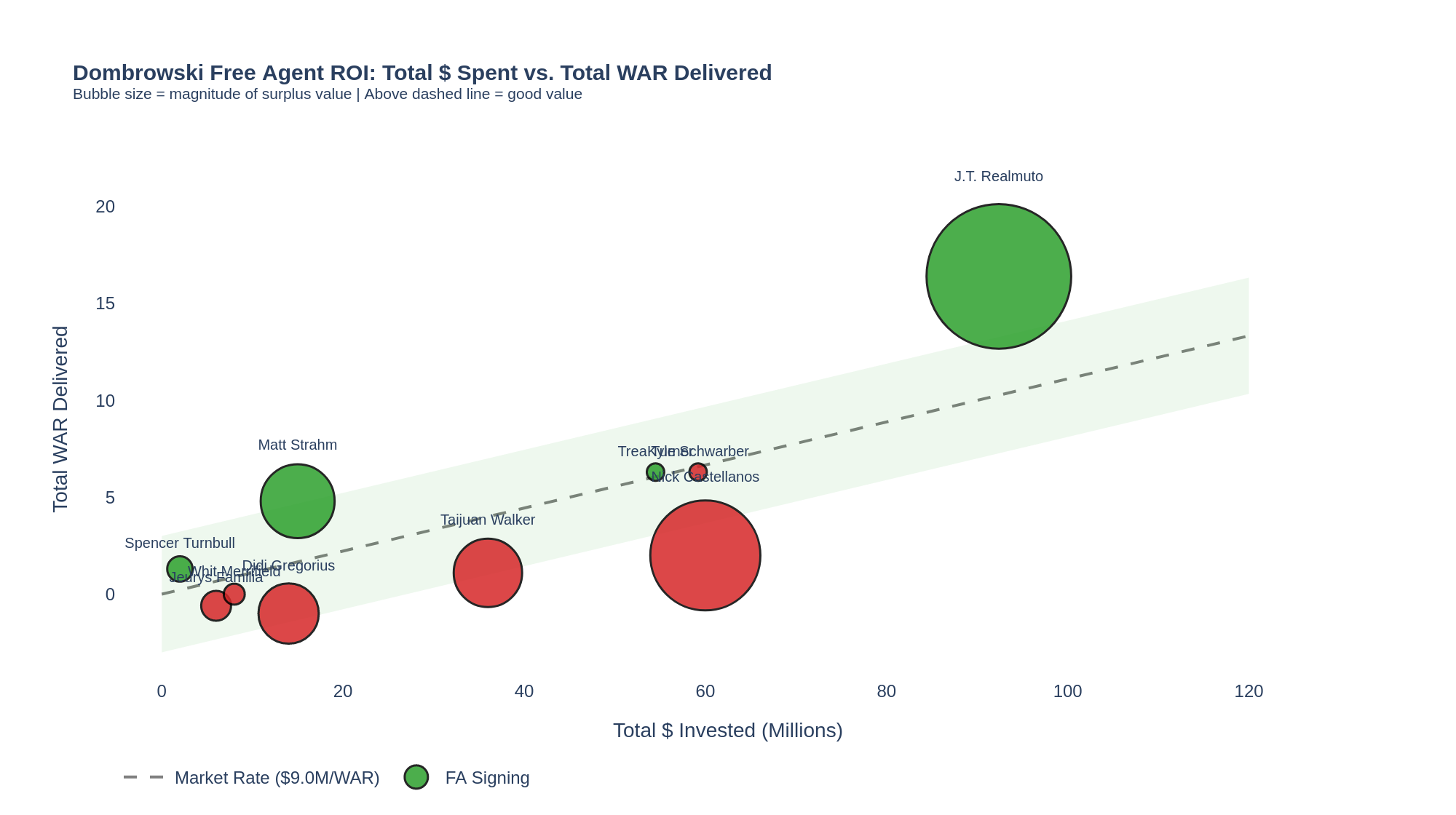
| Player | Contract | AAV ($M) | Total WAR | $/WAR ($M) | Surplus ($M) | Grade |
|---|---|---|---|---|---|---|
| J.T. Realmuto | 5yr/$115.5M | $23.1 | 16.4 | $5.63 | +$55.2 | A+ |
| Matt Strahm | 2yr/$15M | $7.5 | 4.8 | $3.13 | +$28.2 | A+ |
| Spencer Turnbull | 1yr/$2M | $2.0 | 1.3 | $1.54 | +$9.7 | A+ |
| Trea Turner | 11yr/$300M | $27.3 | 6.3 (2 yr) | $8.65 | +$2.2 | B |
| Kyle Schwarber | 4yr/$79M | $19.8 | 6.3 (3 yr) | $9.41 | –$2.6 | B– |
| Nick Castellanos | 5yr/$100M | $20.0 | 2.0 (3 yr) | $30.0 | –$42.0 | F |
| Taijuan Walker | 4yr/$72M | $18.0 | 1.1 (2 yr) | $32.7 | –$26.1 | F |
| Didi Gregorius | 2yr/$28M | $14.0 | –1.0 | — | –$23.0 | F |
| Whit Merrifield | 1yr/$8M | $8.0 | 0.0 | — | –$8.0 | D |
| Jeurys Familia | 1yr/$6M | $6.0 | –0.6 | — | –$11.4 | F |
Table 4 — Dombrowski free agent signing ledger. Surplus Value = (Total WAR × $9M market rate) – Total Invested. Market rate per WAR: $9.0M.
The ledger reveals a bifurcated approach. Three signings — Realmuto (+$55.2M surplus), Strahm (+$28.2M), and Turnbull (+$9.7M) — generated roughly $93M in surplus value combined. Against these wins, three signings — Castellanos (–$42.0M), Walker (–$26.1M), and Gregorius (–$23.0M) — burned through approximately $91M in surplus destruction. The net is nearly a wash, but the composition matters: the big-dollar cornerstone signings have yielded mixed results while the low-cost, high-efficiency additions have been exceptional. Dombrowski can identify undervalued talent; the question is whether the high-profile failures reflect scouting errors, aging curves, or injury bad luck.
Payroll Efficiency: Wins per Dollar vs. League
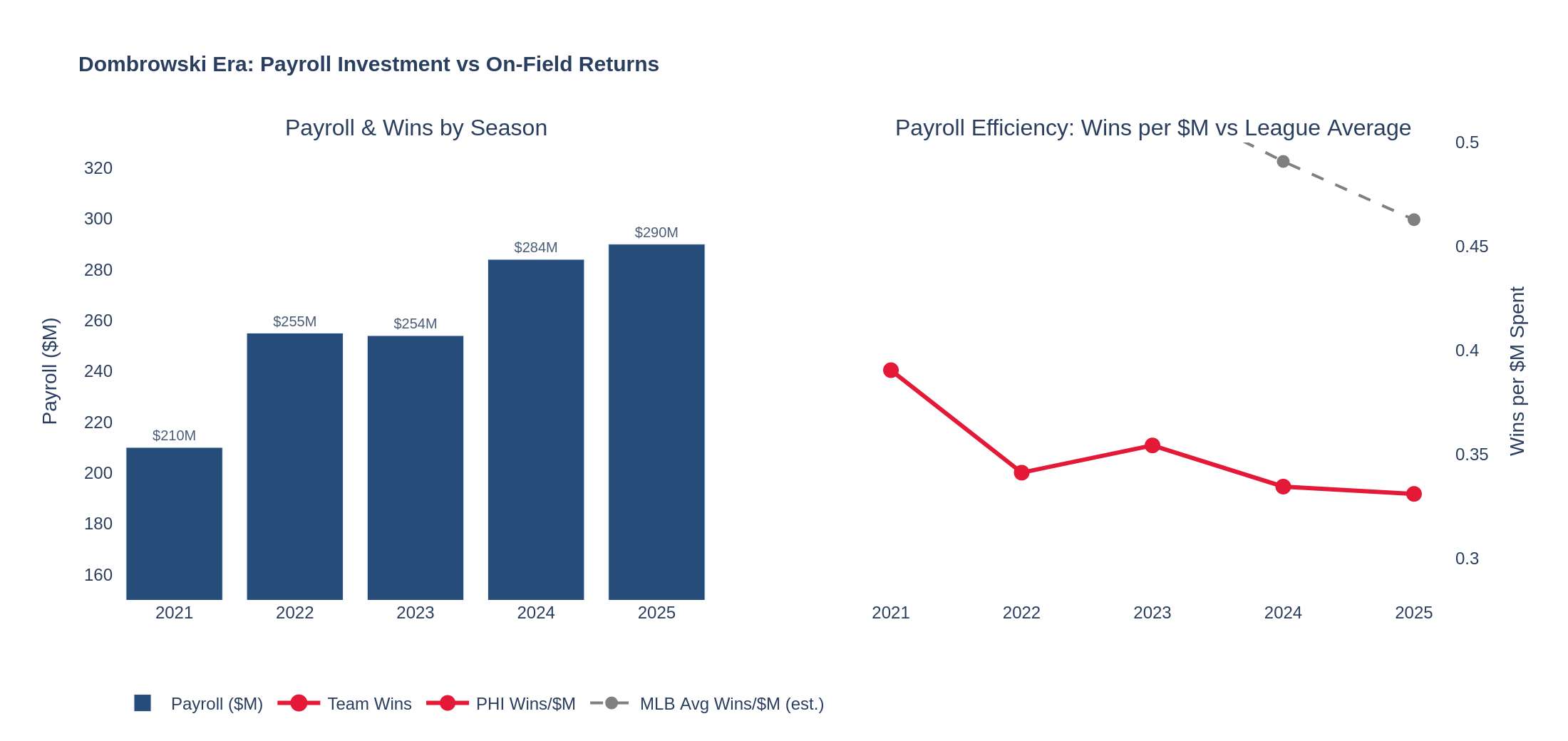
| Season | Payroll ($M) | Wins | PHI Wins/$M | MLB Avg Wins/$M | PHI vs. Avg | Payroll Rank |
|---|---|---|---|---|---|---|
| 2021 | $210M | 82 | 0.390 | 0.623 | –37% | Top 5 |
| 2022 | $255M | 87 | 0.341 | 0.566 | –40% | Top 3 |
| 2023 | $254M | 90 | 0.354 | 0.523 | –32% | Top 3 |
| 2024 | $284M | 95 | 0.335 | 0.491 | –32% | Top 3 |
| 2025 | ~$290M | 96 | 0.331 | 0.463 | –29% | Top 3 |
Table 5 — Phillies payroll efficiency vs. estimated MLB league average. The gap narrows as win growth slightly outpaces payroll growth, but the Phillies consistently purchase wins at roughly twice the cost of an average MLB team.
The payroll efficiency gap — consistently 29–40% below league average in wins per dollar — reflects the structural reality of a high-payroll team: you buy above-average wins, but each incremental win becomes more expensive. The key counterfactual question is whether the Phillies' cost per WAR (~$5.80M in 2024, well below the $9M market rate) suggests that despite the total spend, Dombrowski has assembled the roster with reasonable value consciousness. Some of this efficiency is structural to high-payroll teams that concentrate spending on superstar production. Compared to other top-three payroll franchises (Mets, Yankees, Dodgers), the Phillies' efficiency is more middle-of-the-pack than exceptional. Total team WAR grew 42% from 2021 (34.5) to 2024 (48.9) while payroll grew 35%. On a pure WAR-per-dollar basis, the roster has become modestly more efficient — a legitimate point in Dombrowski's favor.
Luxury Tax Consequences
By 2024, the Phillies were spending deep into the third tier of the Competitive Balance Tax, triggering a penalty that pushed their 2026 first-round draft selection back ten spots. This is the compounding cost of the win-now approach: draft capital sacrificed at precisely the moment the aging core needs replacement. With long-term commitments to Harper, Turner, Schwarber, Wheeler, and Nola all extending through the late 2020s, and the farm system depleted by international prospect trades, the structural constraints Dombrowski has created will define the organization's competitive window for the next half-decade.
Part III: The Verdict
The Evidence in Full
The question framed at the outset — who bears responsibility for the Phillies' 2026 collapse — does not resolve cleanly in either direction. The data supports a more nuanced conclusion: Thomson executed the job of managing this roster at historically high levels; Dombrowski constructed a roster with structural vulnerabilities that Thomson could partially offset but ultimately could not overcome when multiple pieces failed simultaneously.
The postseason regression arc — World Series (2022) → NLCS (2023) → NLDS (2024) → NLDS (2025) — does not automatically implicate Thomson. Playoff baseball is extraordinarily variance-driven, with small sample sizes magnifying the impact of hot or cold performances over a five-to-seven game series. The 2024 NLDS loss to the Mets and the 2025 exit to the Dodgers each featured opponents who were legitimately elite. The more honest critique of Thomson's postseason record is that, with the highest payroll in the NL, earlier exits represent an opportunity cost — but that cost is shared with the GM who assembled the roster.
The Structural Fragility Problem
The 2026 collapse was, at its core, a portfolio risk problem: too many aging veterans on long-term contracts failing in the same window. Aaron Nola's velocity decline began in 2025 and continued into 2026. Zack Wheeler was lost to thoracic outlet syndrome in 2025. The bullpen, projected as third-best in MLB, imploded. Nick Castellanos was released before the season even started. These are not sequentially probable events — they are correlated risks that materialize when a roster lacks depth. Dombrowski built a star-heavy, depth-poor roster with no buffer for simultaneous failures. Thomson managed that roster to its ceiling for four years, then absorbed the blame when the ceiling caved.
The Firing Decision Under Scrutiny
The circumstances surrounding the firing also merit examination. Multiple reports confirmed that Dombrowski had reached out to potential managerial candidates — including Alex Cora — before informing Thomson he was dismissed. Thomson learned of the decision through the process itself rather than through a direct, prior conversation. This sequence reflects poorly on the organizational leadership culture that Dombrowski himself oversees. The irony is notable: a GM who built his tenure on a win-now philosophy fired the most successful manager in franchise history 28 games into a season while retaining full authority over the roster that caused the very failure he blamed on the manager.
Looking Forward
The Phillies face interconnected challenges that transcend any single leadership figure. The new manager — whoever that is — inherits a roster with aging core players on immovable contracts, a depleted farm system that limits internal reinforcement, escalating luxury tax penalties that cap offseason flexibility, and a fanbase whose expectations have been raised by four straight playoff runs. Dombrowski's own contract runs through 2027, and the organization's trajectory over the remainder of that window will be the final measure of his tenure's success or failure.
What is analytically clear is this: Rob Thomson was not the primary cause of the Phillies' competitive problems. He was a historically effective manager who was fired for a roster's failures. Dave Dombrowski built that roster with both genuine skill and consequential miscalculation. The accountability the organization demanded of its manager — and which Thomson displayed with remarkable grace in his farewell press conference — is accountability that should be shared with equal candor by the executive who wrote the checks, made the trades, and pulled the trigger.
Bottom Line: Thomson maximized a flawed roster for four years and was fired when it finally broke. Dombrowski built both the team's successes and its structural vulnerabilities. The data suggests the wrong man may have been held most accountable for the 2026 collapse — though both leaders share some responsibility for a championship window that has, as yet, yielded only one pennant from the most expensive roster in National League history.
All statistical data sourced from Baseball-Reference, FanGraphs, and MLB.com through April 28, 2026. WAR market rate of $9.0M per 1.0 WAR used for surplus value calculations per industry benchmark. Pythagorean win projections for 2022–2023 are estimates; 2024–2025 confirmed from primary sources. Payroll figures reflect Opening Day commitments.