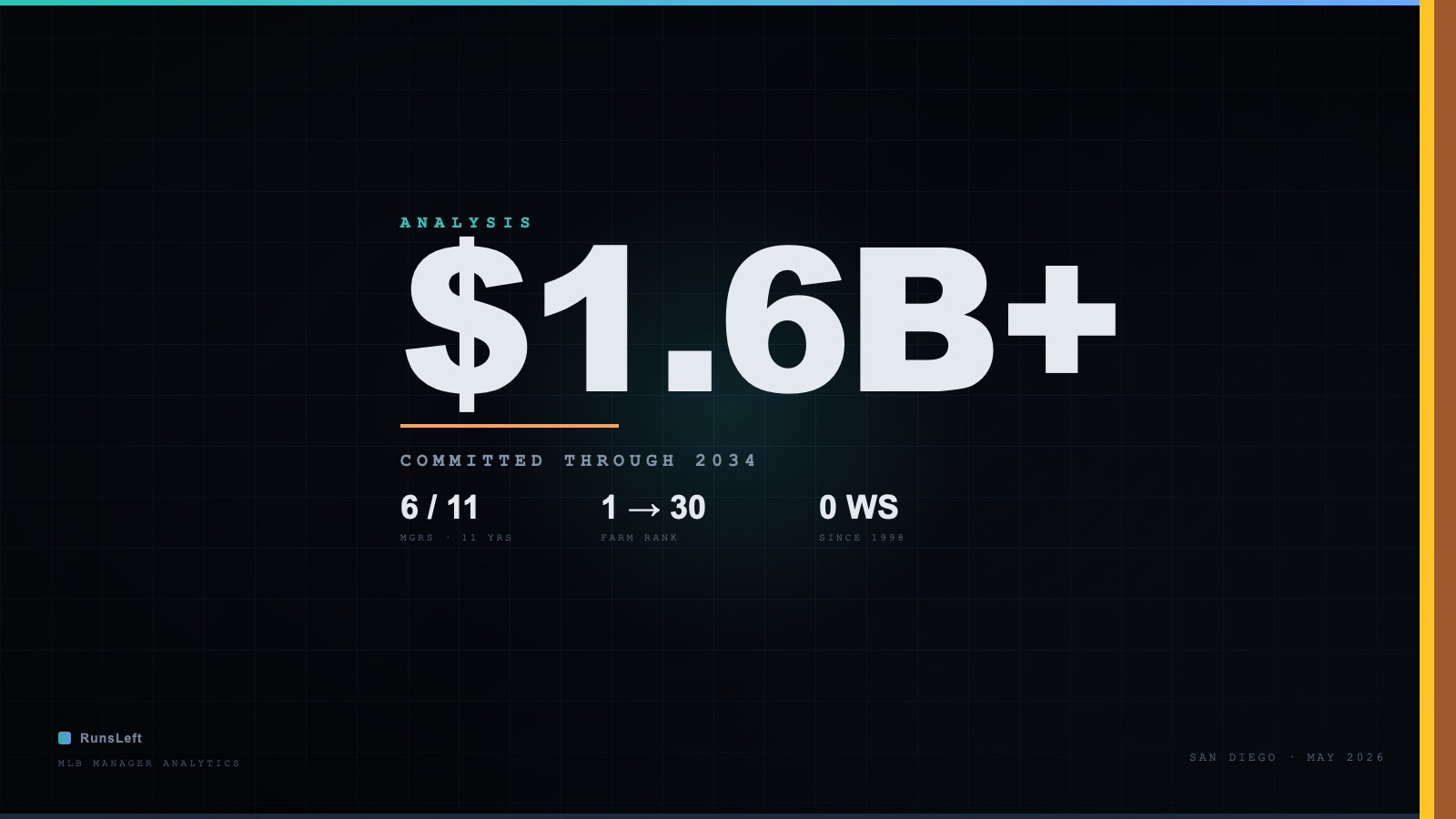
Since A.J. Preller became President of Baseball Operations in August 2014, the San Diego Padres have employed six full-time managers in eleven seasons, reached the postseason four times, and won zero playoff series past the division round. The franchise carries $1.6B+ in long-term contract commitments through 2034 and a farm system ranked dead last by both The Athletic and USA Today. Mike Shildt — the franchise's best W% manager ever (.565) — retired in October 2025 citing burnout. His replacement, Craig Stammen, had no prior managerial experience at any level. The question this article examines is who owns the eleven-year ledger.
This is our analytical verdict.
Stammen is managing a 19-12 team with a +2 run differential — meaning he is overperforming the underlying metrics by a meaningful margin through tactical decisions (lineup platoon, rest day management, collaborative flexibility). His background as a reliever gives him genuine in-game situational intelligence. His willingness to delegate (Knorr's lineup input) and iterate (13 different lineups in 13 games) reflects analytical adaptability. He is managing a roster with significant underperformance from its highest-paid player (Tatis Jr.) and two rotation absences (Darvish, Musgrove partial) — conditions that would test any manager. The 2026 sample is too small for a definitive grade, but the early returns suggest he is the right fit for Preller's organizational culture, even if his eventual ceiling as a tactician over a full season remains unknown.
Preller's eleven-year record is genuinely mixed in a way that resists simple summary. He has produced the franchise's most sustained competitive period, its best winning percentages, its deepest playoff runs, and its highest-quality individual acquisitions. He has also depleted the farm system to #30, cycled through six managers with consistent organizational friction, constructed a $291M team that missed the playoffs in 2023, and committed $1.6B+ in guarantees to a core that has yet to reach a World Series. The Soto trade — "no regrets" — produced an NLCS run but, in surplus-value terms through early 2026, cost a package now worth about 23.5 career bWAR (Gore + Wood + Abrams) versus roughly 7.5 bWAR captured from Soto/Bell in San Diego. The financial architecture he built is durable but inflexible. The managerial carousel he has maintained is the franchise's most persistent organizational problem. Preller is a legitimate competitor and a creative talent evaluator whose methods carry compounding risk that has not yet been converted into a championship.
The Bottom Line
A.J. Preller has owned the Padres' eleven-year ledger — every roster, every trade, every contract, every managerial change. The carousel of six managers is an organizational pattern, not coincidence. Mike Shildt produced the franchise's best two-year record and exited burnt out; Bob Melvin reached the NLCS and left amid friction; Andy Green and Jayce Tingler did the rebuild work and were fired. Craig Stammen — Preller's deliberate correction toward a low-friction organizational fit — is managing the consequences. Whether this $1.6B core ever reaches a World Series rests with the architect, not the dugout.
The full case follows.
Part I: A.J. Preller and the High-Variance Philosophy
The Trade Machine: Philosophy and Track Record
A.J. Preller was hired in August 2014 with a mandate to transform a franchise that had never won a World Series and had made the postseason only twice since 1998. His response was to pursue what might be called an accelerated competitive timeline — compressing the typical build-toward-contention arc by trading future assets for present-tense talent at a pace no other organization has matched. By multiple accounts, Preller has engaged in more trades involving major leaguers than any other team in the sport during his tenure, dealing with 28 of 29 other franchises in the process.
His own stated philosophy is disarmingly simple: "One thing we have never been scared of is: We're going to trade players." The data bears this out with remarkable consistency. Since 2019, the Padres made 18 trades acquiring major league talent — the most by any team — bringing in 23 players with major league experience. This approach has produced genuine competitive moments: a 2020 postseason appearance, a 2022 NLCS run (the franchise's deepest postseason since 1998), and back-to-back 90-win seasons in 2024 and 2025. But it has also produced a farm system ranked dead last by The Athletic and USA Today entering 2026, a payroll commitment of over $1.6 billion in guaranteed money through 2034, and a carousel of managers — six full-time skippers in the Preller era when Bud Black is included as the inherited 2015 manager — that has become one of the defining organizational traits of the front office.
The Financial Architecture
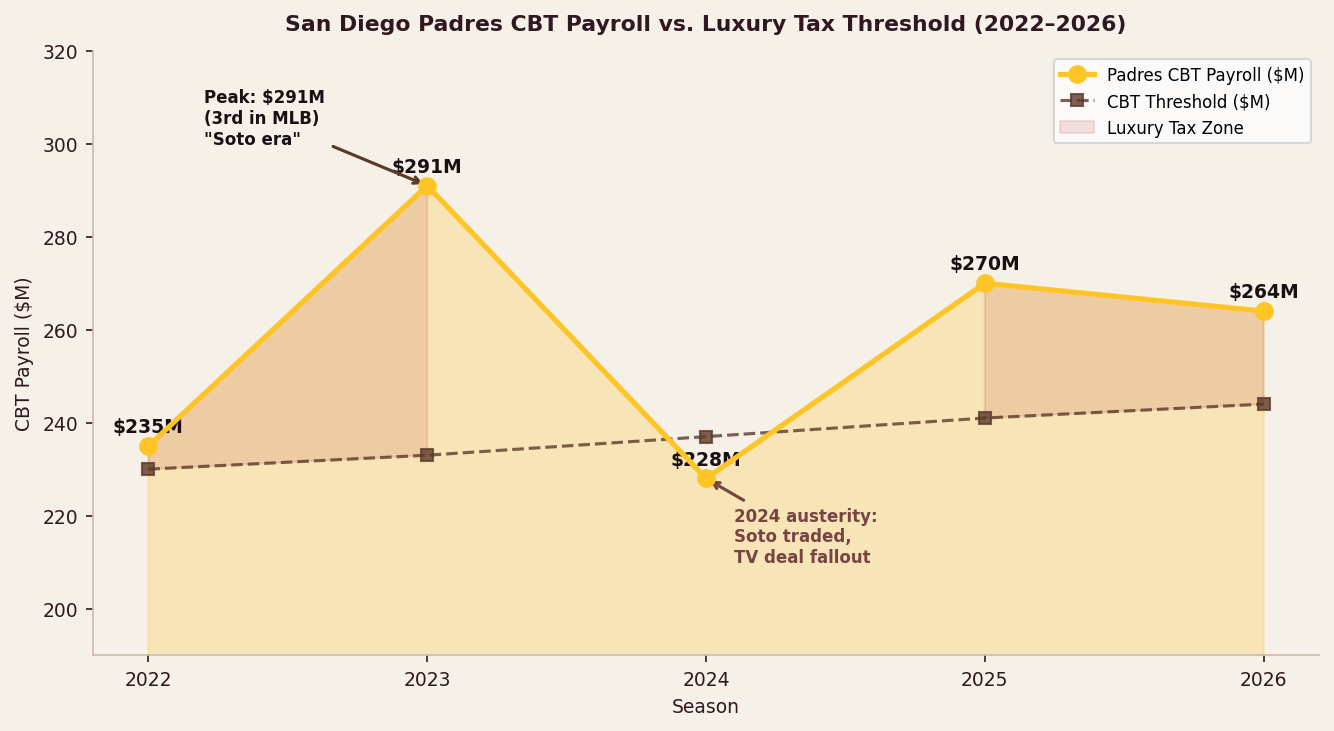
Preller's approach has required the Padres to operate near or above the Competitive Balance Tax (luxury tax) threshold for most of his tenure's competitive windows. In 2023, the team's CBT payroll reached $291 million — third in all of MLB — while simultaneously underperforming its run differential by ten wins and missing the playoffs. The subsequent financial correction in 2024, when the CBT payroll dropped to $228 million after the Juan Soto trade, coincided with the team's best season (93-69). This counterintuitive outcome — paying less, winning more — is one of the central tensions in evaluating Preller's fiscal approach.
| Year | Manager | CBT Payroll | MLB Rank | Record | Postseason |
|---|---|---|---|---|---|
| 2022 | Bob Melvin | $235M | 6th | 89–73 | NLCS (lost to PHI) |
| 2023 | Bob Melvin | $291M | 3rd | 82–80 | Missed playoffs |
| 2024 | Mike Shildt | $228M | 11th | 93–69 | NLDS (lost to LAD 3-2) |
| 2025 | Mike Shildt | $270M | 6th | 90–72 | Wild Card (lost to CHC 2-1) |
| 2026* | Craig Stammen | $264M | 6th | 19–12 | In progress |
Table 1 — Padres payroll and performance context (2022–2026). *2026 partial season through May 1.
The Soto Trade Chain: A Case Study in Cascading Risk
Surplus-value math (through early May 2026): if the Soto deal is treated as a 2.25-season Padres rental (final two months of 2022 plus all of 2023), the outgoing prospect core has already produced substantially more long-horizon value than San Diego captured during the rental window. The three principal assets sent out now total 23.5 career bWAR: CJ Abrams (11.6), MacKenzie Gore (6.1), and James Wood (5.8). By comparison, Soto produced 7.0 bWAR with San Diego (plus Josh Bell's ~0.5 bWAR in 2022), implying a current gap of roughly +16.0 WAR toward the outgoing package.
That gap is not abstract. Wood — a former elite headliner prospect and now a 2025 NL All-Star — has posted a 2026 line around .230/.390/.524 with 10 HR, 24 RBI, and 5 SB (1.1 bWAR). Abrams, a 2024 NL All-Star, is producing at near-star level again in 2026 (.288/.400/.541, 8 HR, 26 RBI, 5 SB; 1.3 bWAR). Gore is now with the Texas Rangers, carrying a 2026 line of 2-2, 4.67 ERA, 34.2 IP, 45 K, 1.356 WHIP. In other words, the opportunity cost is no longer theoretical prospect variance; it is realized MLB production already on the board.
No single sequence of transactions better illustrates Preller's high-variance methodology than the three-trade chain connecting the 2022 Juan Soto acquisition, the 2023 Soto-to-Yankees trade, and the 2024 Dylan Cease acquisition. Each trade was individually defensible. The sequence, viewed in its entirety, reveals the compounding nature of prospect-depletion risk.
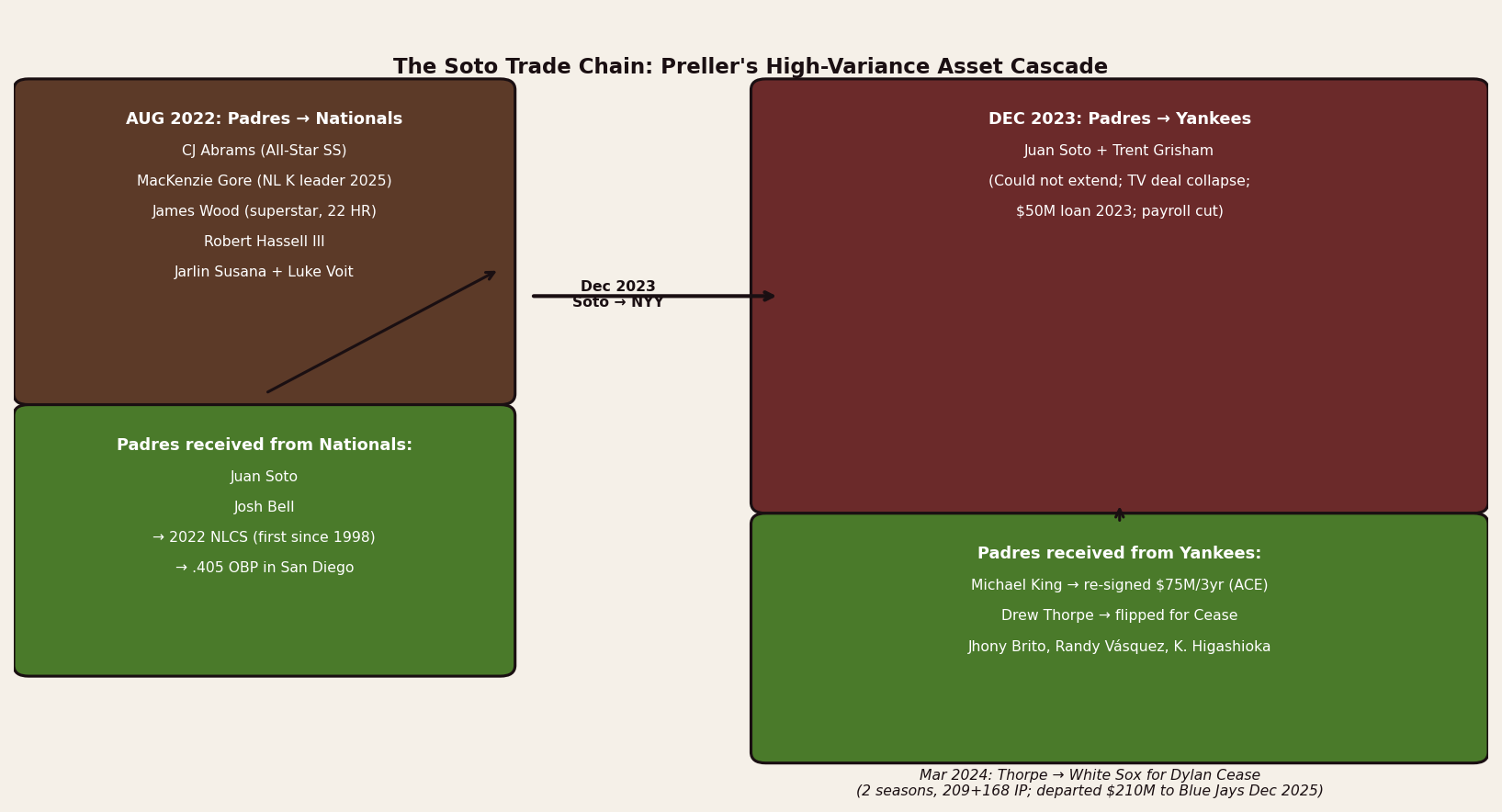
In August 2022, Preller sent C.J. Abrams (now an All-Star shortstop), MacKenzie Gore (NL strikeout leader in 2025), James Wood (22 home runs through 2025, tracking toward superstar status), Robert Hassell III, and Jarlin Susana to Washington for Soto and Josh Bell. The trade was legitimate: Soto delivered a .405 OBP and .893 OPS in 214 Padres games, and the 2022 NLCS run was the franchise's deepest playoff journey since its 1998 World Series appearance. Preller has never wavered from defending it: "You're hoping that we could trade for Juan Soto with none of those guys in there, but we know that's not realistic."
The subsequent trade, however, is where the chain's costs became fully visible. In December 2023, the Padres were forced to trade Soto to the Yankees — not because Soto had underperformed, but because a collapsed regional sports network television deal, a $50 million emergency payroll loan in 2023, and the prohibitive cost of extending Soto combined to make his retention financially untenable. The Padres received Michael King (subsequently re-signed to a 3-year/$75M deal and now the team's ace), Drew Thorpe, and three other pitchers. Thorpe was immediately used as the centerpiece of a March 2024 trade for Dylan Cease from the White Sox — giving Padres pitching the injection it desperately needed after losing Blake Snell, Seth Lugo, Nick Martinez, and Michael Wacha to free agency.
Cease delivered two excellent seasons: a 3.86 ERA over 209 innings in 2024, and a team-best 215 strikeouts and 3.49 ERA in 2025. Then, in December 2025, he signed with the Toronto Blue Jays for $210 million. The Padres, having traded their farm system to acquire Soto and eventually traded Soto to acquire Cease, then watched Cease depart. What remained was Michael King, a depleted farm ranked dead last in baseball, and four position players with contracts running through 2033 or 2034.
The Farm System Cost
The compounding effect of Preller's trade activity on the organizational depth is documented starkly in farm system rankings. In 2018, MLB Pipeline ranked the Padres' minor league system #1 in baseball — seven top-100 prospects, anchored by Tatis Jr., MacKenzie Gore, and Luis Urías. The organization was positioned as the sport's most promising rebuild. Seven years later, entering 2026, the system is ranked 30th out of 30 by both The Athletic and USA Today. USA Today noted bluntly that the Padres "basically gutted their farm system last year at the trade deadline" — a reference to the trade of shortstop prospect Leo De Vries to the Athletics for reliever Mason Miller. Beyond Ethan Salas (catcher, #77 MLB Pipeline), Kruz Schoolcraft (LHP, #95), and 2024 first-round pick Kash Mayfield, the system is devoid of meaningful organizational depth.
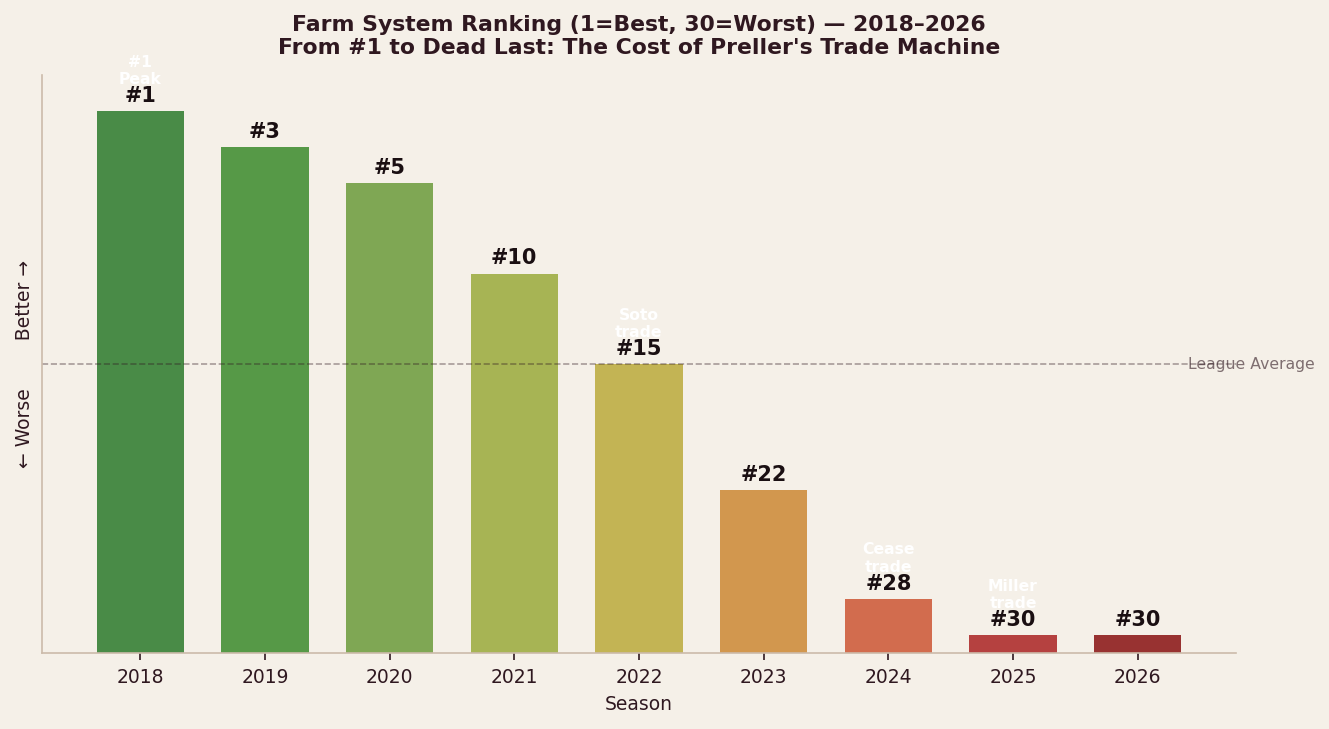
The practical consequences of a depleted farm system are most visible in the Padres' roster flexibility — or its absence. When Cease departed for Toronto, the Padres had no top-tier internal options to absorb the rotation loss. When Yu Darvish required elbow surgery (missing all of 2026), there were no depth arms in Triple-A capable of stepping into a high-leverage starting role. The team's 2026 rotation relies on Michael King, Nick Pivetta, and a recovering Joe Musgrove — a trio of quality starters, but one without the depth cushion that a healthy farm system would provide.
Part II: The Managers — From Green to Shildt
In eleven seasons under Preller, six full-time managers have occupied the Padres' dugout. Including Bud Black, whom Preller inherited and fired in 2015, their departures follow a pattern: two were fired outright after their own full tenures (Green and Tingler), one left for a better opportunity citing organizational friction (Melvin), and one retired citing burnout and emotional toll while simultaneously embroiled in coaching staff conflict (Shildt). The current manager (Stammen) was chosen specifically because he had no prior managerial experience and was considered organizationally embedded. Understanding why each departure happened requires understanding what Preller's roster environment demanded of the men who managed it.
Andy Green and Jayce Tingler: The Rebuild Years (2016–2021)
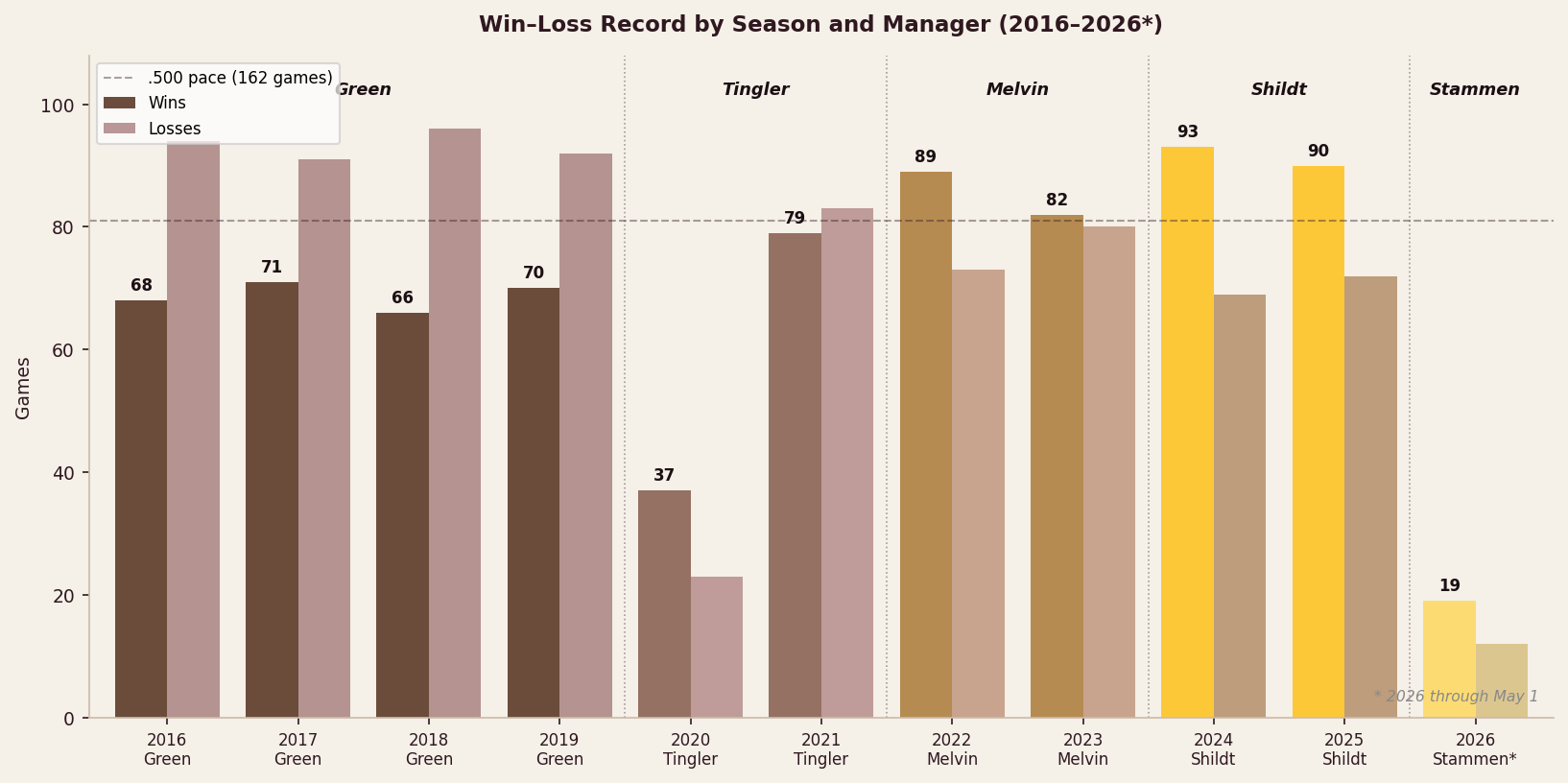
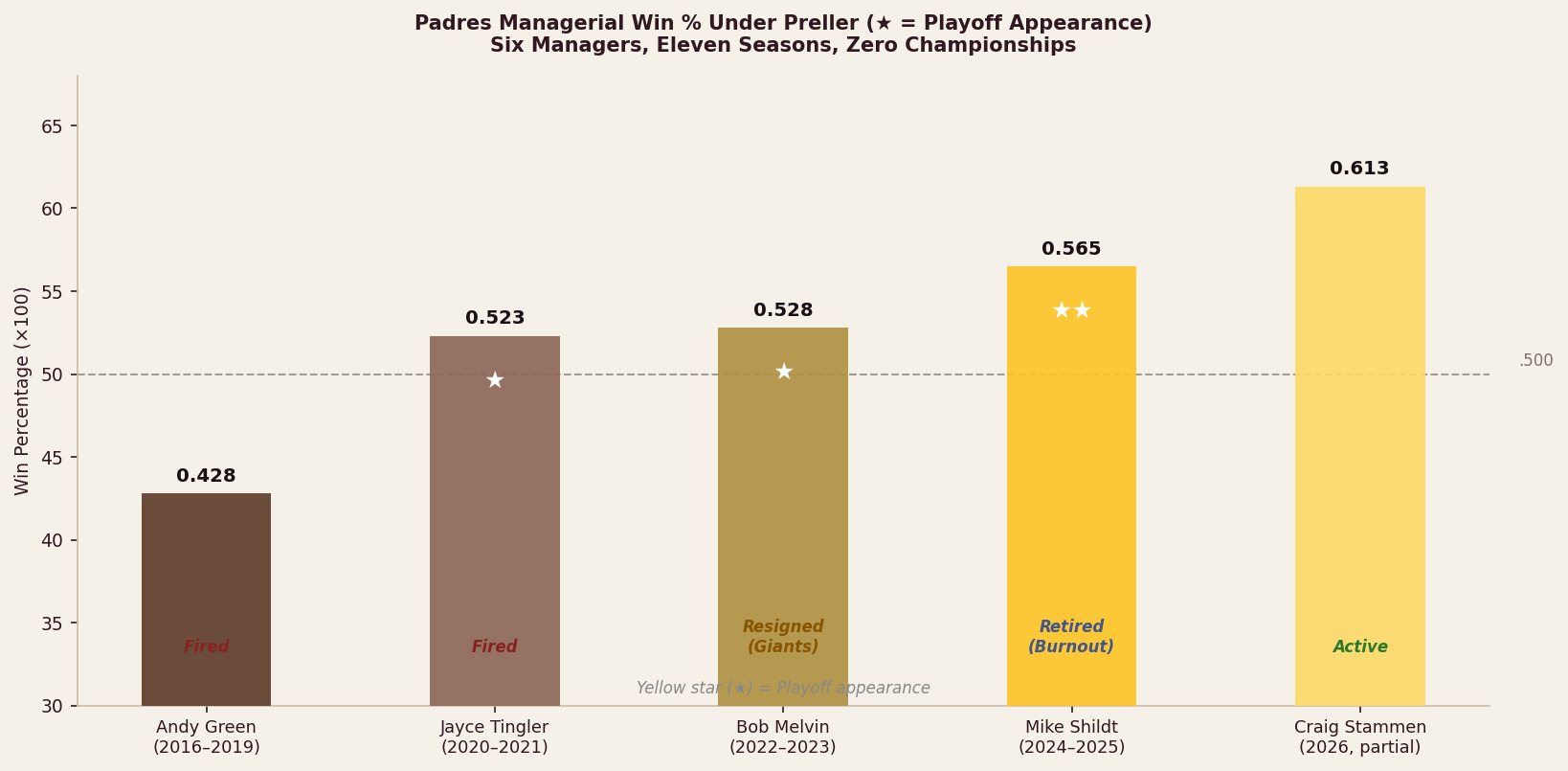
Andy Green was hired in November 2015 as the Padres commenced a full organizational rebuild — acknowledging that the 2014-15 "win now" acquisitions (Matt Kemp, Justin Upton, Craig Kimbrel, Derek Norris) had been a costly failure that left the franchise worse than when Preller started. Green was given the rebuild assignment: develop Tatis Jr., let Gore and the farm system mature, absorb losses. He did the job: 274-366 (.428) over four seasons, but he was fired in September 2019 when the 2019 team — which had been expected to compete with Machado on board — collapsed in the second half, finishing 70-92.
Jayce Tingler inherited the first competitive roster of the Preller era. In the COVID-shortened 2020 season, he managed a 37-23 record and the team's first playoff appearance since 2006. The 2021 campaign exposed a more troubling pattern: San Diego was 79-83, having been 17 games above .500 on August 11 before collapsing through September. Tingler was fired after the season, with Preller citing the need for change to "reach our championship potential." Analytically, the collapse was primarily a roster depth and relief pitching issue — but the manager absorbed the consequence, as managers tend to do.
Bob Melvin: The 2023 Anomaly and the Exit (2022–2023)
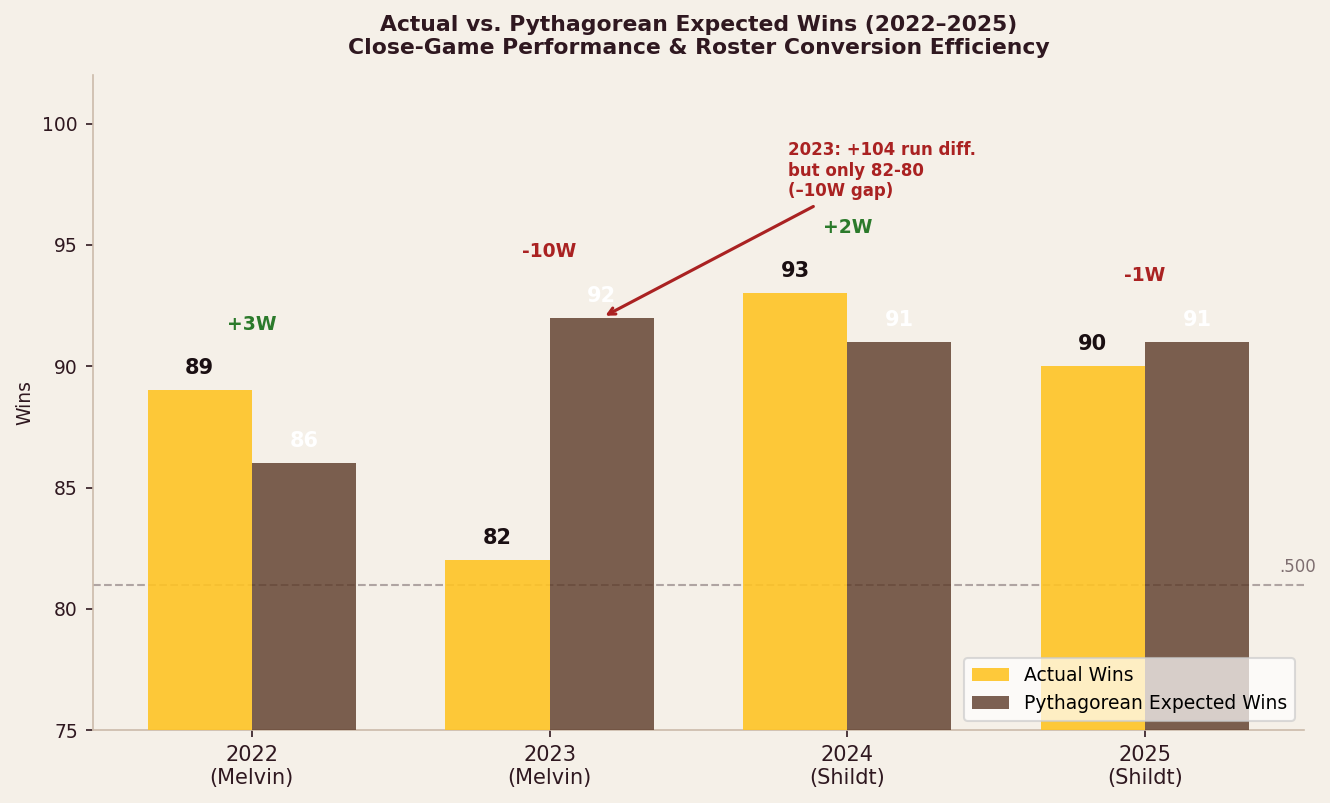
Bob Melvin arrived with a Hall of Fame managerial pedigree, multiple AL Manager of the Year awards, and a reputation as a tactically sophisticated, analytically engaged leader. His 2022 season was the most successful in recent franchise history: an 89-73 record, a first-round upset of the New York Mets, wins over Atlanta in the NLDS, and an NLCS appearance — the first in 24 years. His Pythagorean record in 2022 was 86-76; he overperformed by three wins, converting a mid-tier run differential into a playoff push that exceeded expectations.
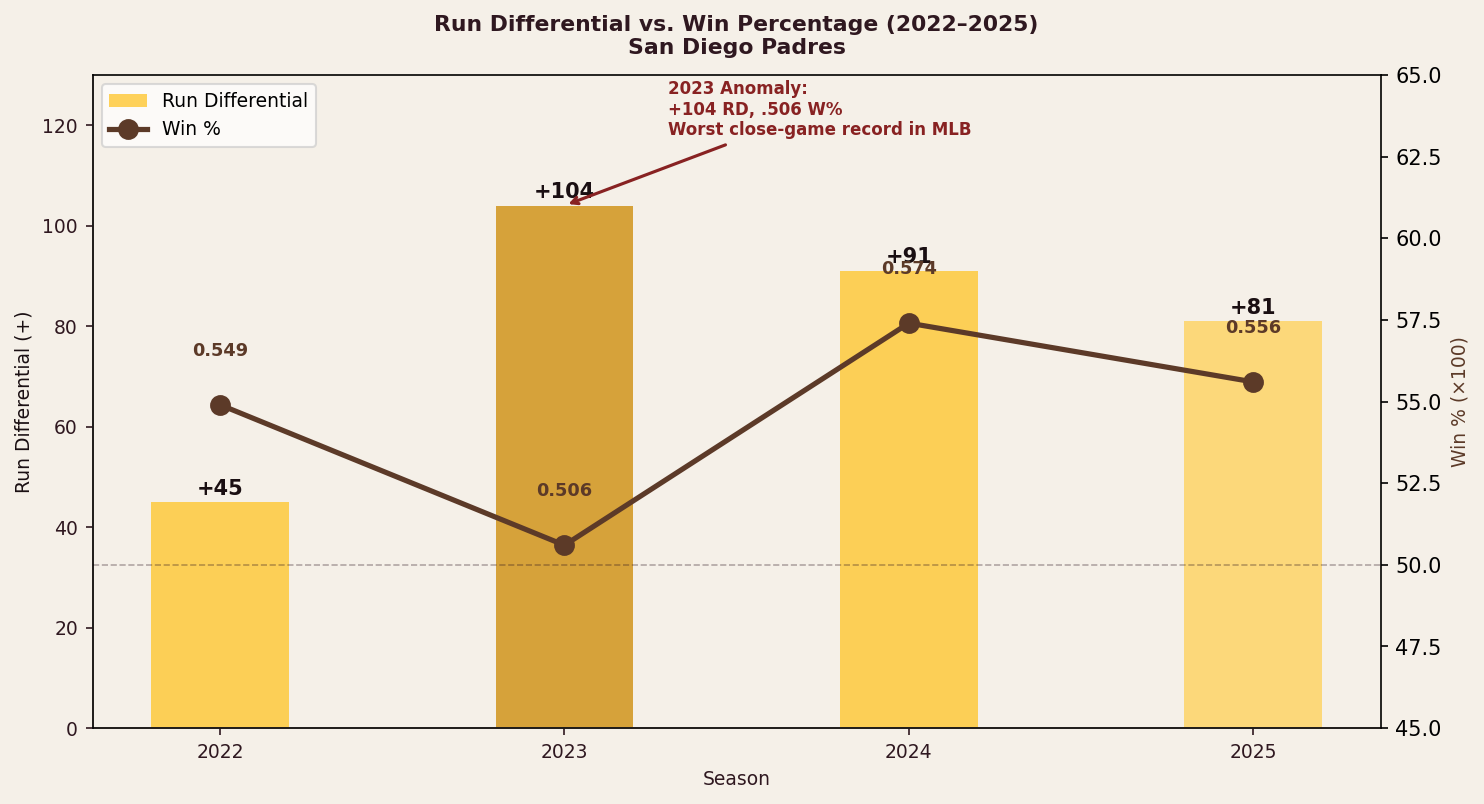
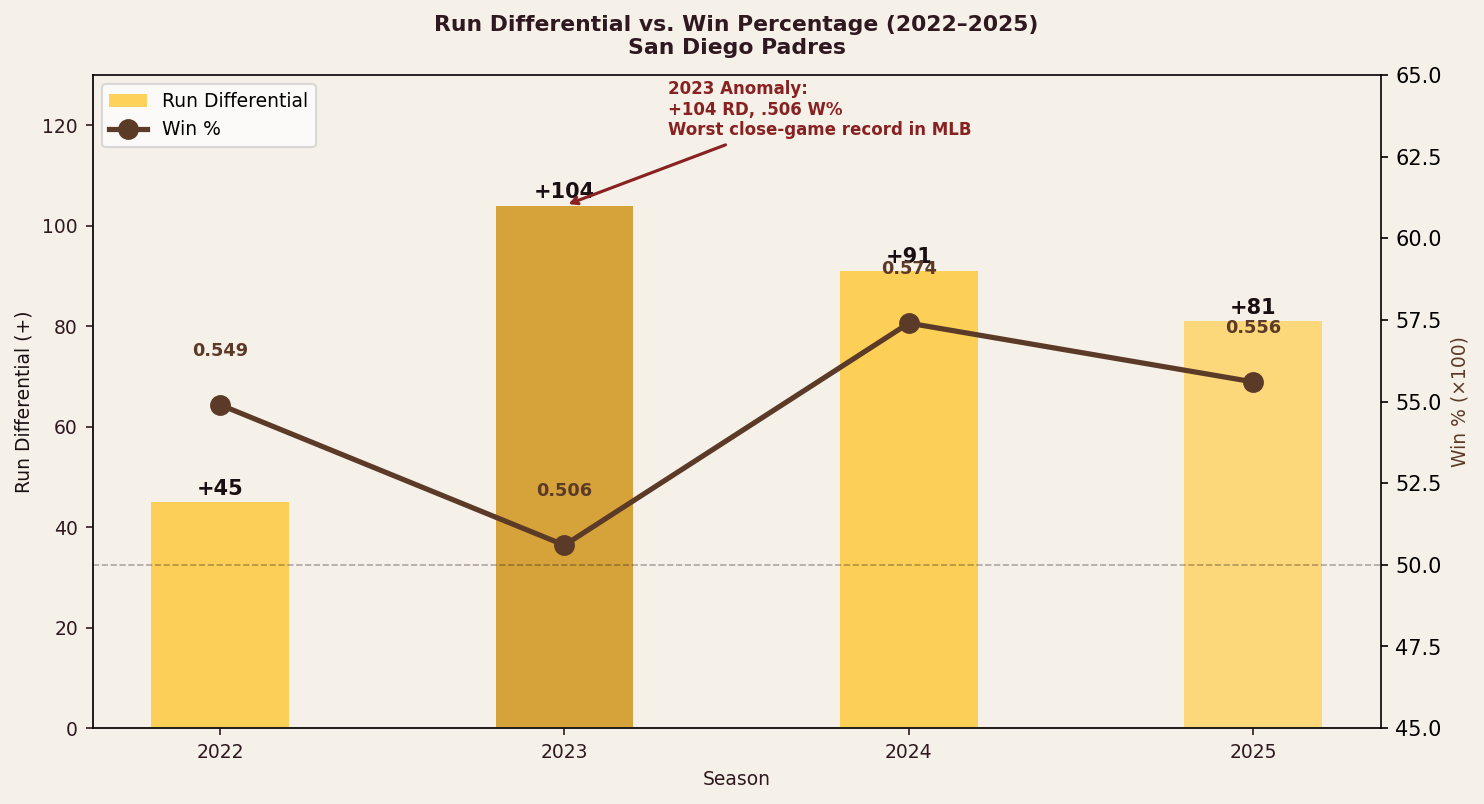
The 2023 season is one of the most analytically confounding in recent MLB history. The Padres scored 752 runs and allowed only 648 — a +104 run differential that should have produced approximately 92 wins by Pythagorean projection. Their actual record: 82-80. The gap of minus-ten wins represented the single worst close-game conversion in the sport that year. They went 9-23 in one-run games and 2-12 in extra innings. The statistical analysis is unambiguous: this was not a managerial failure but a roster construction issue — specifically, a bullpen designed for high-leverage scenarios that catastrophically underperformed in exactly those scenarios. Melvin's role in the bullpen deployment decisions is legitimate to scrutinize, but the depth and magnitude of the failure exceeded any tactical explanation.
Melvin left after 2023 — with one year remaining on his contract — to manage the San Francisco Giants. The published accounts cite a "rift" with Preller that both parties subsequently downplayed, along with Melvin's expressed desire to return to the Bay Area where he spent much of his career. Reading between the lines: the 2023 season, in which the organization spent $291 million (third in MLB), failed to make the postseason, and watched a franchise-quality run differential not translate to wins, created a pressure dynamic that made the working relationship untenable. Melvin's departure was, in effect, a mutual recognition that the fit was not right — and that the team's financial and roster architecture needed a reset.
| Year | Manager | Actual W-L | RS | RA | Run Diff. | Pythag W-L | Gap |
|---|---|---|---|---|---|---|---|
| 2022 | Melvin | 89–73 | 705 | 660 | +45 | 86–76 | +3 |
| 2023 | Melvin | 82–80 | 752 | 648 | +104 | 92–70 | –10 |
| 2024 | Shildt | 93–69 | 760 | 669 | +91 | 91–71 | +2 |
| 2025 | Shildt | 90–72 | 702 | 621 | +81 | 91–71 | –1 |
Table 2 — Run differential vs. win performance (2022–2025).
Mike Shildt: Peak Performance and the Burnout Exit (2024–2025)
Mike Shildt was hired in November 2023 with a specific organizational mandate: convert a team that had dramatically underperformed its talent into a consistent playoff contender. He had a precedent — his own — having managed the St. Louis Cardinals to a .556 winning percentage and a 2019 NL Manager of the Year award before being fired for "philosophical differences" at season's end in 2021. He had spent 2022-2023 with the Padres organization in a player development advisory role, learning the roster and organizational culture from the inside.
His results were the best in franchise history. In 2024, Shildt led a team whose key players (Yu Darvish, Joe Musgrove, Fernando Tatis Jr., Ha-Seong Kim) all missed significant time to injury, to a 93-69 record — "the best offensive season in franchise history" per organizational accounts, achieved despite those absences. Jackson Merrill's breakout (5.3 fWAR, All-Star selection) and the acquisition of Dylan Cease provided the roster foundation, but Shildt's day-to-day management of a depleted roster was analytically impressive. His Pythagorean gap in 2024 was +2 wins — a virtually perfect conversion of run differential to actual wins, suggesting sound tactical management across the season.
In 2025, Shildt delivered a second consecutive 90-win season — a franchise first. Dylan Cease's 215-strikeout campaign and Nick Pivetta's career year (2.87 ERA, 6th in NL Cy Young voting) anchored a rotation that needed both. The postseason exit — a Wild Card loss to the Cubs in three games — was abrupt but unsurprising given the format's volatility. Shildt's two-year cumulative record of 183-141 (.565) is the highest winning percentage of any full-time Padres manager.
On October 13, 2025, Shildt announced his retirement. His public statement cited the "severe toll" of the baseball season on his mental, physical, and emotional health — mentioning poor sleep, chest pains, hair loss, and even death threats from fans. He stated he had been contemplating the decision since late August. In subsequent interviews, he described the experience as "joyless," acknowledged that the grind "probably didn't have that in me anymore," and framed his departure as a health priority.
The industry read was more complicated. Reports emerged within days of alleged "very poor relationship[s]" with coaching staff members, accounts of verbal abuse, and claims that coaches had "nearly fought." Shildt's own acknowledgment that his high standards led to "burnout" of those around him — combined with the fact that this was his second managerial exit under similar circumstances (Cardinals, 2021: "philosophical differences") — painted a picture of a highly effective tactician whose leadership style created organizational friction that ultimately became untenable. Preller had managed that friction for two seasons; after the 2025 Wild Card exit, he did not seek to manage it further.
Part III: Craig Stammen — The Unconventional Hire
From Reliever to Manager: An Unprecedented Path
The hiring of Craig Stammen on November 6, 2025 was, by any objective measure, one of the most unconventional managerial appointments in recent MLB history. Stammen had no coaching experience at any level — not in the minors, not on a major league staff, not as a coordinator. He had never managed a game professionally. He was not initially a formal candidate for the position; he helped interview other candidates before expressing his own interest to Preller. He became one of the only managers in MLB history to have been a former pitcher — and the only one currently working as a field manager whose playing career was spent exclusively as a reliever.
What Stammen had was organizational knowledge and cultural embeddedness. After retiring as a player in August 2023 (torn shoulder capsule), he joined the Padres in January 2024 as an assistant to the major league coaching staff and baseball operations department — a hybrid role that gave him access to front office trade discussions, major league player interactions, and minor league development work simultaneously. Preller cited Stammen's "deep organizational knowledge, natural leadership qualities, and ability to elevate those around him" as the deciding factors. In selecting a manager with no experience, Preller was effectively signaling a preference for a collaborative, organizationally aligned leader over a demanding, autonomous tactician. Given Shildt's departure, this was a deliberate correction.
2026 Performance: Early Evidence
Through May 1, 2026, Stammen's Padres are 19-12 (.613) — second in the NL West, a half-game behind the Dodgers, holding a Wild Card position. The team started 1-4 in the season's opening week before going 18-7 in April. Their run differential is a modest +2, and their expected win-loss record by Pythagorean projection is approximately 16-15 — meaning Stammen is overperforming the underlying run data by roughly three wins through 31 games.
Stammen's 2026 analytical signature. He has used a different lineup in all 17 games of one stretch — 13 different lineup configurations in 13 contests — employing heavy platoon usage, rest day rotation for veterans, and positional flexibility. Bench coach Randy Knorr (Stammen's former college coach, now serving as the experienced voice in the dugout) provided at least one specific lineup adjustment that produced a series win. Stammen has been explicit: he does not expect to have one consistent lineup for the entire season. For a roster with Tatis Jr. in an offensive drought (0 HR in 131 plate appearances, 0.0 WAR), Machado aging at 33, and Musgrove still working his way back from Tommy John, this tactical flexibility is analytically appropriate. Today's configuration is on tonight's Padres edges.
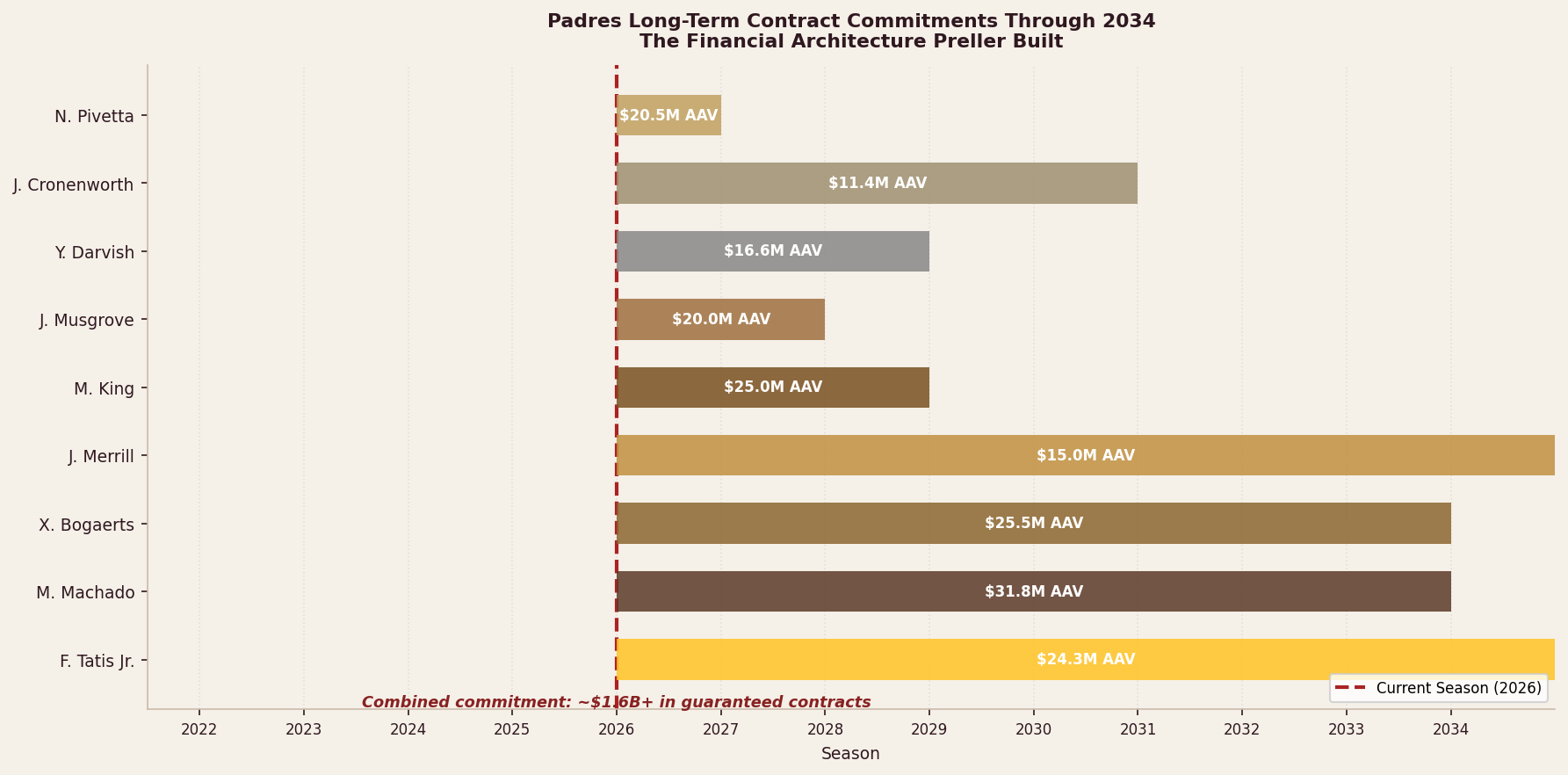
The central challenge Stammen faces is managing the gap between the roster's contractual value and its current production. The Padres have committed $1.6+ billion in guaranteed money to eight position players and starting pitchers through 2033-2034. Four of those players — Tatis Jr. ($24.3M AAV), Machado ($31.8M AAV), Bogaerts ($25.5M AAV), and Merrill ($15.0M AAV starting 2026) — form the position player core. As of May 1, only Bogaerts (5 HR, .783 OPS, recovering from 2023-2025 injury struggles) is producing close to contract value. Tatis's ongoing power outage, Machado's managed workload, and the broader offensive underperformance (.233 team batting average, 22nd in MLB) represent the short-term roster challenge that Stammen's lineup flexibility is attempting to navigate.
| Player | Contract (AAV) | 2026 Line | WAR | Status |
|---|---|---|---|---|
| Xander Bogaerts | $25.5M | .268/.344/.443, 5 HR | 0.7 | Best start since signing |
| Fernando Tatis Jr. | $24.3M | .250/.323/.286, 0 HR | 0.0 | Career-long HR drought (131 PA) |
| Manny Machado | $31.8M | Managing rest days | 0.3 | Managed workload (age 33) |
| Jackson Merrill | $15.0M AAV | .295/.360/.447 range | 0.1 | Key centerpiece, solid |
| Michael King | $25.0M | 3.55 ERA proj. | — | Ace, performing as expected |
| Joe Musgrove | $20.0M | Returning from TJ | — | Tommy John rehab, targeted mid-2026 |
| Yu Darvish | $16.6M | Elbow surgery | — | Out 2026 |
Table 3 — 2026 Padres core player status (through May 1).
Part IV: The Metrics — A Full Statistical Audit
Eleven Seasons of Performance Data
The following tables and analysis integrate the complete performance record of the Preller era across all managerial tenures. The goal is to identify which portions of the franchise's competitive results are attributable to roster construction decisions — Preller's domain — and which reflect managerial execution within those constraints.
| Manager | Tenure | Games | W-L | W% | Playoffs | Exit |
|---|---|---|---|---|---|---|
| Andy Green | 2016–2019 | 640 | 274–366 | .428 | 0 for 4 | Fired |
| Jayce Tingler | 2020–2021 | 222 | 116–106 | .523 | 1 for 2 (WC 2020) | Fired |
| Bob Melvin | 2022–2023 | 324 | 171–153 | .528 | 1 for 2 (NLCS 2022) | Resigned (Giants) |
| Mike Shildt | 2024–2025 | 324 | 183–141 | .565 | 2 for 2 (NLDS/WC) | Retired (burnout) |
| Craig Stammen | 2026–pres. | 31 | 19–12 | .613 | In progress | Active |
Table 4 — Complete managerial record under A.J. Preller (2016–2026).
Three observations deserve emphasis from this table. First, the trend line of winning percentage is consistently upward: each full-time manager has outperformed his predecessor's W%, from .428 (Green) to .565 (Shildt). This pattern is not random — it reflects Preller continually constructing more competitive rosters as the team moves from rebuild to contention, and hiring managers better-suited to those rosters. Second, every manager exit has involved some form of organizational friction — two firings, one departure with reported conflict, one burnout retirement with reported coaching staff conflict. Third, playoff round exits have plateaued: the Padres have reached the NLCS once (2022), the NLDS once (2024), and two Wild Card series (2020, 2025), but never advanced beyond the NLCS round in the entire Preller era.
The Payroll Efficiency Question
One of the most analytically significant findings from Preller's era concerns the relationship between payroll and wins. In 2023 — the Padres' most expensive season ($291M CBT) — they produced 82 wins and missed the playoffs. In 2024, after reducing their CBT payroll to $228M through the Soto trade, they produced 93 wins and reached the NLDS. This inversion has a structural explanation: the Soto trade not only freed payroll but also replenished the rotation (Michael King, who became the team's ace) while adding organizational flexibility. The lesson Preller appears to have absorbed — that financial constraint can force better decision-making — is visible in the subsequent re-investment pattern: the 2025 CBT climbed back to $270M, but around a more organically constructed core (Merrill, King, Pivetta) rather than a single superstar contract.
It is worth a structural caveat here: high-payroll teams are designed to buy above-average wins, and each incremental win above league average is more expensive than the last by definition. So a top-five payroll producing wins at a higher dollar-per-win rate than league average is not, on its own, evidence of inefficiency. The Padres' more telling efficiency signal is the within-tier comparison: at $291M in 2023, the team finished below league-average win totals — that's not the structural premium of a high-payroll team, that's a roster construction failure inside an elite payroll bracket.
The long-term financial architecture Preller has built is simultaneously the franchise's greatest strength and its most significant risk. With Tatis ($24.3M AAV through 2034), Machado ($31.8M through 2033), Bogaerts ($25.5M through 2033), Merrill ($15M through 2034), King ($25M through 2028), and Musgrove ($20M through 2027) all committed, the payroll floor is effectively locked above $150 million for the next seven years regardless of on-field performance. This is a bet that these players will age gracefully and that the franchise will sustain the financial health to support them — neither of which is guaranteed.
Part V: The Pattern and The Verdict
The Organizational Friction Constant
What emerges from eleven years of Padres history under Preller is a consistent, repeating dynamic: highly capable managers produce increasingly strong results, accumulate friction with Preller's organizational structure, and depart under circumstances that reflect that friction rather than performance failure. Andy Green was fired despite doing the rebuild job assigned to him. Jayce Tingler was fired after a collapse that was primarily a roster depth failure. Bob Melvin departed citing Bay Area roots but amid reports of organizational misalignment that both parties acknowledged. Mike Shildt achieved the franchise's best two-year record, then retired citing burnout from a job he described as "joyless" — with reports of coaching staff conflict following immediately after his exit.
This pattern does not indict any individual manager. It suggests, instead, that Preller's organizational environment consistently creates friction with experienced, demanding managers. The common thread is not managerial incompetence; it is organizational culture. Preller's high-control, high-information front office model — in which the GM is deeply involved in roster decisions, trade conversations, and player deployment preferences — appears to conflict with managers who maintain strong independent professional standards for how a major league staff should function. Shildt's "philosophical differences" exit from St. Louis and his burnout exit from San Diego are not coincidental. They reflect a managerial personality that performs at a high level precisely because it is demanding — and that generates friction wherever it is deployed, including in San Diego.
Craig Stammen as Organizational Response
The selection of Stammen — organizationally embedded, without prior managerial independence, instinctively collaborative with his bench coach and front office — reads as a deliberate correction. Preller chose, for the first time, a manager who was not an established independent professional with his own staff culture and tactical philosophy. Instead, he chose someone who built his understanding of how to manage from within Preller's own organization, who sat in front office trade discussions, who learned management by watching Preller manage. The bet is that low organizational friction, combined with genuine baseball intelligence and positional knowledge from Stammen's playing career, can deliver competitive results without the interpersonal volatility that has characterized each previous managerial tenure.
The early evidence supports, but does not confirm, this thesis. Stammen's 19-12 start is encouraging. His analytical approach (heavy platoon, lineup flexibility, collaborative decision-making) is appropriate for a roster that has significant injury uncertainty and star-player underperformance. His ability to manage Tatis's extended slump — a $24.3M player producing 0.0 WAR through 31 games — without public criticism, while keeping the team winning, suggests the mature interpersonal approach Preller was seeking.
Preller's Ledger: Genuine Achievement and Structural Limits
A fair accounting of A.J. Preller's tenure must acknowledge genuine achievements alongside structural criticisms. He correctly identified Fernando Tatis Jr. in a trade for an aging James Shields — among the most consequential minor acquisitions in modern front office history. He orchestrated a 2022 NLCS run that electrified a franchise long starved of postseason significance. His trade deadline work in 2024 and 2025 — acquiring Mason Miller, Freddy Fermin, and Ramon Laureano while managing payroll — has been described as "masterpieces." His ability to repeatedly rebuild from farm system depletion, most recently with the Schoolcraft and Mayfield acquisitions, demonstrates genuine organizational resilience.
But the structural criticisms are equally genuine. Six managers in eleven years is an organizational failure pattern, not bad luck. A farm system ranked #1 and then #30 within seven years is not just the cost of winning — it is evidence of a depletion cycle that leaves the organization perpetually thin on organizational depth at exactly the moments when the major league roster requires it. The 2023 season — the most expensive in franchise history, producing 82 wins and a +104 run differential that went nowhere — remains the single most visible exhibit of what can go wrong when financial ambition, roster construction, and in-game execution all misalign simultaneously.
The Comparison Context: Four Franchises, One Pattern
Across the four articles in this series — Philadelphia, Boston, New York, and San Diego — a consistent structural finding emerges: in each case, the front office architect built a roster with concentrated, identifiable risks, and the manager absorbed disproportionate public accountability when those risks materialized. Rob Thomson was fired when the Phillies' pitching rotation broke down. Alex Cora was fired when the Red Sox's simultaneous rotation injuries became catastrophic. Carlos Mendoza continues to manage a Mets team whose acquisitions are injured and underperforming. Mike Shildt achieved the franchise's best two-year record and retired under organizational friction.
San Diego's version of this pattern is the most fully developed because it spans the longest time period and the most managerial tenures. Preller has had more opportunities to demonstrate both his genuine skill in constructing competitive rosters and his organizational tendency to create conditions that drive talented managers away. The Stammen hire is his most deliberate attempt to address the latter problem — to find a manager who will not generate the friction that has characterized each previous exit. Whether that experiment succeeds will be one of the defining organizational stories of the 2026 and 2027 seasons.
The Central Question
The question this series was designed to answer — who bears primary responsibility for a franchise's competitive outcomes, the manager or the front office — has a clear answer in San Diego. A.J. Preller owns the outcome. He has hired and retained every manager. He has constructed every roster. He has made every trade and signed every contract. The managers he has employed have consistently outperformed their inherited roster constraints: Green developed a franchise-caliber prospect in a rebuild context, Tingler maximized a first competitive window, Melvin produced an NLCS run from a team with a fractured roster, and Shildt posted the best two-year record in franchise history. None of them won a World Series. None of them had that within their authority to achieve. The front office builds the team, and the team has not been built quite right yet — not at the championship level, not in eleven years of trying.
That is not a dismissal of Preller. It is an honest accounting. He has gotten the franchise closer to a championship than it has been since 1998. He may yet get it there. But the ledger — including Bud Black, whom Preller inherited and dismissed in 2015 — of six managers, one depleted farm system, a $1.6 billion payroll commitment, and zero World Series appearances belongs to the man who signed every check and made every trade — not the men in the dugout.
Bottom Line: A.J. Preller has constructed the most ambitious and financially leveraged franchise in recent San Diego history. His best work — Tatis Jr., the Cease chain, the Merrill extension, two consecutive 90-win teams under Shildt — is genuinely excellent. His structural liabilities — a dead-last farm system, an eleven-year managerial carousel driven by organizational friction, and a 2023 season that spent $291M to produce 82 wins — are equally real. Craig Stammen is managing the consequences of Preller's decade of decisions with tactical flexibility and organizational harmony. Whether the result is a championship depends less on Stammen's lineup card than on whether the core of Tatis, Machado, Bogaerts, and Merrill produces at contract value simultaneously — a convergence Preller has spent eleven years and $1.6 billion trying to engineer.
All statistical data sourced from Baseball-Reference, FanGraphs, MLB.com, The Athletic, and the San Diego Union-Tribune through May 1, 2026. Pythagorean win projections calculated from RS/RA data using the formula RS²/(RS²+RA²) × 162. CBT payroll figures from Cot's Baseball Contracts and Baseball Prospectus. Farm system rankings from MLB Pipeline, The Athletic (Jan 2026), USA Today (Jan 2026), and Bleacher Report (Sept 2025). Contract figures from FanGraphs RosterResource and Spotrac. We invite informed disagreement: methodology, data, and editorial judgment can all be challenged via the contact form at /contact, and corrections are issued where warranted. This article is Part IV of a four-article series on 2026 MLB front-office and managerial leadership accountability, covering the Philadelphia Phillies, Boston Red Sox, New York Mets, and San Diego Padres.