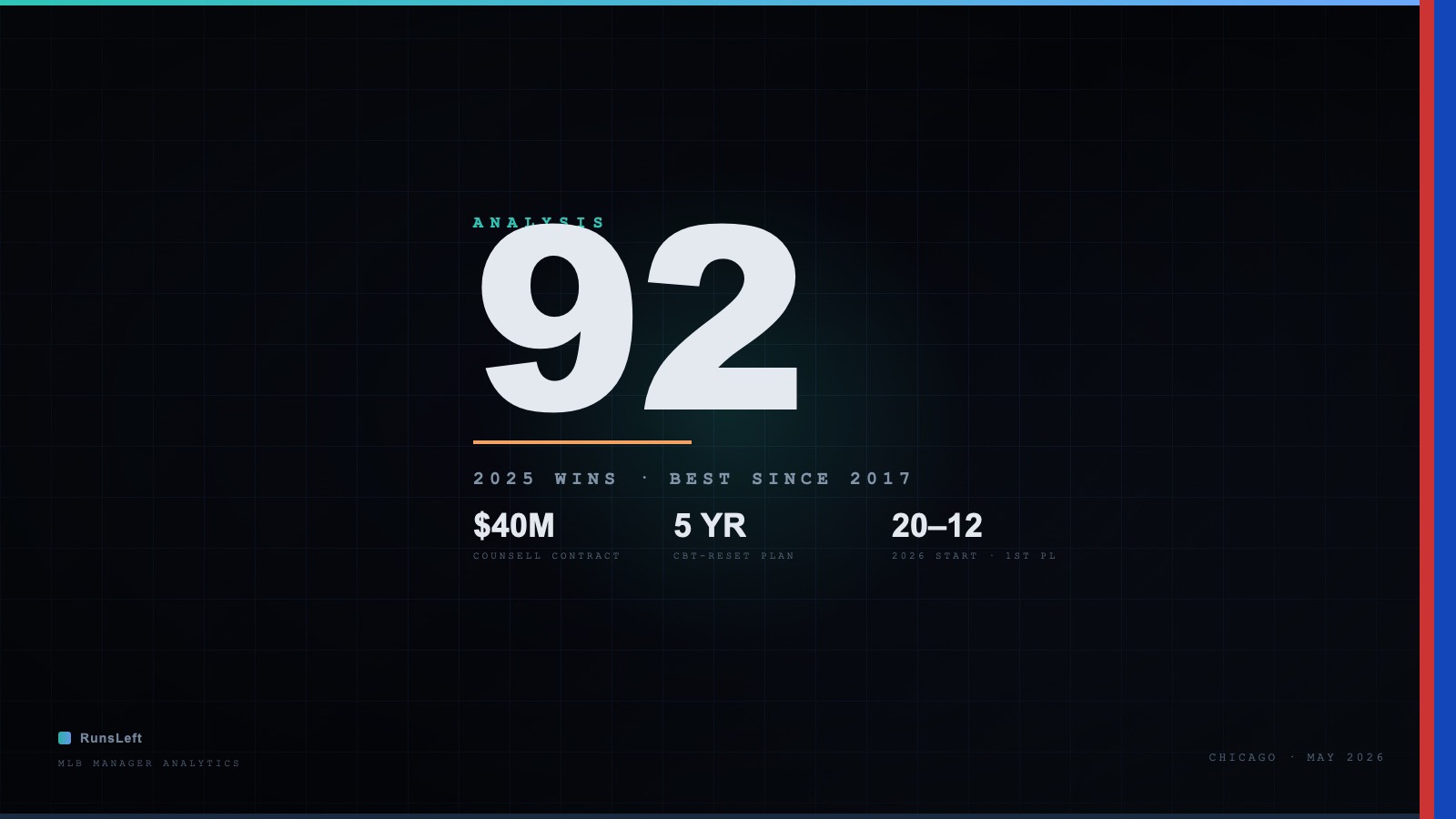
The Chicago Cubs sit in first place at 20–12 on May 2, 2026, the long payoff of Jed Hoyer's five-year luxury-tax reset, his painful 2021 teardown of the 2016 championship core, and his record-shattering November 2023 hiring of Craig Counsell — the highest-paid manager in baseball history at five years, $40 million. Hoyer fired David Ross to clear the chair for Counsell despite Ross's improving 83–79 season. Counsell stagnated at the same 83–79 in 2024, publicly demanded a 90-win roster, then delivered 92 in 2025 with the franchise's first playoff series win since 2017. The harder question is whether the architecture and the manager justify what they have cost.
This is our analytical verdict.
Craig Counsell deserves strong marks for his tactical acumen, his 2025 breakthrough, and his ability to leverage his position to improve the roster. The B+ reflects both his undeniable skill and the reality that one playoff series win in two years does not yet justify the "elite manager" label his contract suggests. If the Cubs win the division in 2026 and advance deep into October, the grade rises to A-. If they falter, questions about the $40M investment will resurface.
Jed Hoyer has executed a disciplined, intelligent rebuild that has positioned the Cubs for sustained success. The five-year luxury tax reset, farm system rebuild, and strategic free agent signings represent excellent organizational stewardship. The B grade reflects both these achievements and the reality that the Cubs have exactly one playoff series victory in five years under his leadership. The 2023 and 2024 seasons could have — and should have — produced playoff appearances with more aggressive talent acquisition. If the 2026 team wins the division and advances deep into October, the grade rises to B+. If they win the World Series, it's an A-. But until the Cubs compete for championships, not just playoff berths, Hoyer's tenure remains incomplete.
The Bottom Line
Jed Hoyer executed a disciplined five-year reset — luxury tax restraint, a painful 2021 teardown of the 2016 championship core, a farm system rebuild from #22 to #4, and patient free-agent additions — that has put the Cubs in first place in May 2026. Craig Counsell, the highest-paid manager in baseball history, stagnated in 2024, publicly demanded a 90-win roster, then delivered 92 in 2025 with Chicago's first playoff series win since 2017. The architecture is sound and the partnership is working. Until the Cubs compete for championships, not just playoff berths, both men carry unfulfilled potential.
The full case follows.
Part I: Hoyer's Philosophy — Payroll Discipline and the Long Reset
The Luxury Tax Gambit: A Five-Year Financial Plan
Jed Hoyer's defining strategic choice was rooted not in baseball romanticism but in cold financial calculus. Upon taking control in late 2020, he committed to a five-year plan to stay below Major League Baseball's Competitive Balance Tax (CBT) threshold — commonly known as the luxury tax. The objective was simple yet ruthless: reset the Cubs' penalty rate to zero, creating maximum payroll flexibility for a future contention window.
The luxury tax imposes escalating penalties on teams whose payrolls exceed the annual threshold. First-time offenders pay a 20% tax on overages; repeat offenders face rates as high as 50% plus the loss of draft picks. By operating below the threshold for five consecutive seasons, Hoyer could ensure that when the Cubs finally spent aggressively, they would do so at the lowest possible penalty rate — effectively buying themselves tens of millions in additional spending power.
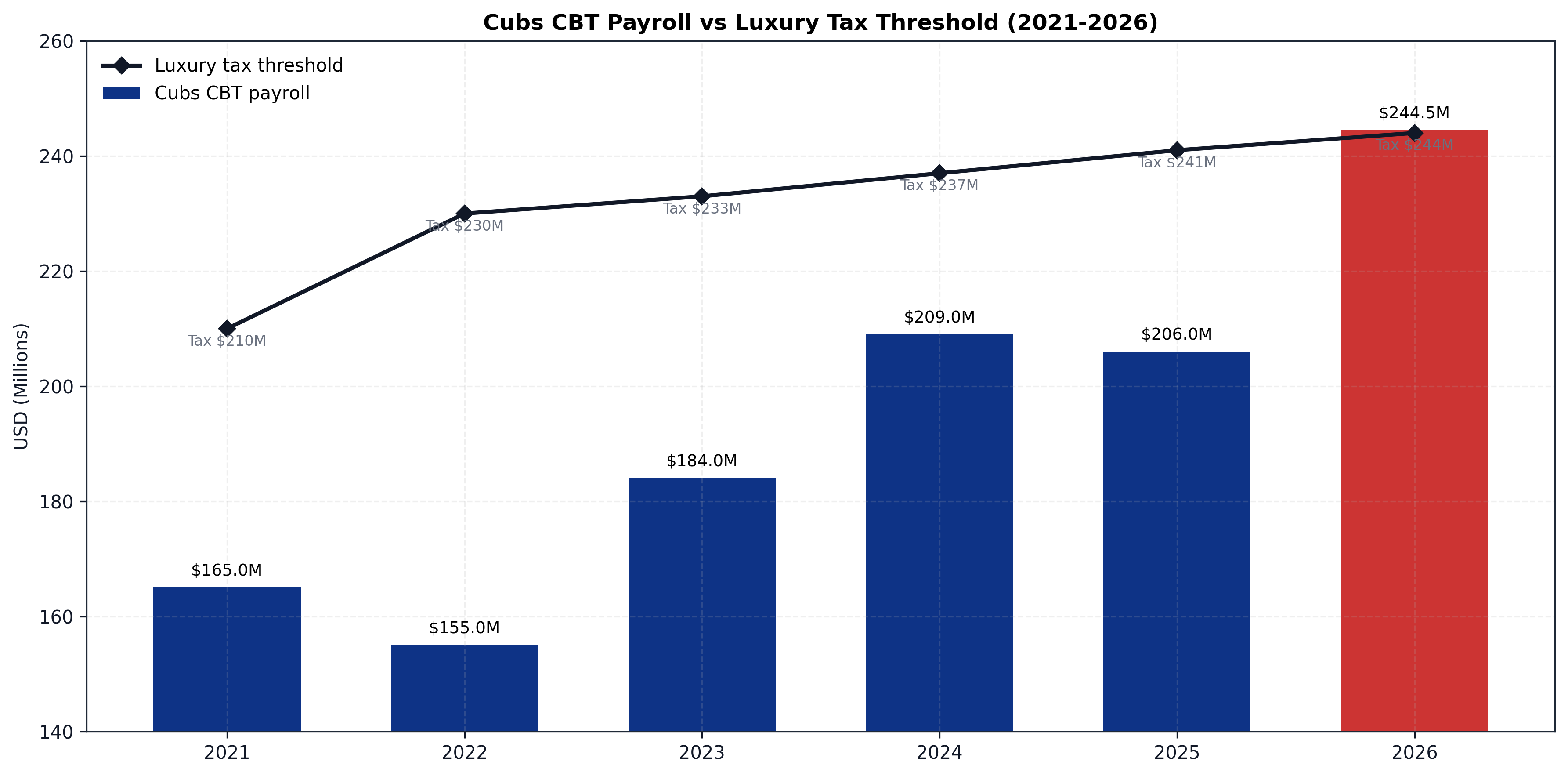
The execution was flawless. From 2021 ($165M) through 2025 ($206M), the Cubs operated comfortably beneath the rising CBT ceiling, even as nine other teams paid luxury taxes in 2025 alone. The 2026 payroll of $244.5 million — pushed over the $244M threshold by the Alex Bregman signing and Kyle Tucker's arbitration raise — represented the strategic payoff Hoyer had engineered from day one.
Critics would argue this approach prioritized financial flexibility over competitive urgency, particularly during the 2023 and 2024 seasons when the team hovered on the playoff periphery. Defenders counter that Hoyer's discipline created the very conditions that made 2025's playoff return and 2026's first-place start possible. The verdict depends on whether you view two additional years of non-contention as an acceptable cost for sustainable competitiveness.
The 2021 Teardown: Trading Icons for Futures
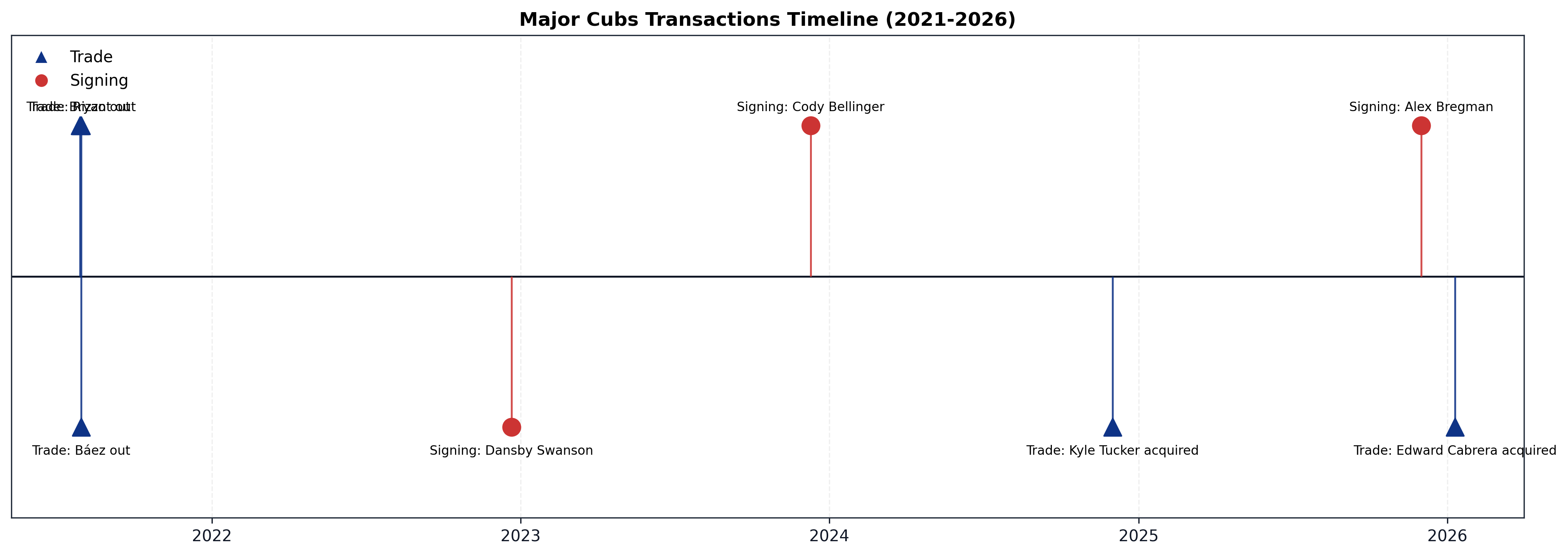
No moment defines Hoyer's tenure more starkly than the July 2021 trade deadline, when he traded the three most beloved figures from the 2016 championship team within a 48-hour span. Anthony Rizzo, Javier Báez, and Kris Bryant — the core of Chicago's first title in 108 years — were all jettisoned for prospect packages as their contracts expired and extension talks stalled.
The deals. Anthony Rizzo to Yankees: Returned Kevin Alcantara (OF) and Alexander Vizcaino (RHP). Javier Báez to Mets: Returned Pete Crow-Armstrong (OF), the Mets' 2020 first-round pick. Kris Bryant to Giants: Returned Alexander Canario (OF) and Caleb Kilian (RHP).
Hoyer defended the moves as necessary asset management. With extension talks going nowhere and the team sitting at 52-53, he faced a choice: watch these players walk in free agency for mere compensatory draft picks, or recoup tangible talent immediately. He chose the latter, framing it as the only responsible path forward for an organization with a depleted farm system ranked 22nd by Baseball America.
The returns were mixed but included one franchise-altering piece. Pete Crow-Armstrong, the centerpiece of the Báez deal, blossomed into an elite two-way center fielder who posted a 30-homer, 30-steal campaign in 2025 and became a cornerstone of the Cubs' 2026 contender. Kevin Alcantara showed promise. Alexander Canario provided depth. Caleb Kilian and Alexander Vizcaino became organizational arms. The trades didn't produce a bonanza, but they provided exactly what Hoyer needed: controllable young talent to build around.
The emotional cost, however, was steep. Fans mourned the abrupt end of an era. Trust in ownership's commitment to winning eroded. Wrigley Field attendance declined. Yet Hoyer remained unmoved, insisting the organization's long-term health demanded short-term pain. Five years later, with Crow-Armstrong patrolling center field for a first-place team, the pain feels justified — if not entirely forgiven.
The Rebuild Strategy: Farm System Resurrection
The 2021 trades were just the beginning of Hoyer's farm system rehabilitation. He combined the acquired prospects with aggressive drafting and smart low-cost acquisitions to engineer one of the league's steepest organizational climbs. By the 2024 preseason, Baseball America ranked the Cubs' system as the #4 best in baseball — a stunning reversal from the #22 ranking Hoyer inherited.
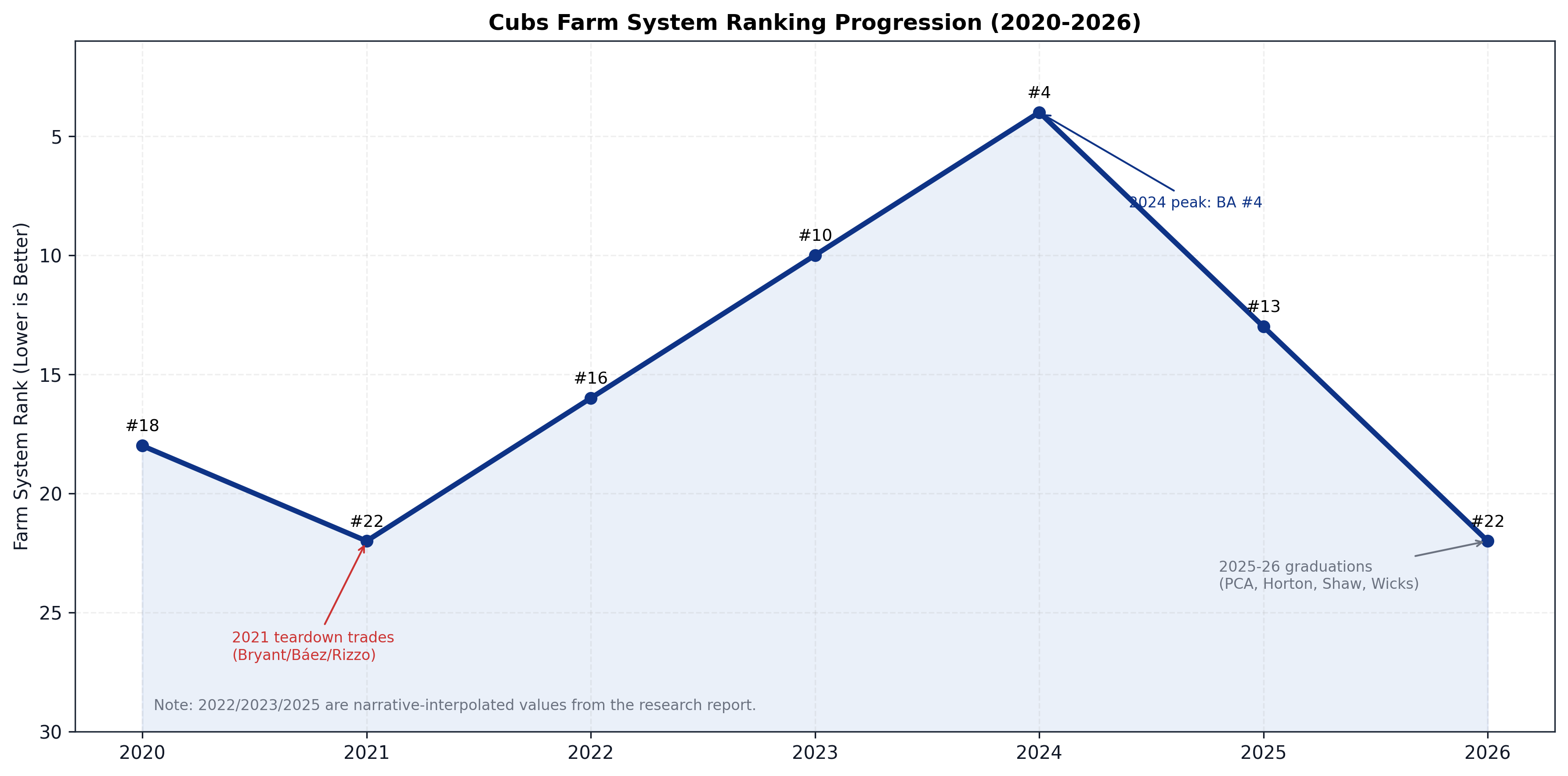
The 2024 peak was stocked with impact talent: Pete Crow-Armstrong (Báez trade), Cade Horton (2022 1st round), Matt Shaw (2023 1st round), Jordan Wicks (2021 1st round), and Moises Ballesteros (2021 international signing). By 2026, all five had graduated to the major league roster, directly contributing to the team's first-place standing. The farm system's descent back to #22 in 2026 rankings is not evidence of failure — it's evidence of a system fulfilling its purpose by feeding the parent club with controllable talent.
This farm system arc is central to evaluating Hoyer's tenure. He inherited organizational barrenness and transformed it into productivity. The question is whether the graduations occurred on an optimal timeline or whether an extra year or two of development in the minors might have yielded greater long-term returns. Given the Cubs' current competitive window, accelerating promotions appears justified.
Building the Core: Free Agency and Extensions
With the farm system restocked and financial flexibility preserved, Hoyer began methodically layering in veteran talent through targeted free agency and extensions. His approach was selective rather than scattershot, focusing on players who could anchor positions for the duration of the competitive window.
Dansby Swanson (7 years, $177M) was the first major investment, signed in December 2022 to provide elite defense, clubhouse leadership, and stability at shortstop. Shota Imanaga, the Japanese left-hander, arrived in 2024 and immediately became a top-of-the-rotation anchor. Alex Bregman (5 years, $175M) was the capstone — a franchise-caliber third baseman whose signing in December 2025 signaled Chicago's full transition to "win-now" mode.
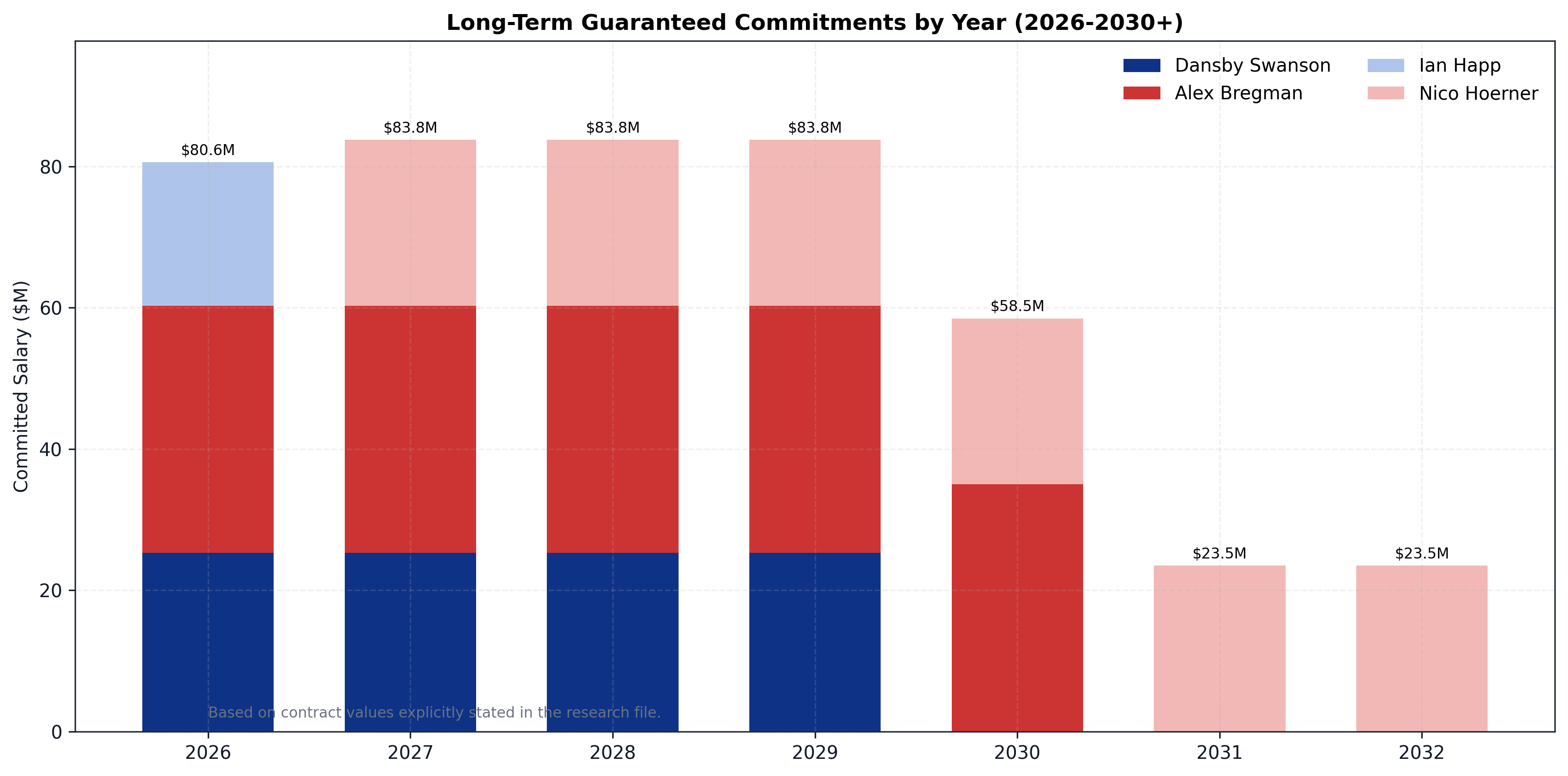
Hoyer also aggressively extended homegrown and acquired talent. Ian Happ (3 years, $61M) and Nico Hoerner (6 years, $141M beginning in 2027) were locked up to provide cost certainty and roster continuity. The message was clear: Hoyer would spend on the right players at the right time, but not a dollar more than necessary during the rebuild years.
The trade market also played a role. Kyle Tucker, acquired from Houston in a prospect-heavy deal before the 2025 season, won a Silver Slugger and became the offensive centerpiece. Michael Busch, a low-cost acquisition from the Dodgers in 2024, exploded for 34 homers in 2025. Edward Cabrera, the young right-hander acquired for top prospect Owen Caissie in 2026, addressed rotation depth. Each move reflected a front office willing to pay market price when the asset justified it — and walk away when it didn't.
Part II: The Managerial Story — From Beloved Icon to Elite Mercenary
David Ross (2020–2023): The Rebuild Steward
David Ross was hired with no prior managerial experience, but he possessed something more valuable to a franchise in transition: credibility. As the backup catcher who delivered clutch hits during the 2016 championship run, Ross was a living embodiment of Cubs glory. His hiring in 2020 signaled continuity and hope during a period of organizational uncertainty.
Ross's four-year tenure can be divided into three distinct phases. The 2020 season (34-26, .567) was an anomaly — a pandemic-shortened year in which the Cubs won the NL Central and advanced to the Wild Card Series before losing 0-2. Ross managed a roster still anchored by the 2016 core, and the playoff appearance provided a momentary reprieve from the difficult decisions looming on the horizon.
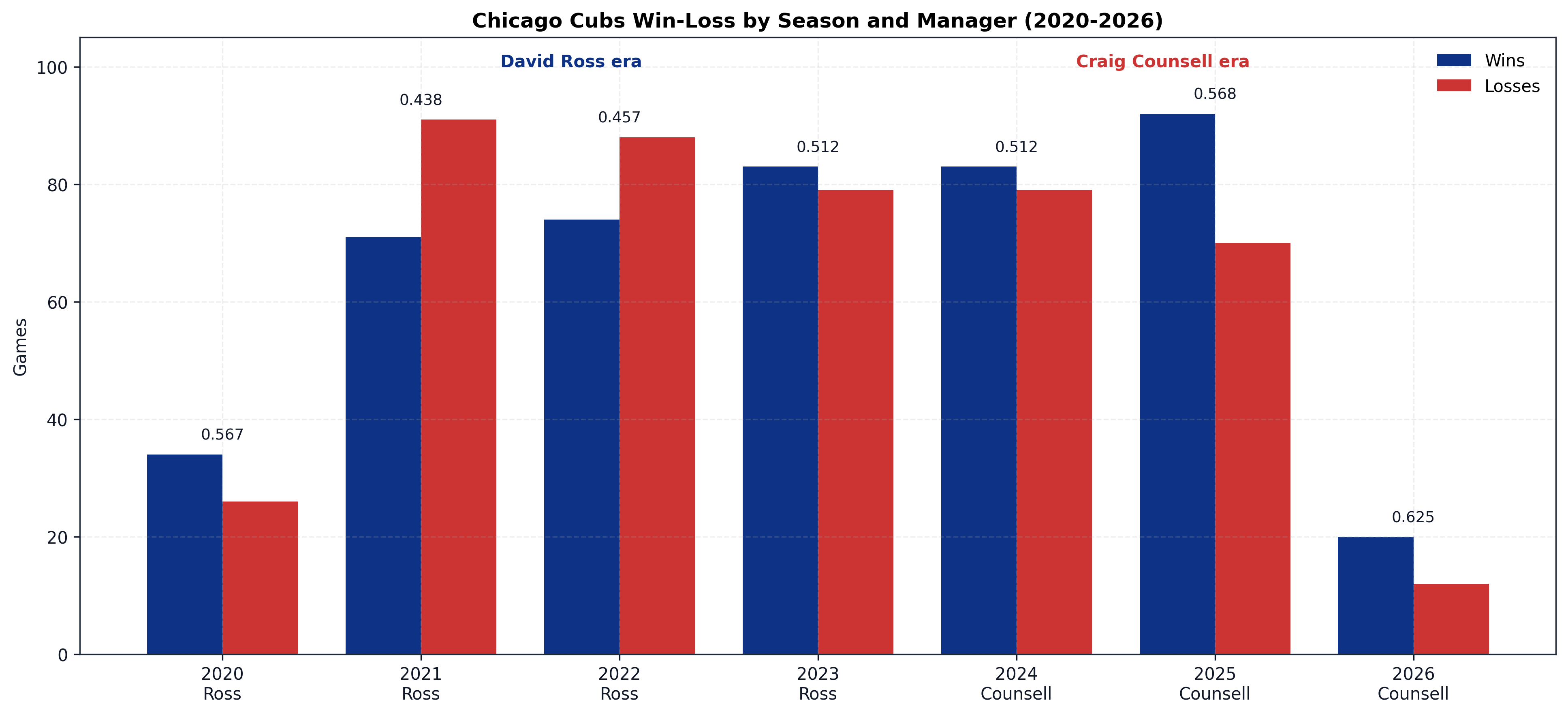
The 2021–2022 seasons were the valley of the rebuild. After the July 2021 teardown, Ross managed rosters filled with young players, reclamation projects, and organizational depth. The team went 71-91 in 2021 and 74-88 in 2022 — difficult years that tested Ross's optimism and player development skills. To his credit, he maintained clubhouse morale and fostered development without public complaints about the lack of talent.
The 2023 season (83-79, .512) represented clear progress. The young core — anchored by Dansby Swanson, Nico Hoerner, Ian Happ, and emerging prospects — competed until the final weekend for a playoff spot. Ross earned praise for his handling of a young rotation and for keeping the team engaged despite falling short. He had a contract through 2024 and every reason to believe he would lead the team into contention.
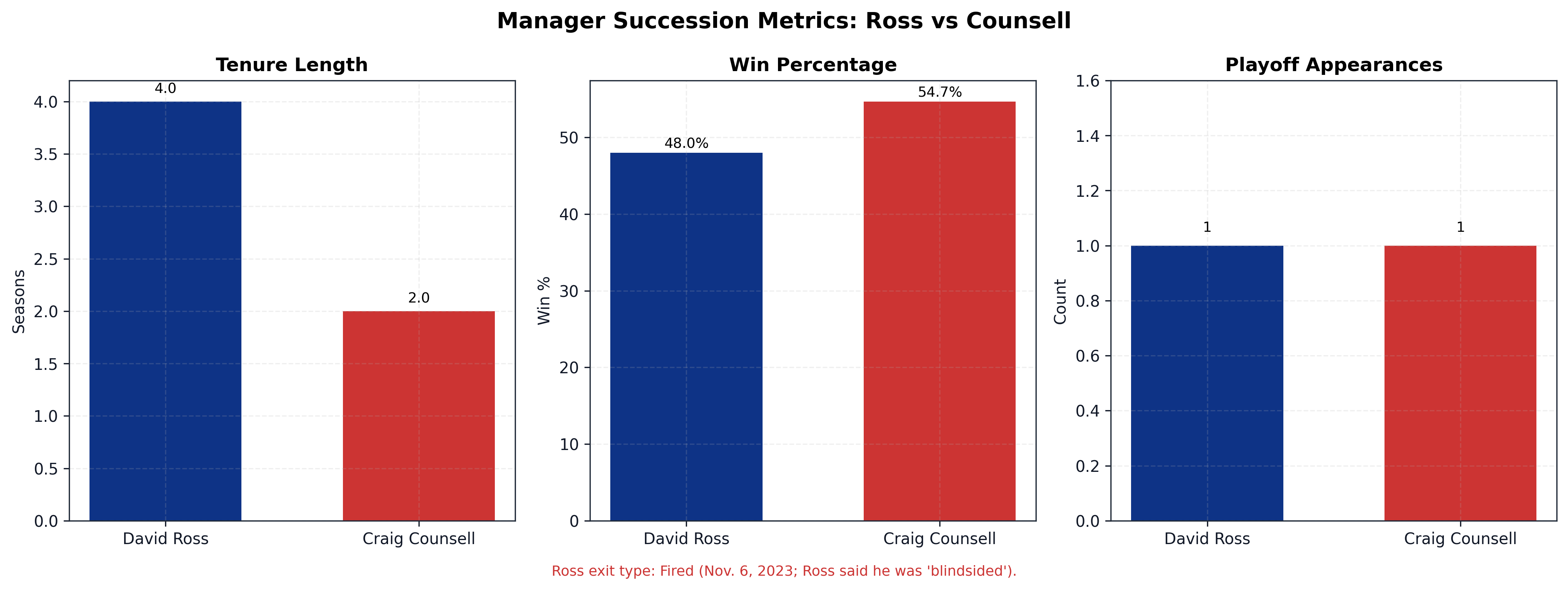
David Ross managerial record (Cubs, 2020–2023). 262–284 overall (.480 win percentage) · 1 playoff appearance (2020 NL Wild Card Series, 0–2) · Improved from 71 wins (2021) to 83 wins (2023) · Dismissed November 6, 2023, despite upward trajectory and contract through 2024.
Then came the shock. On November 6, 2023, Jed Hoyer fired David Ross. The manager admitted he was "blindsided." Fans were outraged. Hoyer's explanation was direct: Craig Counsell, one of baseball's elite managers, had become available, and the opportunity to hire him was too significant to pass up. Ross's performance wasn't the issue; Counsell's availability was the opportunity. It was a cold, calculated organizational decision that prioritized competitive advantage over loyalty.
Ross handled his dismissal with grace, eventually expressing understanding while admitting the initial sting of rejection. His legacy is that of a development-focused leader who shepherded the Cubs through their darkest years with professionalism and optimism. He gave the organization everything it asked for — and was discarded the moment something shinier appeared.
Craig Counsell (2024–Present): The Elite Acquisition
When Jed Hoyer signed Craig Counsell to a five-year, $40 million contract in November 2023, he made Counsell the highest-paid manager in baseball history. The move was both a statement of ambition and a gamble on competitive advantage. Counsell arrived from Milwaukee with a resume that dwarfed Ross's: 707-625 overall record (.531), five playoff appearances in nine seasons, and a reputation as one of the game's sharpest tactical minds.
Counsell's strengths are well-documented. He is a master of bullpen management, using high-leverage relievers in optimal situations rather than adhering to rigid ninth-inning save roles. He optimizes lineups based on matchups and platoon advantages, often platooning at multiple positions simultaneously. He is analytically sophisticated without being dogmatic, willing to trust instinct when data provides no clear answer. And he fosters a professional, player-first clubhouse culture that has consistently extracted maximum effort from rosters with limited star power.
The 2024 season (83-79, .512), however, was a disappointment. Counsell's Cubs finished with the identical record David Ross had posted the previous year — the very record that cost Ross his job. The team underperformed its talent on paper, and while Counsell's tactical adjustments were praised in some quarters, the bottom line was undeniable: the Cubs had invested $40 million for no discernible improvement in year one.
Rather than accept mediocrity quietly, Counsell did something remarkable: he publicly challenged his employer. In September 2024, he told reporters that the front office needed to build "90-win teams" if expectations were to change. It was a calculated, even brazen move — a manager with a fully guaranteed contract using his leverage to demand better resources. The gambit worked. Hoyer responded by acquiring Kyle Tucker, signing Matthew Boyd, and committing to aggressive spending ahead of 2025.
The 2025 season (92-70, .568) validated the entire sequence. Counsell guided the upgraded roster to 92 wins, the Cubs' highest total since 2017. They defeated the Padres in the Wild Card Series — Chicago's first playoff series win since that same 2017 season — and pushed the rival Brewers to five games in the NLDS before falling. Counsell earned Manager of the Year consideration, and his relationship with Hoyer appeared to have evolved into a constructive partnership between a demanding field leader and a responsive front office.
The 2026 season (20-12 through May 2) suggests continued excellence. The Cubs sit in first place with strong underlying metrics, powered by the Bregman addition and the maturation of young stars like Pete Crow-Armstrong and Matt Shaw. Counsell's tactical fingerprints are evident in Chicago's elite bullpen usage and dynamic lineup construction. The contract that once seemed exorbitant now appears justified. Those tactical fingerprints — platoon decisions, leverage-based reliever usage — drive tonight's Cubs edges.
Craig Counsell managerial record (Cubs, 2024–present). 195–161 overall through May 2, 2026 (.547 win percentage) · 1 playoff appearance (2025 NLDS, 2–4 record across two series) · Won first playoff series as Cubs manager (2025 Wild Card vs. Padres) · Publicly challenged front office in 2024; front office responded with roster upgrades.
The Counsell hire represents a gamble that is beginning to pay off. The initial 2024 stagnation invited justified criticism, but the subsequent partnership between manager and front office has produced tangible results. The question is whether Counsell's tactical brilliance is the decisive factor in Chicago's resurgence or whether the improved roster would have produced similar results under any competent manager. The answer likely lies somewhere in between.
Part III: Current State (2026) — First Place and the Fruits of Patience
As of May 2, 2026, the Chicago Cubs are exactly where Jed Hoyer envisioned them when he began his five-year plan in late 2020. They are a first-place team (20-12, tied for the NL Central lead) with a robust run differential (+38), a deep roster blending homegrown and acquired talent, and the financial flexibility to make in-season upgrades if needed. The rebuild is complete. The contention window is open.
Roster Composition: The Multi-Layered Core
The 2026 Cubs roster is a testament to Hoyer's multi-pronged roster construction philosophy. High-impact free agents like Alex Bregman (3B), Dansby Swanson (SS), and Shota Imanaga (LHP) provide star power and veteran leadership. Trade acquisitions like Kyle Tucker (OF), Michael Busch (INF), and Edward Cabrera (RHP) add elite production at controlled costs. Homegrown cornerstones like Ian Happ (OF) and Nico Hoerner (INF) provide continuity and cost efficiency. Graduated top prospects like Pete Crow-Armstrong (OF), Cade Horton (RHP), Matt Shaw (INF/OF), Jordan Wicks (LHP), and Moises Ballesteros (C) represent the future already delivering in the present.
The offense is among baseball's deepest, featuring multiple All-Star caliber bats and excellent lineup balance. Pete Crow-Armstrong, building on his 30-homer, 30-steal breakout in 2025, has emerged as one of the game's premier two-way center fielders. Kyle Tucker continues to provide elite production in right field. Alex Bregman anchors third base with power and on-base skills. The lineup has no easy outs.
The pitching staff is strong but not without questions. Shota Imanaga leads a rotation that includes Edward Cabrera, Cade Horton, and Jordan Wicks. The early-season injury to ace Justin Steele has created uncertainty about long-term rotation depth, potentially setting up a mid-season trade-deadline decision for Hoyer. The bullpen, managed aggressively by Counsell, has been a strength, with multiple high-leverage arms deployed flexibly rather than in rigid roles.
Financial Flexibility: The Payoff of Discipline
The 2026 payroll of approximately $244.5 million marks the first time under Hoyer that the Cubs have exceeded the luxury tax threshold. This was by design. Five consecutive years below the threshold (2021–2025) reset the team's penalty rate to zero, meaning the 2026 overage will be taxed at just 20% rather than the 50% rate repeat offenders face. In practical terms, Hoyer bought the organization tens of millions in effective spending power by delaying this moment until the roster was ready to compete for championships.
This financial positioning also means the Cubs can be aggressive at the trade deadline if rotation depth becomes a concern. Unlike luxury tax repeat offenders who face punitive penalties for adding payroll, Chicago can absorb salary with minimal financial friction. The discipline of the rebuild years has created precisely the flexibility Hoyer promised.
The Championship Window: Open but Not Guaranteed
The Cubs are built to contend not just in 2026 but for the next several years. Core players like Bregman, Tucker, Swanson, and Imanaga are under contract through at least 2028. Hoerner's extension runs through 2032. Crow-Armstrong, Shaw, Horton, and other young players are controllable through arbitration for years. The foundation for sustained competitiveness is in place.
Yet championship windows rarely remain open as long as projections suggest. Injuries, underperformance, and organizational complacency can close them prematurely. The Cubs have the talent to win now, but "now" is the operative word. Hoyer and Counsell must capitalize on this moment, because no amount of financial planning or prospect development guarantees it will last.
Part IV: Statistical Audit — What the Numbers Reveal
Behind every organizational narrative lies a trail of statistical evidence. The following audit examines the Cubs' performance under Jed Hoyer through multiple analytical lenses: payroll efficiency, run differential versus win-loss records, Pythagorean expected wins, one-run game performance, and farm system utilization. The goal is to separate perception from reality and identify where the front office and manager have excelled — and where gaps persist.
Payroll Efficiency: Spending Smarter, Not Harder
One of Hoyer's core principles has been "intelligent spending" — the belief that success stems not from having the highest payroll but from deploying resources optimally. The data supports this philosophy, at least in recent years. The Cubs' 2025 payroll of $206 million ranked 12th in baseball, yet the team won 92 games — tying for the 8th-best record in MLB. This represents above-average performance relative to financial investment.
The 2024 season (83-79, $209M payroll) was less impressive, producing below-average efficiency. The 2021–2022 rebuild years featured low payrolls and correspondingly poor records, which was expected and intentional. The 2023 season (83-79, $184M payroll) showed strong efficiency given the team's youth and developmental focus. The 2026 season will provide the most important test: can a $244.5M payroll deliver championship-caliber results?
One structural caveat is worth flagging: high-payroll teams are designed to buy above-average wins, and each incremental win above league average is more expensive than the last by definition. So a team paying more per win than league average is not, on its own, evidence of inefficiency — it's the structural premium of operating at the top of the payroll distribution. The Cubs' more telling efficiency signal is the within-tier comparison, where their 2025 cost-per-win was meaningfully better than other top-15 payroll teams.
Run Differential: Underlying Performance Strength
Run differential — the gap between runs scored and runs allowed — is one of the strongest predictors of team quality. Teams with positive run differentials typically outperform their records over large samples, while teams with negative differentials tend to regress. The Cubs' run differential arc under Hoyer reveals a team that has often been better than its record suggests.
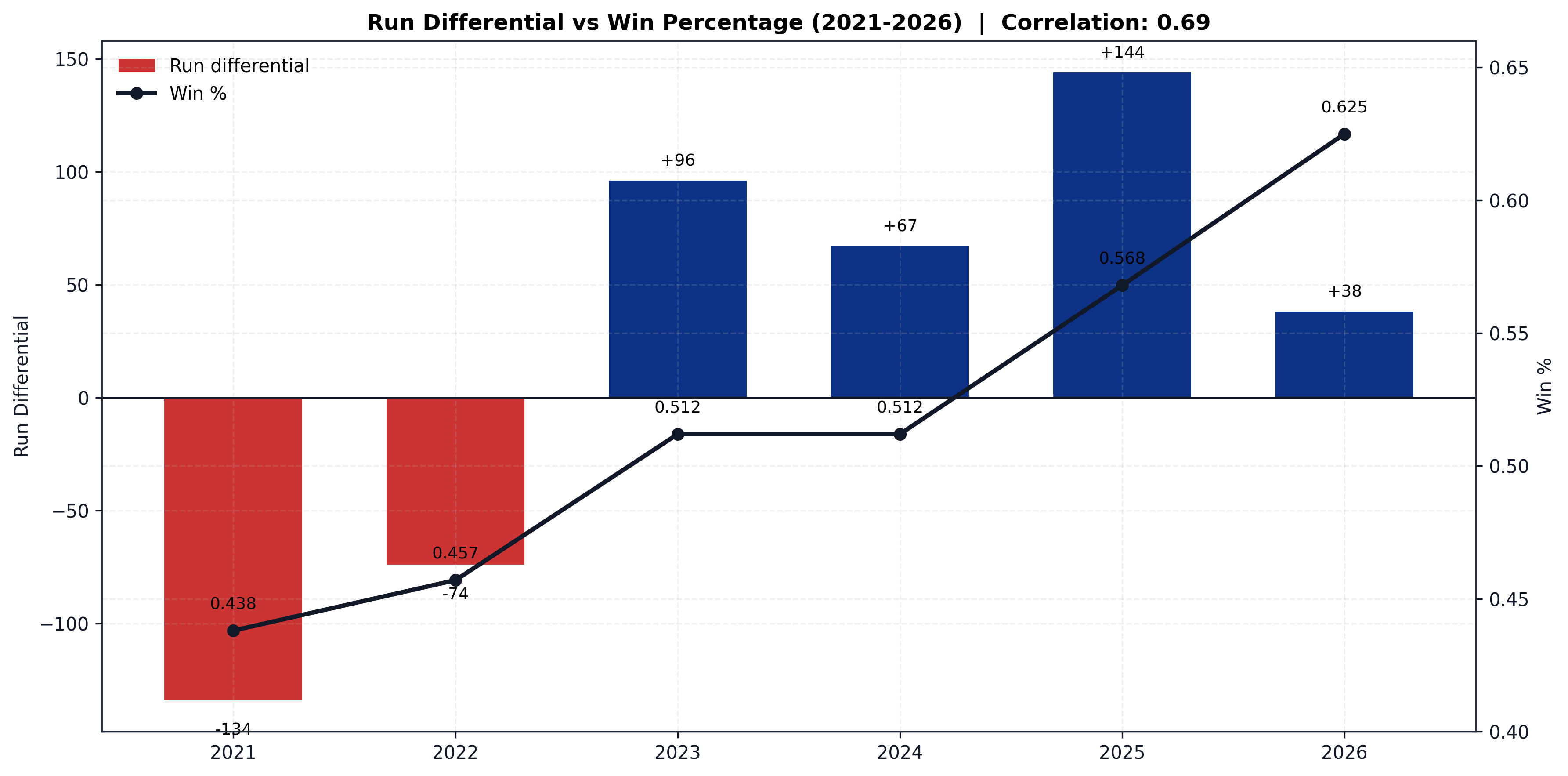
| Year | Record | Win % | Run Diff | Evaluation |
|---|---|---|---|---|
| 2021 | 71–91 | .438 | –134 | Aligned with rebuild |
| 2022 | 74–88 | .457 | –74 | Improving but still poor |
| 2023 | 83–79 | .512 | +96 | Strong run diff, unlucky record |
| 2024 | 83–79 | .512 | +67 | Good but not elite run diff |
| 2025 | 92–70 | .568 | +144 | Dominant underlying performance |
| 2026* | 20–12 | .625 | +38 | Strong early-season performance |
*Through May 2, 2026.
The 2023 season stands out: a +96 run differential that should have produced approximately 90 wins, not 83. The team underperformed by roughly 7 wins, likely due to poor sequencing in close games. The 2025 season (+144 run differential) represents elite underlying performance, validating the roster upgrades and Counsell's tactical impact.
Pythagorean Expectation: Talent vs. Results
The Pythagorean win-loss formula estimates a team's expected record based on runs scored and runs allowed. Significant deviations between Pythagorean expectation and actual record often indicate luck (positive or negative) or clutch performance. The Cubs' Pythagorean record reveals persistent underperformance in close games during the 2023–2024 seasons, followed by better alignment in 2025–2026.
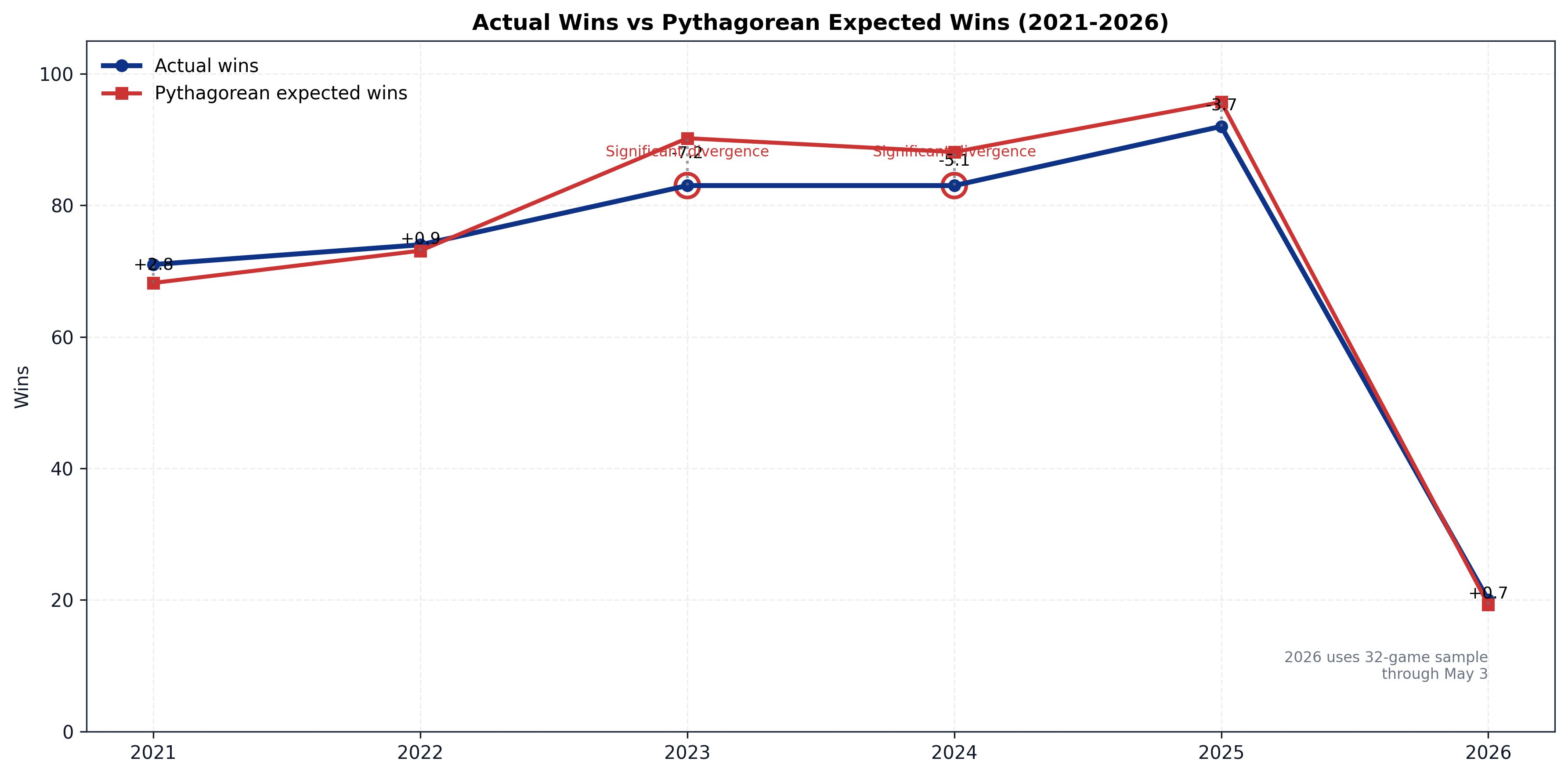
| Year | Actual W-L | Pythag W-L% | Expected Wins | Difference |
|---|---|---|---|---|
| 2021 | 71–91 | .421 | ~68 | +3 (slightly lucky) |
| 2022 | 74–88 | .451 | ~73 | +1 (aligned) |
| 2023 | 83–79 | .557 | ~90 | –7 (unlucky) |
| 2024 | 83–79 | .544 | ~88 | –5 (unlucky) |
| 2025 | 92–70 | .591 | ~96 | –4 (slightly unlucky) |
| 2026* | 20–12 | .604 | ~19–13 | +1 (aligned) |
*Through May 2, 2026 (32-game pace).
The 2023 and 2024 underperformance relative to Pythagorean expectation suggests the Cubs struggled in high-leverage situations — likely a combination of bullpen inconsistency, poor clutch hitting, and managerial decisions in close games. Craig Counsell's arrival did not immediately solve this issue in 2024, but the 2025 improvement suggests his tactical adjustments (particularly in bullpen deployment) began to close the gap.
One-Run Game Performance: The Clutch Test
One-run games are often cited as tests of managerial acumen, bullpen quality, and clutch performance. While record in close games can be noisy and heavily influenced by luck, persistent underperformance suggests structural issues. The Cubs' one-run game records under David Ross and Craig Counsell reveal a persistent challenge that has only recently begun to improve.
One-run game records (2021–2025). 2021 (Ross): 23–28 (.451) · 2022 (Ross): 21–26 (.447) · 2023 (Ross): 24–29 (.453) · 2024 (Counsell): 22–27 (.449) · 2025 (Counsell): 28–24 (.538).
The pattern is clear: from 2021 through 2024, the Cubs consistently lost one-run games at a .450 clip, well below the .500 baseline one would expect from a competent team. This underperformance contributed directly to the 2023 and 2024 seasons falling short of playoff expectations. The 2025 improvement to 28-24 (.538) represents a dramatic reversal and suggests Counsell's bullpen management and tactical adjustments finally gained traction.
Whether the 2025 improvement represents skill or regression to the mean remains an open question. If it's skill — evidence of Counsell's high-leverage bullpen usage and better clutch hitting coaching — then the Cubs are well-positioned for sustained success. If it's luck, regression could derail the 2026 season. The early 2026 data will be telling.
Farm System Utilization: Development Success
The ultimate measure of a farm system is not its ranking but its production of major league contributors. By this standard, Hoyer's farm system rebuild has been a resounding success. Multiple top prospects from the 2021–2024 pipeline are now key contributors to the 2026 first-place team:
- Pete Crow-Armstrong (2021 trade acquisition): Elite two-way center fielder, 30-HR/30-SB in 2025
- Cade Horton (2022 1st round): Front-line starting pitcher
- Matt Shaw (2023 1st round): Versatile infielder/outfielder providing offensive punch
- Jordan Wicks (2021 1st round): Rotation contributor
- Moises Ballesteros (2021 international): Emerging catcher with offensive upside
This production rate — five players from a four-year window contributing to a first-place team — is excellent. The farm system did exactly what it was supposed to do: replenish organizational talent and feed the major league roster with controllable, cost-effective contributors. The fact that the system's ranking declined from #4 in 2024 to #22 in 2026 is not a failure but the natural consequence of successful graduations.
The question moving forward is whether Hoyer can sustain this pipeline. With top prospect Owen Caissie traded for Edward Cabrera and several others graduated, the system is thinner than it has been in years. Continued smart drafting, international signings, and trade acquisitions will be essential to maintaining organizational depth as the current core ages.
Part V: The Verdict — Grading Counsell and Hoyer
Every front office executive and manager must ultimately be judged by results. Championships are the ultimate currency in sports, but the path to sustained competitiveness requires more than titles — it demands smart decisions, disciplined execution, and the ability to adapt when plans fail. The full analytical case for each grade — the strengths and weaknesses behind the front-loaded verdict — follows.
Craig Counsell — Manager (2024–present)
Strengths
- Tactical excellence: Counsell's bullpen management and lineup optimization are elite. His willingness to use high-leverage relievers in the highest-leverage situations has maximized bullpen value. His platoon-heavy lineup construction extracts maximum production from role players.
- 2025 breakthrough: The 92-win season and playoff series victory vindicated both the hiring and Counsell's public challenge to the front office. He delivered when given the resources he demanded.
- Clubhouse culture: Counsell's professional, player-first approach has created a positive environment without sacrificing accountability. The 2026 first-place start suggests sustained buy-in from the roster.
- Leverage and communication: Counsell's willingness to publicly challenge Hoyer in 2024 showed both confidence and strategic savvy. He used his fully guaranteed contract as leverage to demand better resources — and it worked.
Weaknesses
- 2024 stagnation: Counsell's first season produced the identical record (83-79) that cost David Ross his job. While some roster underperformance was beyond his control, the lack of improvement raised questions about whether his elite reputation was overstated.
- Pythagorean underperformance: The Cubs underperformed their Pythagorean expectation in both 2023 and 2024, suggesting persistent issues in close games that Counsell did not immediately solve.
- Playoff results: While the 2025 Wild Card Series victory was important, the NLDS loss to Milwaukee (2-3) represented a missed opportunity. Counsell's tactical edge did not translate to a deep playoff run.
Jed Hoyer — President of Baseball Operations (2020–present)
Strengths
- Financial mastery: The five-year luxury tax reset was executed flawlessly, creating maximum payroll flexibility for the 2026 contention window. This is organizational planning at its finest.
- Farm system rebuild: Hoyer transformed a bottom-tier system (#22) into a top-5 system by 2024, then successfully graduated multiple impact players (Crow-Armstrong, Horton, Shaw, Wicks) to the major league roster.
- Targeted free agency: The Swanson, Imanaga, and Bregman signings represent smart, high-value investments. Hoyer paid market rate for elite talent without overpaying for second-tier players.
- 2021 teardown execution: Trading Bryant, Báez, and Rizzo was emotionally difficult but organizationally necessary. Hoyer extracted tangible value (particularly Crow-Armstrong) rather than losing them for nothing in free agency.
- Responsive to feedback: When Counsell challenged him publicly in 2024, Hoyer responded by acquiring Tucker and committing to aggressive spending. He did not let ego prevent him from adjusting course.
Weaknesses
- Vision-execution gap: The Cubs should have made the playoffs in 2023 given their +96 run differential. The failure to add impact talent at the 2023 or 2024 trade deadlines extended the rebuild by at least one unnecessary year. Hoyer's patience occasionally crossed into passivity.
- David Ross dismissal optics: Firing Ross after an improving 83-79 season, despite a contract through 2024, created unnecessary friction with the fanbase. While the Counsell hire may ultimately prove correct, the manner of Ross's dismissal was poorly handled.
- 2024 roster construction: The 2024 roster, despite Counsell's arrival, lacked the depth to compete for a playoff spot. Hoyer underestimated the talent gap and should have been more aggressive in the 2023–2024 offseason.
- Pitching depth: The Justin Steele injury in 2026 exposed rotation depth issues that Hoyer should have addressed more aggressively. The Cabrera trade helps, but the reliance on young, unproven arms creates vulnerability.
Conclusion: The Partnership That Must Deliver
The Chicago Cubs enter the heart of the 2026 season with everything aligned: a first-place record, a deep and talented roster, financial flexibility, and a proven manager-executive partnership. The five-year rebuild that began with the painful July 2021 teardown has delivered exactly what Jed Hoyer promised: a sustainable contender built on homegrown talent, strategic free agent additions, and disciplined financial management.
Craig Counsell, once criticized for a stagnant 2024 debut, has validated his record-breaking contract with a 92-win season and a public challenge to his employer that forced organizational improvement. Jed Hoyer, once vilified for trading franchise icons, has proven that patience and financial discipline can coexist with championship ambition. The David Ross dismissal, once seen as ruthless, now looks like a calculated decision that accelerated the team's competitive timeline.
Yet none of this matters if the Cubs do not capitalize on the moment. Championship windows are fragile. Injuries, underperformance, and organizational complacency can close them overnight. The Cubs have the talent to win now — but "now" is the operative word. Hoyer and Counsell have built the foundation. The 2026 season will determine whether they can construct the championship that has eluded Chicago since 2016.
The verdict on this partnership will ultimately be written not by payroll spreadsheets or farm system rankings but by October results. Until the Cubs compete for World Series titles, both men will carry the burden of unfulfilled potential. But if they succeed — if the vision-execution gap finally closes and Chicago returns to championship glory — this entire arc will be remembered as one of the smartest, most disciplined rebuilds in modern baseball history.
"We've built a 90-win team. Now we need to prove we can be a championship team." — Craig Counsell, Spring 2026
Bottom Line: Jed Hoyer executed one of modern baseball's most disciplined rebuilds — a five-year luxury tax reset, a painful 2021 teardown, a farm system rebuilt from #22 to #4 then successfully graduated, and patient free-agent additions that capped with Bregman. Craig Counsell, the highest-paid manager in baseball history, stagnated at 83–79 in year one, publicly demanded a 90-win roster, then delivered 92 in 2025 with the franchise's first playoff series win since 2017. The architecture is sound, the partnership is working, and the 2026 first-place start is real. But until the Cubs compete for championships rather than just playoff berths, the verdict on this entire rebuild — and on both men — remains incomplete.
All statistical data sourced from Baseball-Reference, FanGraphs, MLB.com, The Athletic, and contemporaneous Chicago reporting through May 2, 2026. Pythagorean win projections calculated from RS/RA data using the formula RS²/(RS²+RA²) × 162. CBT payroll figures from Cot's Baseball Contracts and Baseball Prospectus. Farm system rankings from Baseball America. Contract figures from FanGraphs RosterResource and Spotrac. We invite informed disagreement: methodology, data, and editorial judgment can all be challenged via the contact form at /contact, and corrections are issued where warranted. This article is Article V of the 2026 MLB front-office and managerial leadership accountability series.