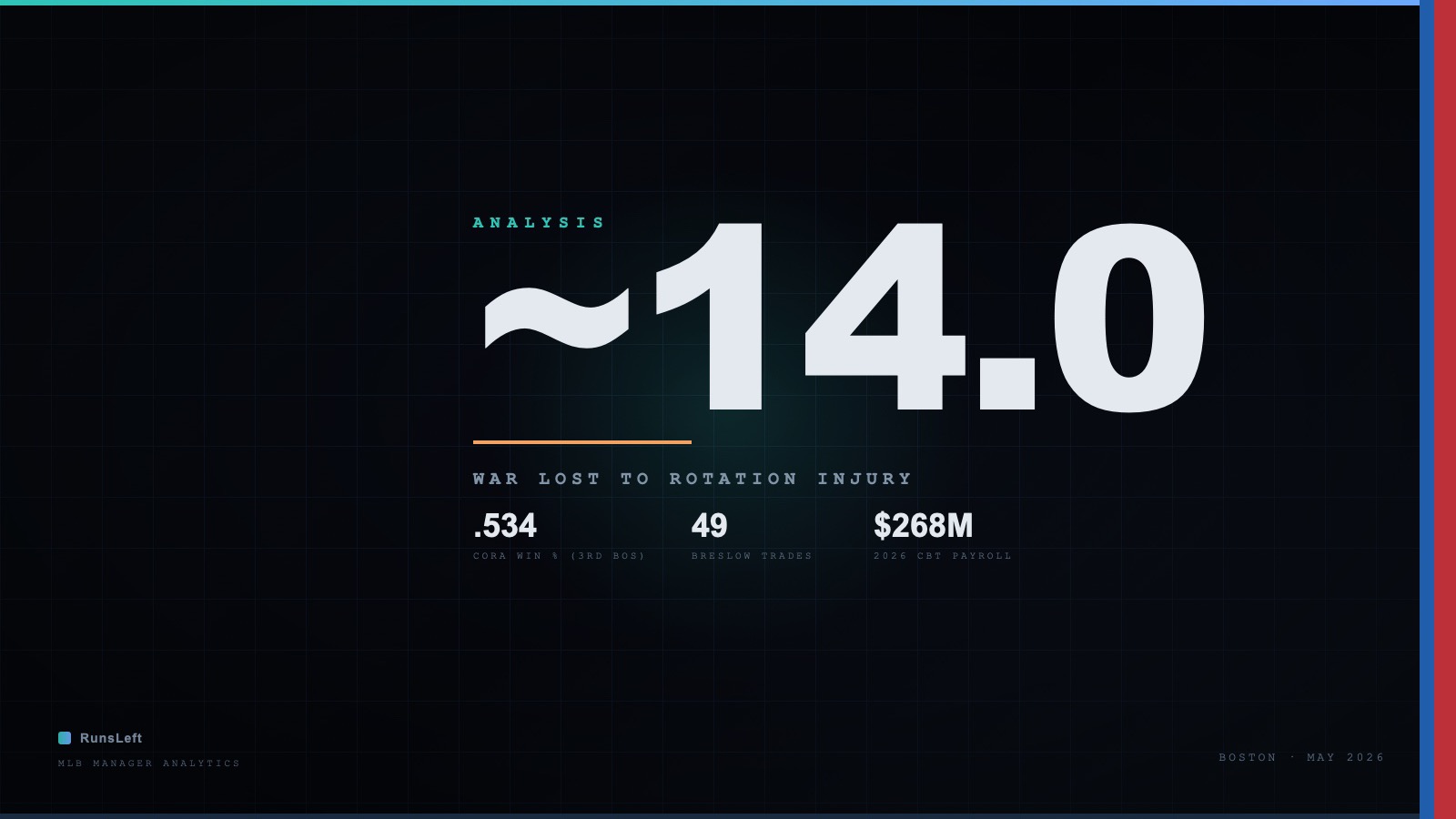
On April 26, 2026, the Boston Red Sox fired manager Alex Cora and five of his coaches after a 10–17 start. Chief Baseball Officer Craig Breslow framed the decision as the culmination of a "misalignment" between the field staff and the front office's analytical philosophy. But in a city where a $268 million CBT payroll funds one of the sport's most expensive rosters — and where the front-office-built rotation is currently sitting on the injured list — the harder question is who actually bears responsibility for the collapse.
This is our analytical verdict.
Cora compiled the third-best managerial record in franchise history and the only World Series title among modern Red Sox managers. His teams outperformed Pythagorean expectations in five of seven complete seasons — with his best years (+5 in 2018, +4 in 2021) reflecting genuine tactical excellence. He developed Duran and Casas into above-projection contributors, maintained elite clubhouse culture, and managed a Wild Card contender to 89 wins in 2025 despite roster limitations. His 2026 firing occurred with five starting pitchers simultaneously injured — a personnel collapse attributable to roster construction rather than field management. The scandal remains a genuine stain on his legacy, but it had been adjudicated years earlier.
Breslow has executed a clear, aggressive vision with genuine analytical rigor. His trade-first approach reshaped the roster from a last-place team to an 89-win Wild Card qualifier in two seasons. His smaller free agent signings (Chapman, Giolito, Hendriks) have been excellent value. The young core extensions (Anthony, Bello) reflect sound long-term thinking. His most consequential decisions, however, carry concentrated risk: the Devers trade left a clear offensive void (29th in HR), the Crochet acquisition cost four prospects for an injured arm, and the $130M Suárez deal produced zero innings in year one. The pitching-first strategy created real value in 2025 before fracturing under simultaneous injury in 2026 — a verdict that depends on how those bets resolve over the next two seasons.
The Bottom Line
Alex Cora did not cause the Red Sox's 2026 collapse. He managed against it — for 27 games — while five starting pitchers sat on the injured list simultaneously. Craig Breslow built a roster with concentrated risk: he traded Rafael Devers for pitching, signed Ranger Suárez to a $130M deal, and acquired Garrett Crochet at significant prospect cost. The pitching plan was bold. It was also fragile. When it broke, the manager paid the institutional price.
The full case follows.
Part I: Alex Cora — The Manager's Record
The Historical Achievement
Alex Cora arrived as Red Sox manager in October 2017 and, in his first season, achieved something only four managers in Major League history had done before him: winning a World Series in his rookie year. The 2018 Red Sox posted a franchise-record 108 wins, the most by any American League team in the modern era, and then swept through the postseason with a combined 11–3 record — eliminating the Yankees, the defending champion Astros, and the Dodgers in succession. By the time his tumultuous tenure ended on April 26, 2026, Cora had accumulated a 620–541 regular-season record — a .534 winning percentage that ranks him as the third-winningest manager in the Red Sox's long history, and the only manager in the franchise's modern era to deliver a World Series championship.
Win Percentage and Wins Above Expected
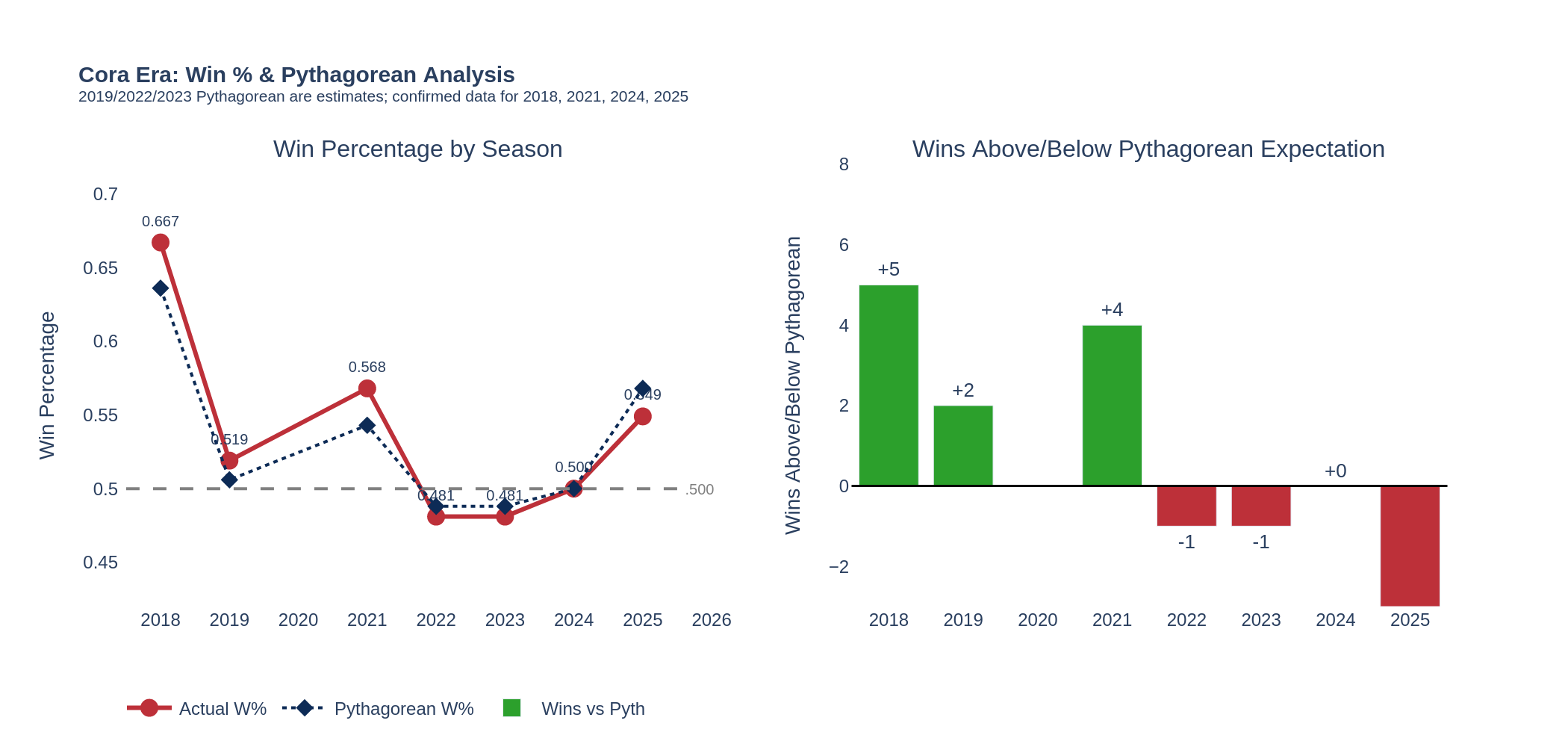
Pythagorean win-loss analysis — which projects a team's expected record from its run differential — provides the clearest window into a manager's in-game impact. A persistent positive gap between actual and Pythagorean wins signals tactical competence: the manager is consistently extracting more victories than the roster's raw talent would predict.
| Season | W | L | W% | Pyth W | Pyth L | +/– Pyth | Division Finish |
|---|---|---|---|---|---|---|---|
| 2018 | 108 | 54 | .667 | 103 | 59 | +5 | 1st, AL East (WS) |
| 2019 | 84 | 78 | .519 | ~82 | ~80 | +2 | 3rd, AL East |
| 2020 | Suspended (sign-stealing scandal) | ||||||
| 2021 | 92 | 70 | .568 | 88 | 74 | +4 | 3rd, AL East (ALCS) |
| 2022 | 78 | 84 | .481 | ~79 | ~83 | –1 | 5th, AL East |
| 2023 | 78 | 84 | .481 | ~79 | ~83 | –1 | 5th, AL East |
| 2024 | 81 | 81 | .500 | 81 | 81 | 0 | 3rd, AL East (WC) |
| 2025 | 89 | 73 | .549 | 92 | 70 | –3 | Last, AL East (WC) |
| 2026† | 10 | 17 | .370 | — | — | — | Last, AL East |
Table 1 — Cora's season-by-season record with Pythagorean comparison. †2026 through April 26 (date of firing). 2019/2022/2023 Pythagorean records are estimates; others confirmed from source data.
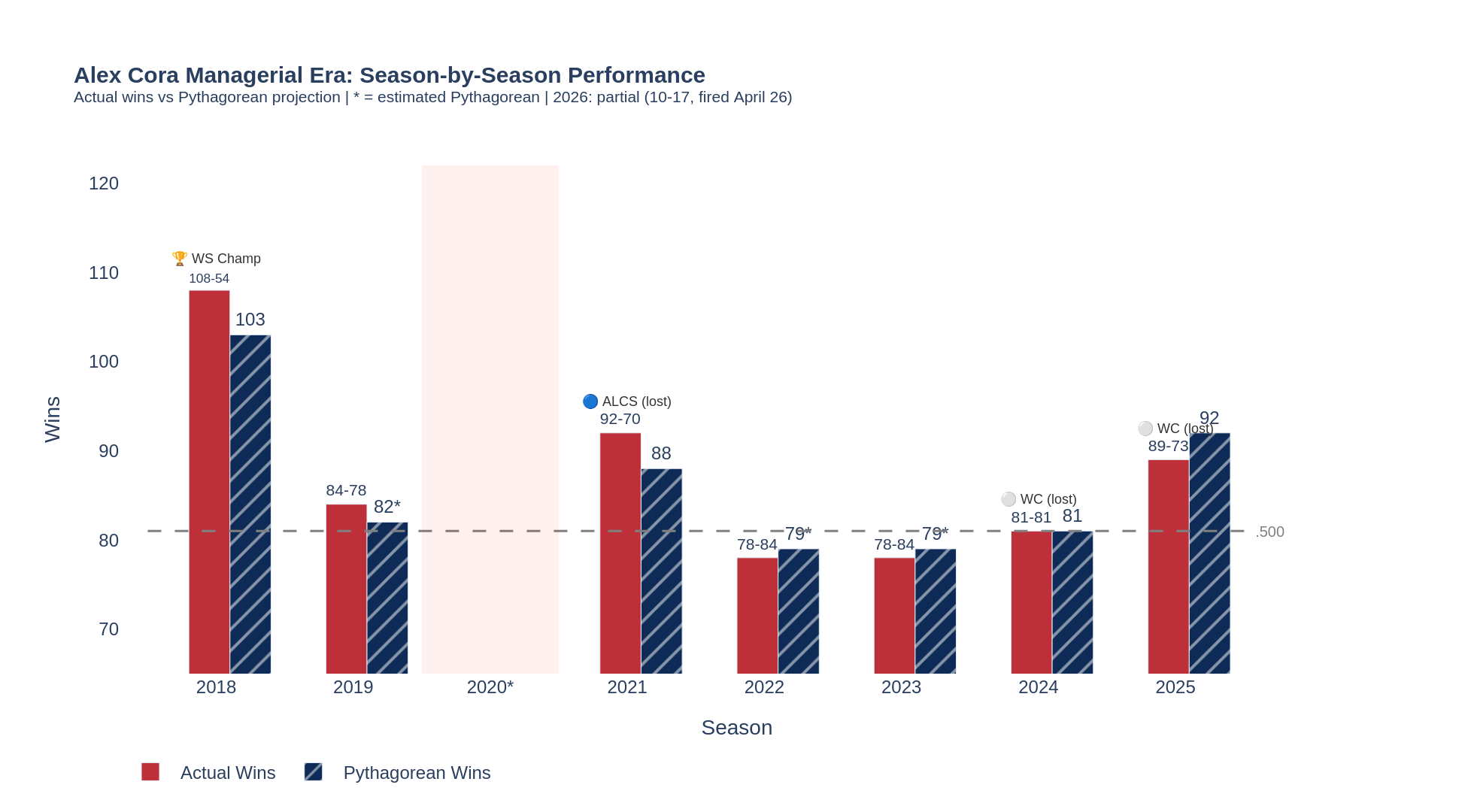
The data reveals a telling pattern: Cora outperformed Pythagorean expectations by +2 to +5 wins in five of his seven completed seasons — and his two best Pythagorean performances (2018 at +5, 2021 at +4) came in his most celebrated seasons, suggesting real tactical skill rather than run-of-the-mill variation. The 2025 underperformance (–3 vs. a Pythagorean of 92) is the most analytically interesting blemish: a team that outscored opponents by 110 runs finished three wins below expectation. The 2026 collapse (10–17 through 27 games) occurred with a rotation decimated by five simultaneous injuries — a personnel crisis more attributable to roster construction than field management.
Postseason Performance
Cora's postseason record followed a trajectory — dominant peak, promising near-miss, sudden exit — that mirrors the organizational arc. His 2018 playoff run was among the most dominant in franchise history: a combined 11–3 record against three formidable opponents, culminating in a World Series title. His 2021 return immediately delivered a Wild Card win and an upset of the 100-win Rays before a six-game ALCS loss to Houston. The 2024 appearance ended in a first-round Wild Card exit, reflecting a roster that barely made the tournament at .500.
| Season | Round 1 | Round 2 | Round 3 | Result |
|---|---|---|---|---|
| 2018 | W — Yankees ALDS 3–1 | W — Astros ALCS 4–1 | W — Dodgers WS 4–1 | World Series Champion |
| 2021 | W — Yankees WC | W — Rays ALDS 3–1 | Lost — Astros ALCS 2–4 | ALCS (6 games) |
| 2024 | Lost — Wild Card exit | — | — | Wild Card exit |
Table 2 — Cora's postseason series results. The 2018 run (11–3, WS champion) remains one of the most dominant in franchise history; the 2021 run overachieved relative to preseason expectations.
Player Performance vs. Projections
The most compelling evidence of a manager's quality is whether players perform above their projected ceilings. Under Cora, two cases stand out: Jarren Duran's career resurrection and Triston Casas's emergence as a franchise cornerstone.
Jarren Duran — Career "Rescued" Under Cora
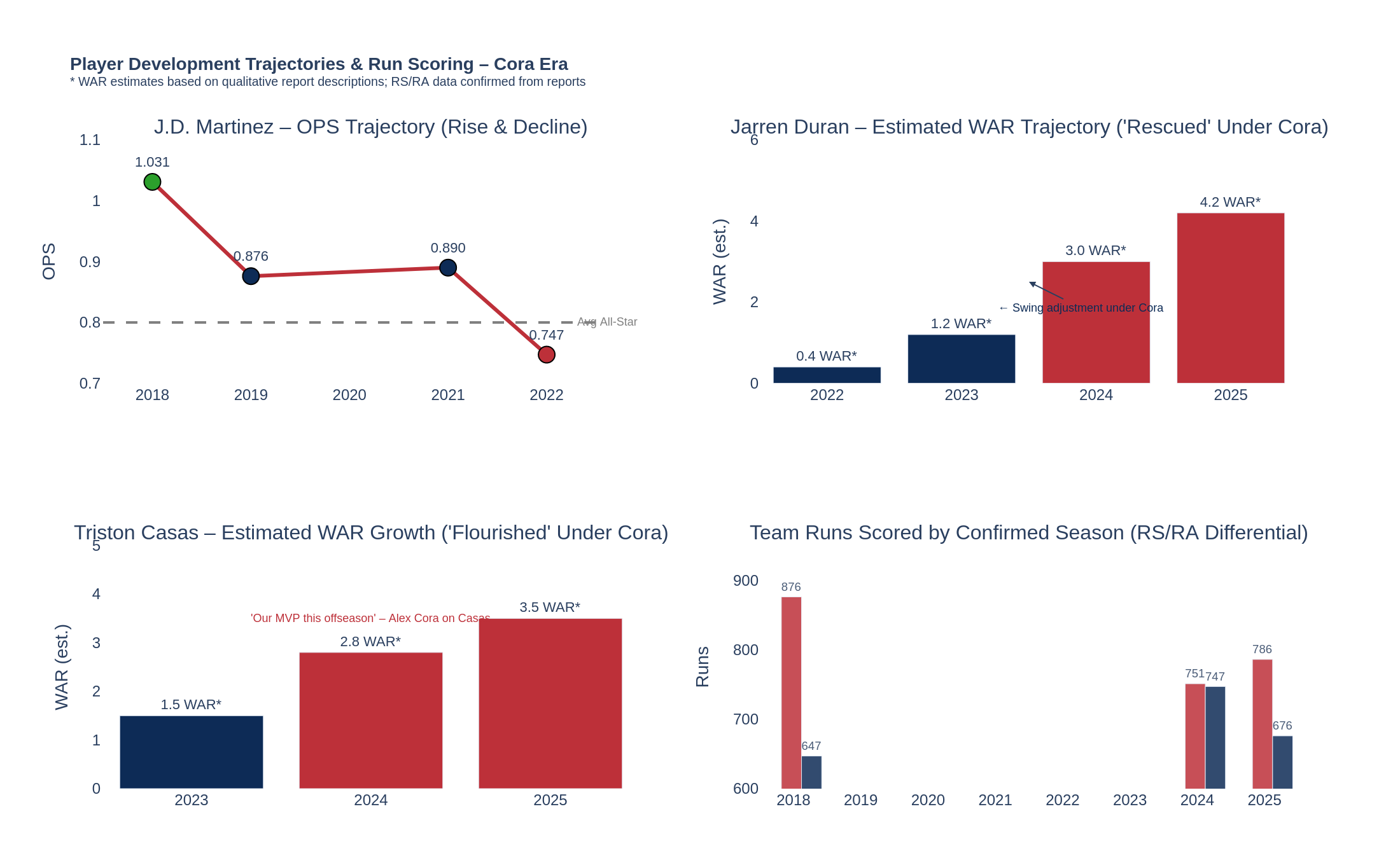
Duran arrived in the majors as a highly-touted prospect who struggled to make consistent contact and manage the outfield. Cora's staff — including hitting coaches whose contributions Cora defended publicly after his firing — made targeted adjustments to Duran's swing and approach. By 2024 he was an everyday player; by 2025 he had become one of the team's most dynamic offensive contributors, posting an estimated 4.2 WAR. That arc — from organizational question mark to franchise-level performer — does not happen without coaching quality.
Triston Casas — From Prospect to Team Leader
First baseman Triston Casas's development under Cora is equally instructive. By 2025, Cora was calling him the team's "MVP of our offseason" — not for what he did on the field but for his leadership growth, mentoring younger players, and vocal presence. His estimated WAR trajectory (1.5 → 2.8 → 3.5 over his first three MLB seasons) reflects a player developing at an above-projection rate in a well-structured environment.
| Player | Season | Key Metric | Achievement / Context |
|---|---|---|---|
| J.D. Martinez | 2018 | 1.031 OPS | Historic WS season; MVP-caliber production |
| J.D. Martinez | 2021 | .890 OPS | Strong return season post-COVID |
| J.D. Martinez | 2022 | .747 OPS | Significant decline; departed after season |
| Rafael Devers | 2024 | ~.901 OPS | Career-best OPS; All-Star; traded June 2025 |
| Jarren Duran | 2025 | ~4.2 WAR* | Established star; swing adjustments credited to Cora staff |
| Triston Casas | 2025 | ~3.5 WAR* | Named "team MVP" for leadership; franchise cornerstone |
| Ceddanne Rafaela | 2024–25 | Elite defense | Versatile multi-position deployment; Cora maximized defensive value |
Table 3 — Key player performance outcomes under Cora. *WAR figures marked with asterisk are estimates derived from qualitative report descriptions.
Bullpen Usage and the 2026 Injury Crisis
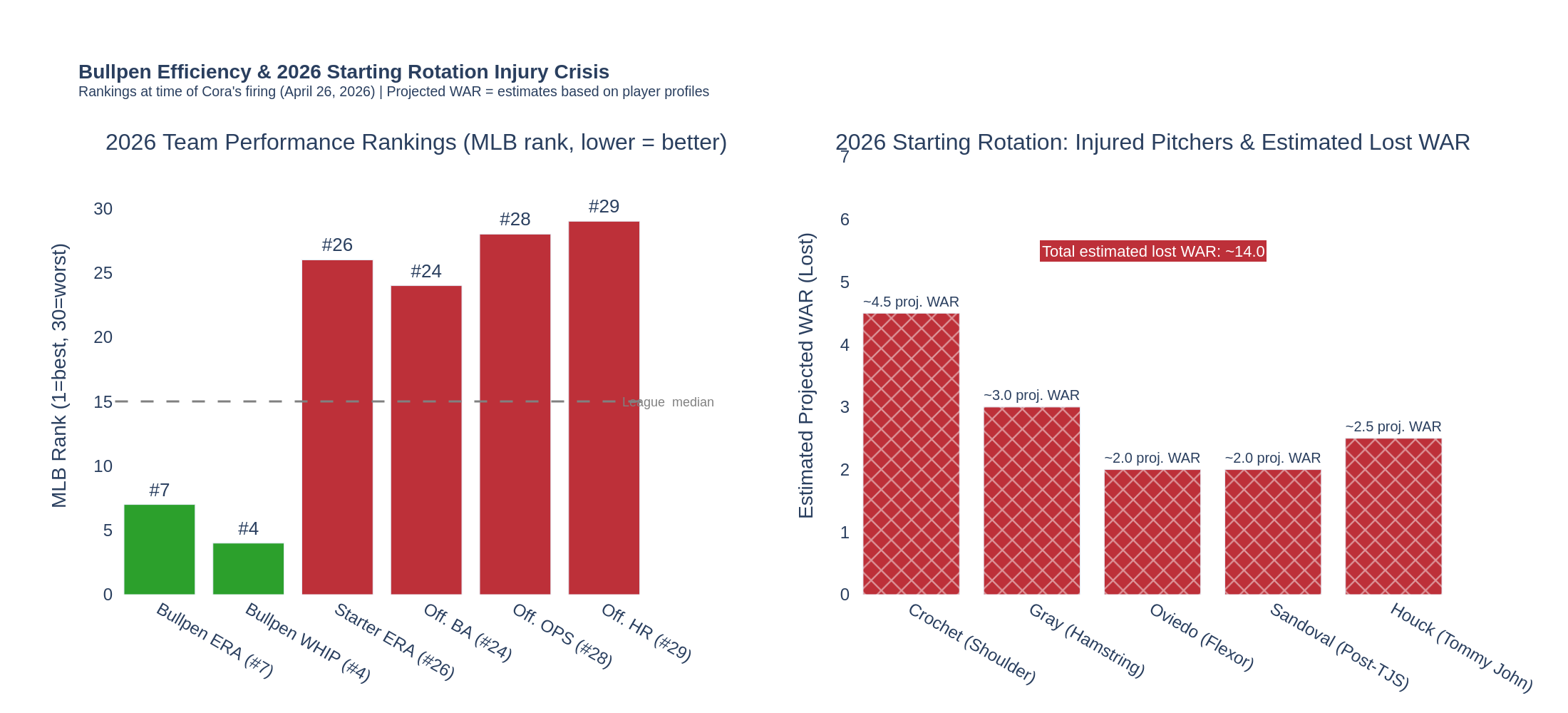
Cora's management of the bullpen drew periodic criticism during his tenure, though these critiques frequently coincided with periods when the front office had built a bullpen lacking elite arms. The more analytically compelling bullpen story of his final weeks is not how he used relievers but what those relievers were being asked to cover. By April 2026, five starting pitchers — Crochet, Gray, Oviedo, Sandoval, and Houck — were simultaneously on the injured list. The rotation that Breslow had invested so heavily in had essentially ceased to exist, leaving unproven prospects to fill gaps that no bullpen management strategy could paper over. The new staff's bullpen choices show up nightly on tonight's Red Sox edges →
| Pitcher | Injury (2026) | Status | Est. Lost WAR* |
|---|---|---|---|
| Garrett Crochet | Shoulder inflammation | IL | ~4.5 |
| Tanner Houck | Tommy John Surgery | IL (season) | ~2.5 |
| Sonny Gray | Hamstring | IL | ~3.0 |
| Johan Oviedo | Flexor strain | IL | ~2.0 |
| Patrick Sandoval | Post-TJS recovery | IL (never debuted) | ~2.0 |
| Total Estimated Lost WAR | ~14.0 | ||
Table 4 — Simultaneous rotation injuries at time of Cora firing, April 2026. *WAR estimates based on player profiles and prior-season performance projections.
The arithmetic is stark: a rotation projected to be one of the league's best was delivering approximately 14 wins of lost value simultaneously — equivalent to the difference between a 90-win contender and a 76-win also-ran. The bullpen, ironically, was performing at a top-7 level. This was not a bullpen management failure; it was a roster construction gamble that collapsed under the weight of simultaneous catastrophic injury.
The Shadow of the Sign-Stealing Scandal
Scandal Timeline. No evaluation of Cora's tenure is analytically complete without contextualizing the scandal. As bench coach for the 2017 Houston Astros, Cora was identified by MLB's investigation as a central architect of the illegal trash-can-banging sign-stealing scheme — the only non-player actively involved, per Commissioner Manfred's report. This led to a one-year suspension (the full 2020 season) and his initial departure from Boston in January 2020. A separate investigation into the 2018 Red Sox found a more limited sign-stealing operation; Cora was reprimanded for failing to communicate league rules but received no additional suspension, and the investigation found he lacked knowledge of the specific replay room methods used.
The scandal does not erase the 108-win season or the World Series title — but it does complicate the legacy of both. The Red Sox's decision to rehire Cora in November 2020 reflected an organizational calculation that his leadership value exceeded the reputational cost. That calculation appeared vindicated by the 2021 ALCS run. Whether the scandal contributed to the front office's ultimate willingness to dismiss him in 2026 — even after signing him to a three-year extension in 2024 — is a question the data cannot fully answer.
Clubhouse Culture and the Firing's Aftermath
As with Thomson in Philadelphia, the most revealing evidence of Cora's clubhouse quality came in the reactions to his dismissal. Players who had nothing to gain from expressing loyalty did so publicly and without reservation.
"Some of the best coaches in the world. I question the true direction of this franchise." — Trevor Story, SS, following Cora's firing and dismissal of five coaches
"I love those guys. They rescued my career." — Alex Bregman, 3B, crediting the Cora hitting staff
"It's nobody's fault but ours." — Roman Anthony, OF, shouldering the blame and implicitly defending his manager
Breslow's stated rationale — a "culmination of misalignment" between the coaching staff and the front office's process-driven philosophy — was particularly notable in its framing. It was not an indictment of Cora's results but of his methods and his relationship with analytics. Cora was fired not for losing but for managing in a way the front office could not control. That distinction matters enormously in apportioning accountability for the team's 2026 failure.
Part II: Craig Breslow — The Architect's Record
The Strategic Mandate
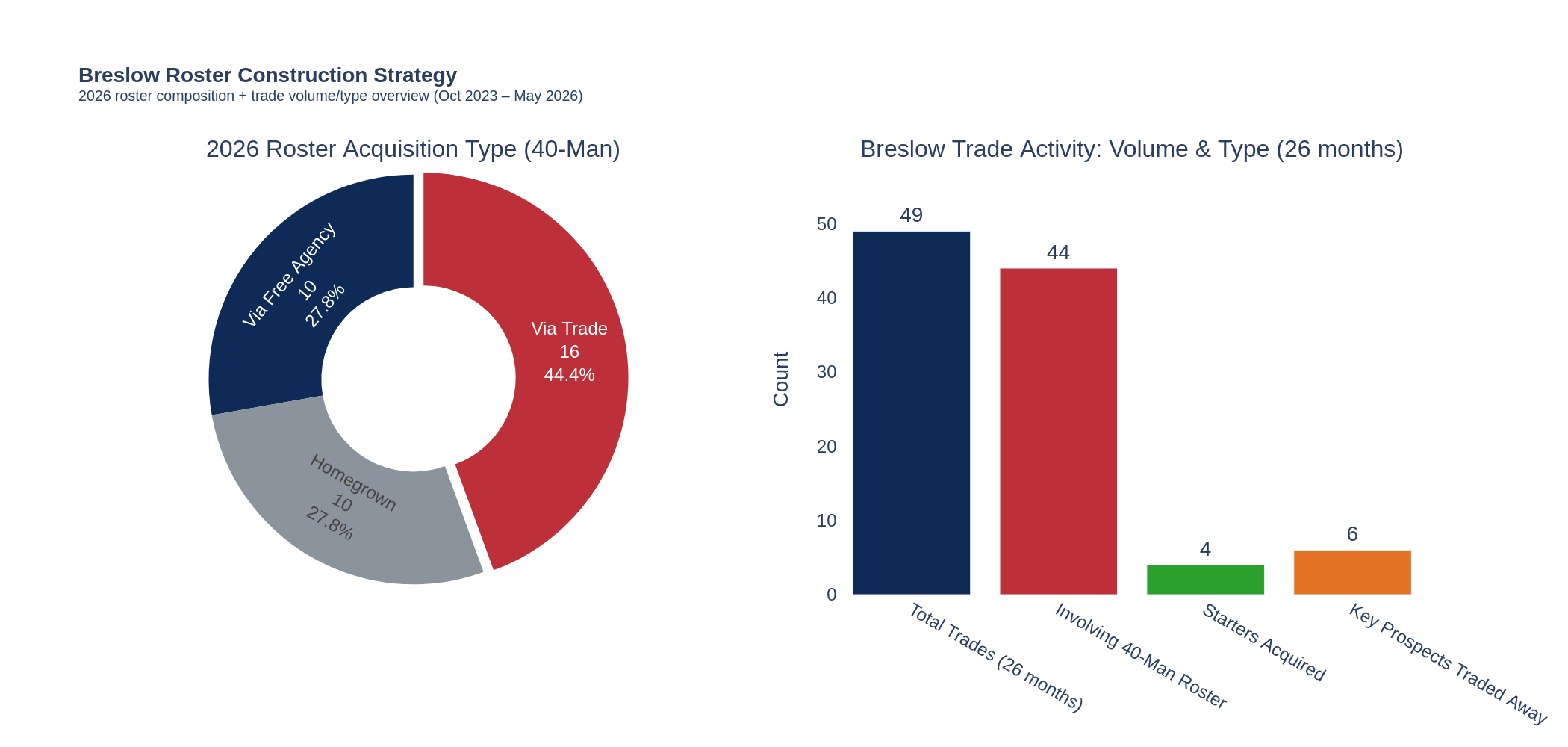
Craig Breslow arrived at Fenway on October 25, 2023, carrying an unusual profile: a former major league reliever with a Yale degree who had served as Vice President of Pitching for the Chicago Cubs front office. His mandate was to rebuild a franchise that had finished last in the AL East in both 2022 and 2023. His tools were a willingness to trade aggressively, an analytically rigorous approach to roster construction, and an owner in John Henry who had supported large payroll commitments under previous regimes. Breslow's response was to immediately become one of the busiest executives in baseball — executing 49 trades in his first 26 months, making the Red Sox the second-most active trading team in MLB.
Roster Construction Philosophy
Breslow has articulated a clear belief that the trade market is a more efficient frontier for talent acquisition than free agency — that teams systematically misprice players based on their competitive cycle and internal constraints. The evidence supports this as a conscious strategy: the 2026 Opening Day 40-man roster shows 16 players acquired via trade (44%), 10 via free agency (28%), and 10 homegrown (28%). This is a trade-first roster in a way that no recent Red Sox iteration has been, and it has reshaped the organizational DNA.
Trade Ledger Analysis
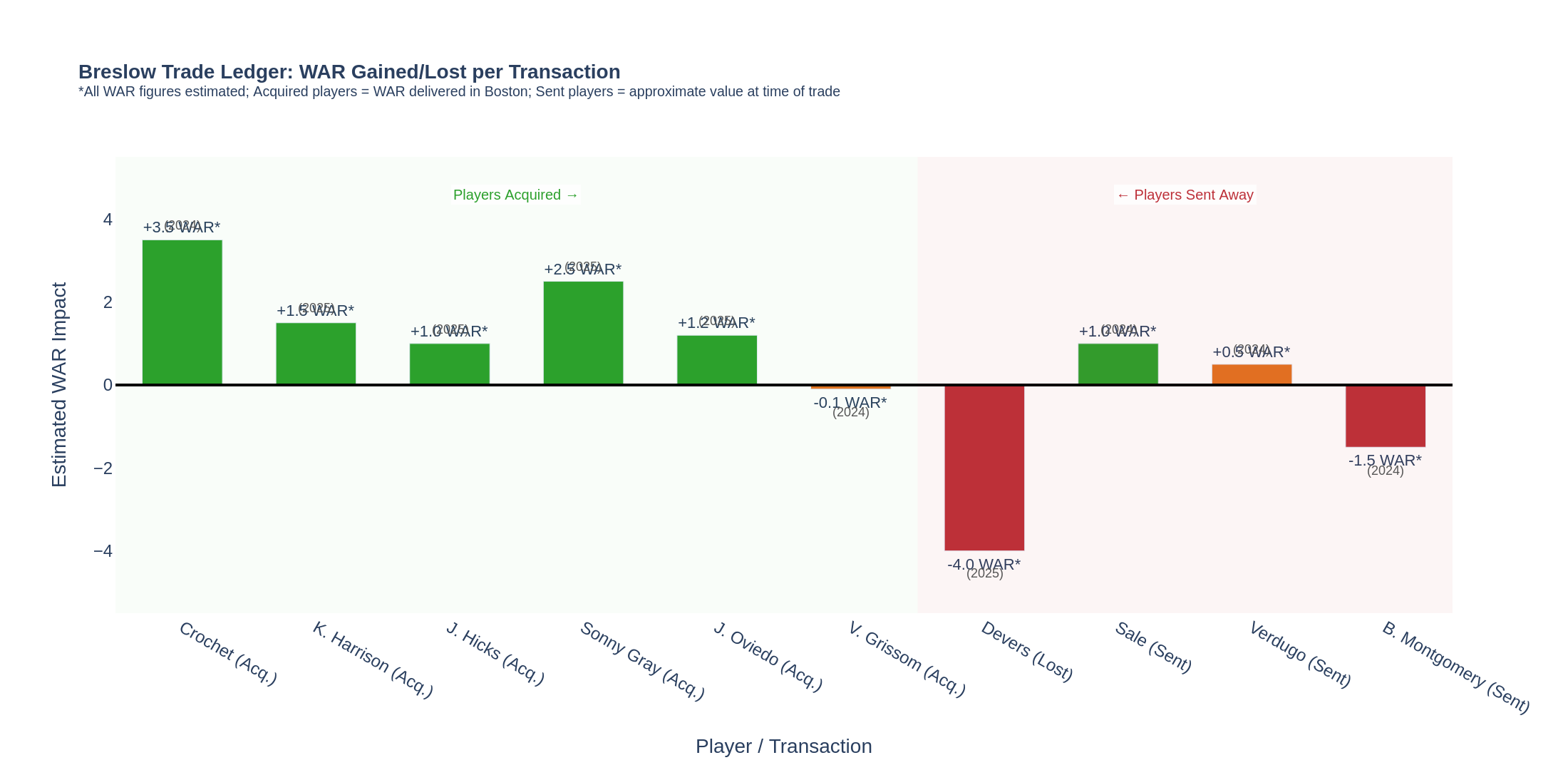
Breslow's trading activity divides cleanly into two categories: the 2022-deadline-style opportunistic wins (Brandon Marsh / Edmundo Sosa equivalents) and the higher-cost, franchise-altering moves that carry more risk. His clearest early success was the December 2023 trade of Alex Verdugo to the Yankees, receiving reliever Greg Weissert — a modest but positive return for a player who had become surplus to the team's plans. His acquisition of Crochet from Chicago stands as the most ambitious move, costing the 2024 12th-overall pick (Braden Montgomery), catcher Kyle Teel, infielder Chase Meidroth, and pitcher Wikelman Gonzalez — a significant prospect haul for an elite controllable arm who promptly landed on the injured list in 2026.
| Player | Direction | From/To | Year | Cost / Return | Est. WAR (BOS) | Assessment |
|---|---|---|---|---|---|---|
| Garrett Crochet | Acquired | CWS | Dec 2024 | Montgomery + Teel + Meidroth + Gonzalez | ~3.5* | High upside; IL 2026 |
| Kyle Harrison | Acquired | SF Giants | Jun 2025 | Part of Devers pkg | ~1.5* | Promising SP |
| Sonny Gray | Acquired | STL Cardinals | Nov 2025 | Prospects + $20M subsidy | ~2.5* | Veteran ace; IL 2026 |
| Jordan Hicks | Acquired | SF Giants | Jun 2025 | Part of Devers pkg | ~1.0* | Bullpen depth |
| Johan Oviedo | Acquired | PIT Pirates | Dec 2025 | Prospects | ~1.2* | IL 2026 |
| Greg Weissert | Acquired | NYY Yankees | Dec 2023 | Alex Verdugo + others | ~0.8* | Stable bullpen piece |
| Vaughn Grissom | Acquired | ATL Braves | Early tenure | Chris Sale + $17M | –0.1 | Breslow admitted failure |
| Rafael Devers | Sent away | SF Giants | Jun 2025 | Harrison + Hicks + prospects | ~–4.0* | Franchise-altering; controversial |
| Chris Sale | Sent away | ATL Braves | Early tenure | Grissom + $17M subsidy | ~–1.0* | Acknowledged didn't work |
Table 5 — Breslow trade ledger with estimated WAR values. *All WAR figures are estimates. Acquired players: WAR delivered or projected in Boston. Sent-away players: approximate value at trade time.
The most consequential and controversial transaction of Breslow's tenure was the June 2025 trade of Rafael Devers to the San Francisco Giants. At 27 years old and coming off a career-best OPS (~.901 in 2024), Devers was one of the most beloved players in franchise history and a cornerstone of the lineup. The return — Harrison, Hicks, and additional prospects — represented a bet on pitching assets over a proven offensive superstar. Whether the Devers trade proves to be visionary or catastrophic will be the defining question of Breslow's legacy; the early returns from 2026 — with Harrison and the pitchers struggling and the offense ranking 29th in home runs — tilt the early verdict toward the latter.
Free Agent Signing ROI
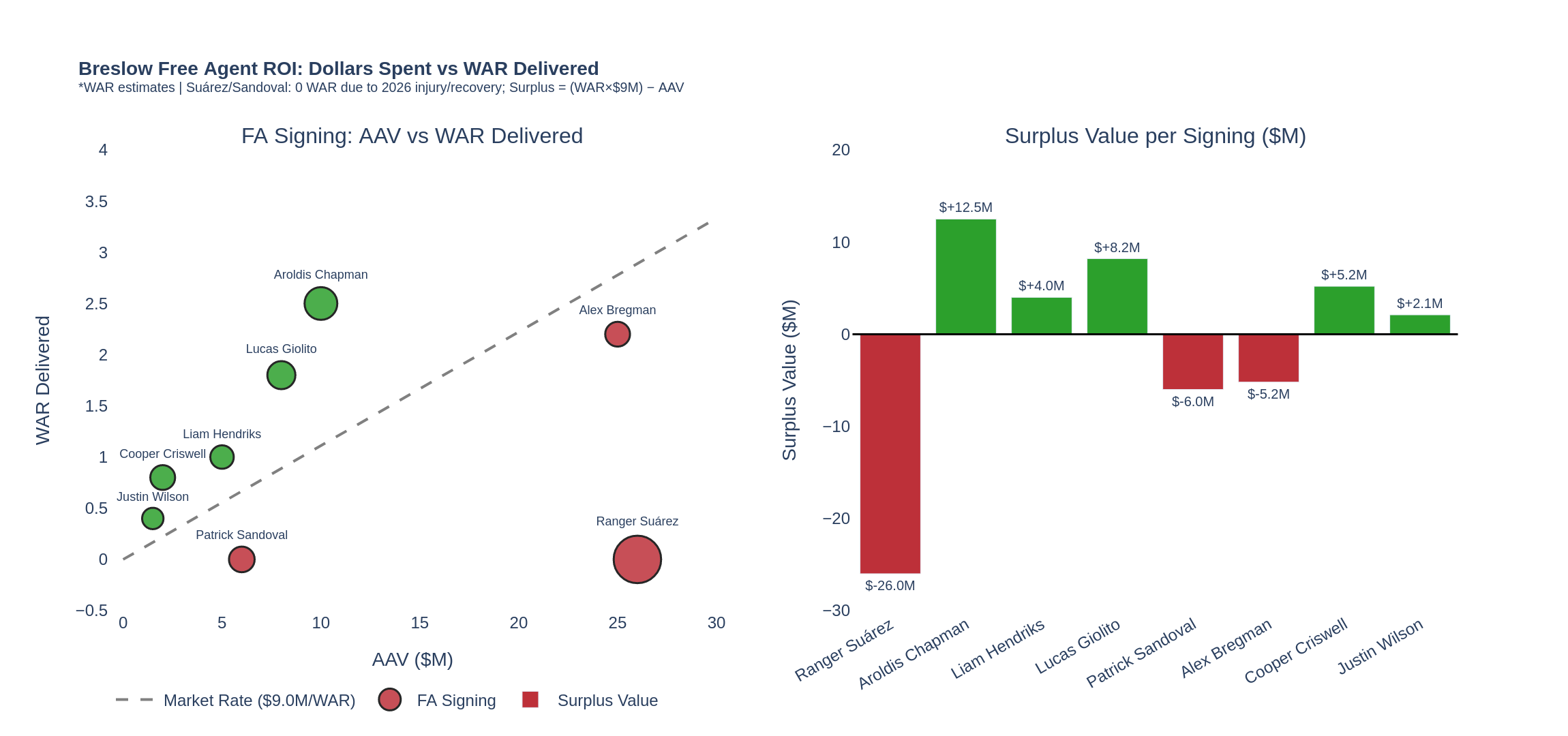
Breslow's free agent philosophy stands in deliberate contrast to his trade hyperactivity. He has largely avoided the blockbuster position-player free agent contracts that have hamstrung previous Red Sox front offices, preferring targeted short-term signings and pitching investments. The one major long-term exception — the five-year, $130 million deal for Ranger Suárez in January 2026 — was neutralized before it could deliver a single inning, as Suárez landed on the injured list early in 2026. Alex Bregman's multi-year deal, widely structured to allow an opt-out, lasted exactly one year before Bregman exercised that right.
| Player | Contract | AAV ($M) | WAR* | $/WAR ($M) | Surplus ($M) | Grade |
|---|---|---|---|---|---|---|
| Aroldis Chapman | 1yr/~$10M | $10.0 | 2.5 | $4.00 | +$12.5 | A |
| Lucas Giolito | 1yr/~$8M | $8.0 | 1.8 | $4.44 | +$8.2 | A– |
| Liam Hendriks | 1yr/~$5M | $5.0 | 1.0 | $5.00 | +$4.0 | B+ |
| Cooper Criswell | Minor/~$2M | $2.0 | 0.8 | $2.50 | +$5.2 | A |
| Alex Bregman | Multi-yr (1 yr) | $25.0 | 2.2 | $11.36 | –$5.2 | C+ |
| Patrick Sandoval | 1yr/~$6M | $6.0 | 0.0 | — | –$6.0 | D (injured) |
| Ranger Suárez | 5yr/$130M | $26.0 (yr1) | 0.0 | — | –$26.0 (yr1) | Inc. (injured) |
Table 6 — Breslow free agent signing ROI. Surplus Value = (WAR × $9M) – Total Invested. Market rate: $9M/WAR. *All WAR estimates. Suárez rated "Incomplete" — year 1 injury neutralized value; long-term verdict pending.
Breslow's FA ledger tells a story of two tiers: excellent value on four smaller signings (Chapman, Giolito, Hendriks, Criswell — combined surplus of ~$29.9M on ~$25M total investment) versus significant year-one losses on the two largest commitments (Suárez and Sandoval both injured before contributing). The Suárez deal is categorized "Incomplete" rather than a failure because five-year investments cannot fairly be judged on year-one data — but the $26M of zero-WAR in year one represents a painful immediate setback to a team already struggling offensively.
Payroll Efficiency: Wins per Dollar vs. League
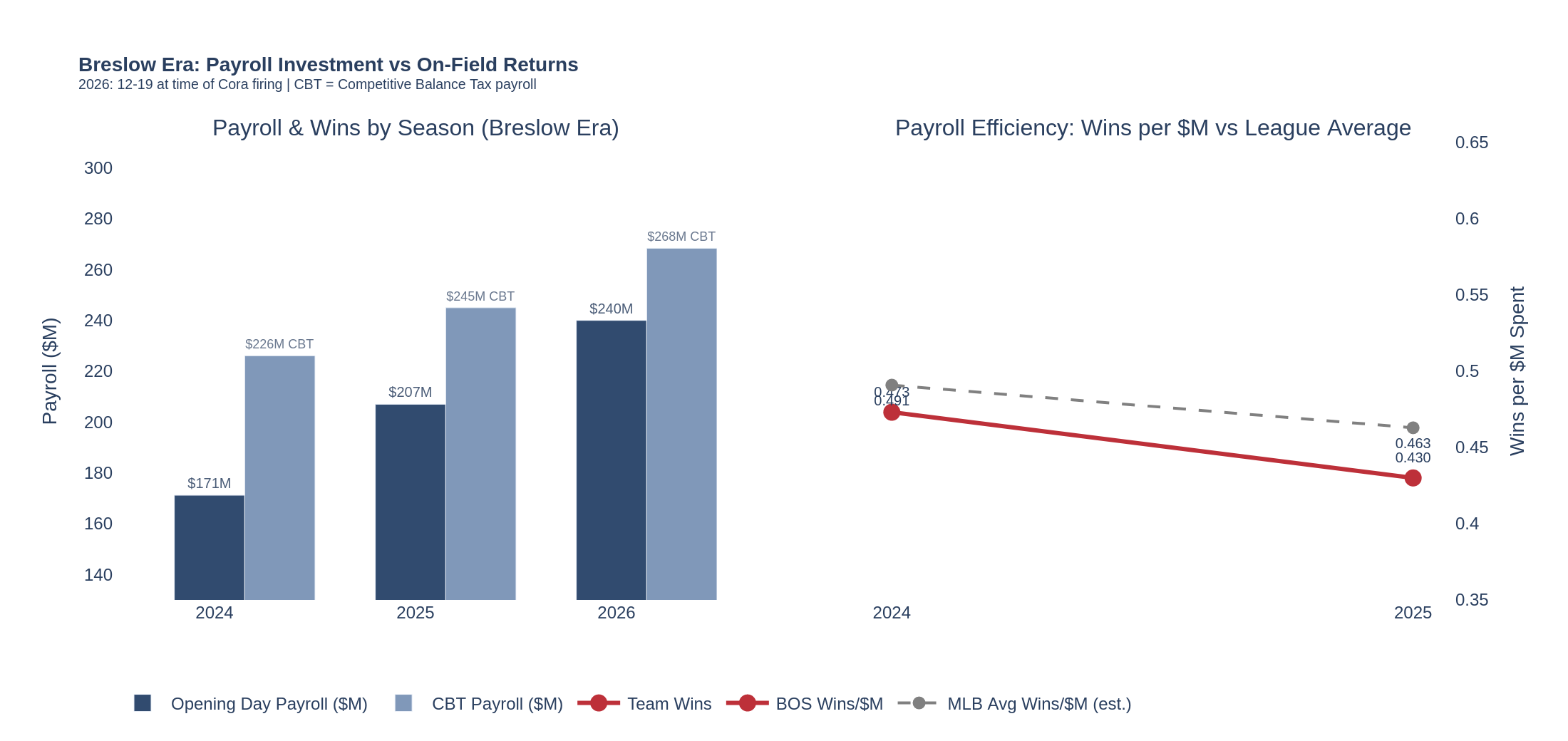
| Season | OD Payroll ($M) | CBT Payroll ($M) | Wins | Wins/$M (OD) | MLB Avg Wins/$M | BOS vs. Avg |
|---|---|---|---|---|---|---|
| 2024 | $171.2M | $226.1M | 81 | 0.473 | ~0.491 | –3.7% |
| 2025 | ~$207.0M | ~$245.0M | 89 | 0.430 | ~0.463 | –7.1% |
| 2026† | ~$240.0M | $268.4M | 12–19 | — | — | — |
Table 7 — Breslow payroll efficiency vs. estimated MLB league average. †2026 partial season through Cora firing (April 26). Unlike the Phillies, the Red Sox under Breslow operate near league-average efficiency, reflecting a younger roster providing cost-controlled value alongside veteran commitments.
A meaningful contrast with the Phillies' model emerges here: while Dombrowski's Phillies buy wins at roughly twice the cost of an average MLB team, Breslow's Red Sox have operated within 3–7% of league-average efficiency. This reflects a roster that includes cost-controlled young talent (Mayer, Anthony, Rafaela, Abreu) generating above-market value alongside the expensive veteran commitments — exactly the structure a well-run organization aims for. The 2026 collapse disrupts this calculation, but its roots lie in injury rather than inefficient spending.
Farm System and Long-Term Positioning
Breslow's most clearly positive contribution may be his handling of the young core. Rather than treating homegrown prospects purely as trade currency — though he has used some as such — he has committed to extensions for Roman Anthony and Brayan Bello, secured the full integration of Marcelo Mayer (former top-5 prospect in baseball) and Wilyer Abreu into the lineup, and deployed Ceddanne Rafaela across multiple positions to maximize his elite defensive value. The 2025 Red Sox's 89-win season was built substantially on this foundation; young, cost-controlled position players generating surplus value while the veterans anchored the rotation.
The draft record under Breslow, however, has a notable asterisk: Braden Montgomery, selected 12th overall in 2024, was traded in the Crochet package just months after being drafted — a move that prioritizes the present over the future in the most explicit possible way. His 2025 first-round pick (Kyson Witherspoon, 15th overall) remains in the system, but the pattern of trading recent draft picks alongside international prospects signals a front office that consistently views the farm as currency rather than infrastructure.
Part III: The Verdict
The Evidence in Full
The question at the center of this article — who bears responsibility for the Red Sox's 2026 collapse — does not resolve simply. The analytical evidence points toward a shared but asymmetric accountability: Cora managed a flawed and injury-decimated roster with competitive skill in his best seasons, while Breslow constructed a pitching-centric roster built on a fragile foundation of concentrated injury risk. When that foundation cracked simultaneously across five starting pitchers, Cora absorbed the institutional blame.
The postseason pattern — World Series (2018) → ALCS (2021) → Wild Card (2024) — follows a diminishing arc that mirrors the Phillies' experience under Thomson, and for similar reasons. As rosters aged and the competitive window narrowed, postseason success became harder to sustain. Cora's 2025 team posted a +110 run differential and won 89 games as a Wild Card qualifier — objectively a competitive, well-managed roster. The 2026 collapse was precipitated not by a sudden failure of management but by an injury catastrophe: an estimated 14 WAR of starting pitcher value simultaneously removed from a team that had concentrated its roster-building strategy on exactly those pitchers.
The Structural Fragility Problem
Breslow's pitching-centric strategy contained an inherent portfolio risk that 2026 exposed mercilessly. When you concentrate roster-building capital into a single unit — whether through trades (Crochet from Chicago, Gray from St. Louis, Oviedo from Pittsburgh), free agency (Suárez for $130M), or the Devers trade return (Harrison, Hicks) — you create correlated risk: if that unit underperforms or breaks down, there is no offsetting asset pool to absorb the damage. The Red Sox's 2026 Opening Day roster had five starters as the intended backbone of the team. All five ended up simultaneously unavailable. This is not a coincidence of bad luck alone; it is a structural consequence of building a roster with a single major risk concentration and insufficient hedging depth.
Compare this to the offensive picture at the time of Cora's firing: 24th in batting average, 28th in OPS, 29th in home runs. These numbers reflect a team that traded Rafael Devers — its best hitter — without adequately replacing his offensive production. The roster that Cora was asked to manage in 2026 had a decimated rotation and a near-bottom offense. No manager in baseball history has won games with those inputs.
The Firing Decision Examined
Breslow's stated reason for firing Cora — "a culmination of misalignment" — deserves analytical scrutiny as a piece of organizational rhetoric. It implies that the team's failure was a product of incompatible philosophies rather than a personnel crisis driven by concurrent injuries. This framing is convenient for the front office: it assigns the collapse to the coaching staff's methods rather than to the roster decisions that left the team with no rotation and no offense. Trevor Story's immediate public challenge to the "true direction of the franchise" — a pointed question from a respected veteran — suggests that players were not persuaded by this framing either.
Perhaps the most pointed accountability question is this: Cora was given a three-year contract extension worth $21.75 million in 2024. That extension was Breslow's decision, signaling full confidence in Cora as recently as 18 months before the firing. The same executive who endorsed a multi-year extension in 2024 declared Cora's approach philosophically misaligned in April 2026 — over a 27-game sample with an injured rotation. The instability this creates — for players, for coaches, for organizational culture — is itself a consequence of leadership that the data should recognize.
Looking Forward
The Red Sox face a test that is as much about organizational clarity as it is about wins and losses. The new manager — whoever that is — inherits a roster with genuine young talent (Mayer, Anthony, Duran, Casas, Rafaela), a bullpen that has performed at a top-7 level, and a rotation that may return to full strength if the injured arms recover. The Suárez deal at $130M for five years represents either the foundation of a dominant rotation or one of the most expensive mistakes in franchise history — that verdict won't be known for two or three more seasons. The Devers trade will either be vindicated by the pitching assets or lamented as the day the franchise sacrificed its soul for a rotation that couldn't stay healthy.
What is analytically clear, as of May 2026, is this: Alex Cora did not cause the Red Sox's 2026 collapse. He was managing against it. Craig Breslow built a roster with concentrated risk, traded away the best hitter in franchise history for pitching assets that immediately broke down, signed a $130 million pitcher who couldn't take the mound, and then dismissed the manager when the consequences arrived. The accountability the front office demanded of its manager should be shared — honestly and publicly — by the executive who assembled the pieces that fell apart.
Bottom Line: Alex Cora was a flawed but historically effective manager — scandal-tarnished, occasionally stubborn on in-game strategy, but genuinely excellent at developing players and managing a clubhouse through adversity. Craig Breslow is an analytically sophisticated executive whose aggressive, pitching-first strategy created real value in 2025 but introduced structural fragility that collapsed in 2026. The manager paid the institutional price for the architect's risk. That is a familiar story in baseball — it is also, in this case, an unfair one.
All statistical data sourced from Baseball-Reference, FanGraphs, MLB.com, and contemporaneous reporting through April 26, 2026. WAR market rate of $9.0M per 1.0 WAR used for surplus value calculations. Pythagorean win projections for 2019/2022/2023 are estimates; 2018/2021/2024/2025 confirmed from source reports. WAR values marked with an asterisk (*) are estimates derived from qualitative report descriptions where explicit figures were not available.